
BlueHammer, RedSun PoCs Target Defender for Privilege Escalation and Update Disruption
Summary
The article details BlueHammer’s Defender TOCTOU exploit, RedSun’s SYSTEM-level binary overwrite, and UnDefend’s update blocking, with detection queries and defenses. Huntress says actors are trying to operationalize the tools; Microsoft patched BlueHammer’s linked CVE-
Key points
- BlueHammer uses a TOCTOU race in Defender’s update handling to access the SAM hive from a Volume Shadow Copy and extract local NT hashes.
- BlueHammer is linked to CVE-2026-33825; Microsoft addressed the flaw in its April 14, 2026 Patch Tuesday updates.
- RedSun abuses Defender’s handling of a cloud-tagged file and mount-point path redirection to overwrite TieringEngineService.exe and achieve SYSTEM-level execution.
- UnDefend is designed to lock Defender update files, disrupting signature or platform updates and potentially degrading protection.
- Huntress Labs has warned that threat actors are attempting to operationalize these tools.
- Suggested detection signals include suspicious temporary directories and bait files, unexpected changes to TieringEngineService.exe, services launched from user-writable paths, and unexpected password resets.
- Recommended defenses include monitoring Defender health and update age, applying application control and least privilege, investigating suspicious services, and isolating affected hosts.
Article Details
- Defense Focus
- Detect exploitation of Microsoft Defender update handling, RedSun’s replacement and execution of a protected system binary, and attempts to block Defender updates.
- Detection Methods
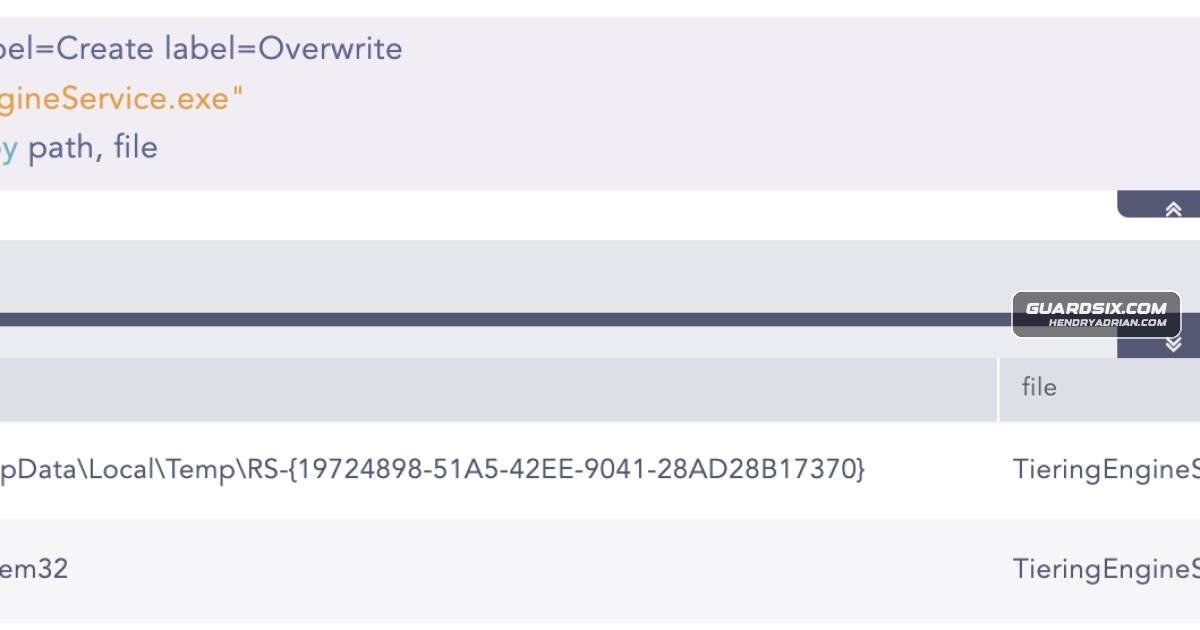
- Monitor for short-lived, GUID-like directories under user-writable temporary paths, especially when followed by creation of TieringEngineService.exe or EICAR-like bait files.
- Correlate temporary-directory activity and Defender detections with file creation, replacement, or modification of TieringEngineService.exe in System32.
- Detect services.exe launching TieringEngineService.exe at SYSTEM integrity, and watch for conhost.exe spawned by that binary.
- Correlate executable file creation in user-writable paths with network connections from the same process context and review the process tree.
- Alert on successful service installations from user-writable or suspicious paths and unexpected local password-reset events.
- Monitor non-standard processes that lock or persistently access Defender-related update files; track Defender health, signature age, platform version, and last successful update.
- Data Sources
- Windows process-creation events with command-line auditing, including parent process, process path, integrity level, and process GUID.
- File creation, overwrite, and modification events, including paths and filenames.
- Microsoft Defender malware-detection and threat events, including detection labels.
- Sysmon or equivalent network-connection telemetry correlated with file events.
- Windows service-installation events and local user password-reset events.
- Defender update and health status, signature age, platform version, and last successful update time.
- File-monitoring telemetry for access or locks on Defender update files.
- Rule Types
- File-event queries for suspicious temporary-directory staging and system-binary replacement.
- Defender detection-event queries for EICAR-like bait activity.
- Process-event correlation for SYSTEM-integrity execution and suspicious parent-child relationships.
- Network-to-file-creation correlation by process GUID.
- Service-installation and password-reset event queries.
- Guardsix alert rules for files dropped in suspicious locations and suspicious Windows service creation.
- Platforms
- Windows endpoints with process, file, network, and security-event telemetry.
- SIEM and EDR environments with file monitoring.
- Defensive Actions
- Apply the Microsoft Defender update addressing CVE-2026-33825; the article identifies platform version 4.18.26030.3011 as patched.
- Use application control to restrict unsigned, unapproved, or rare binaries, particularly from user-writable locations.
- Apply least privilege, limit local administrator rights, and tightly control service-account permissions.
- Investigate unexpected services, scheduled tasks, startup entries, and trusted processes launching unusual children or interacting with security-sensitive paths.
- Isolate affected hosts when Defender degradation, tampering, or related indicators are detected.
- Disable or restrict potentially impacted accounts, reset passwords, and revoke active sessions when credential access or privilege escalation is suspected.
- Segment networks to limit lateral movement and maintain tested incident-response procedures and protected backups.
MITRE ATT&CK
T1003.002 · Security Account ManagerBlueHammer reads the SAM, reconstructs the LSA boot key from registry values, and decrypts local users’ NT hashes.T1068 · Exploitation for Privilege EscalationBlueHammer exploits a TOCTOU race in Defender update handling to access a protected file from a Volume Shadow Copy and escalate privileges.T1218 · System Binary Proxy ExecutionRedSun triggers the replaced TieringEngineService.exe through a tiering-engine COM path to obtain elevated execution.T1543.003 · Windows ServiceBlueHammer’s post-exploitation flow can create a short-lived Windows service to reach SYSTEM execution.T1562 · Impair DefensesUnDefend monitors Defender update locations and locks signature or related update files to interfere with updates and degrade protection.T1574 · Hijack Execution FlowRedSun uses mount-point reparse redirection and Defender’s handling of a cloud-tagged bait file to replace TieringEngineService.exe in System32 with attacker-controlled code.
CVE
People
Vendors
Products
Microsoft Defender Antimalware Platform2026 a researcher released BlueHammer, a local privilege-escalation PoC abusing a TOCTOU race in Microsoft Defender’s update handling (linked to CVE-2026-33825), and subsequent PoCs RedSun and UnDefend demonstratedMicrosoft Windows[T1543.003 ] Create or Modify System Process: Windows Service – BlueHammer’s post-exploitation flow can create a short-lived Windows service to escalate to SYSTEM.
Tools
BlueHammerOn 26 Mar 2026 a researcher released BlueHammer, a local privilege-escalation PoC abusing a TOCTOU race in Microsoft Defender’s update handling (linked to CVE-2026-33825), and subsequent PoCs RedSun and UnDefendRedSuna TOCTOU race in Microsoft Defender’s update handling (linked to CVE-2026-33825), and subsequent PoCs RedSun and UnDefend demonstrated additional escalation and Defender-update disruption techniques.SysmonWindows SysmonUnDefendrace in Microsoft Defender’s update handling (linked to CVE-2026-33825), and subsequent PoCs RedSun and UnDefend demonstrated additional escalation and Defender-update disruption techniques.