Windows SeManageVolumePrivilege Can Enable SYSTEM Escalation Through ACL Changes and DLL Hijacking
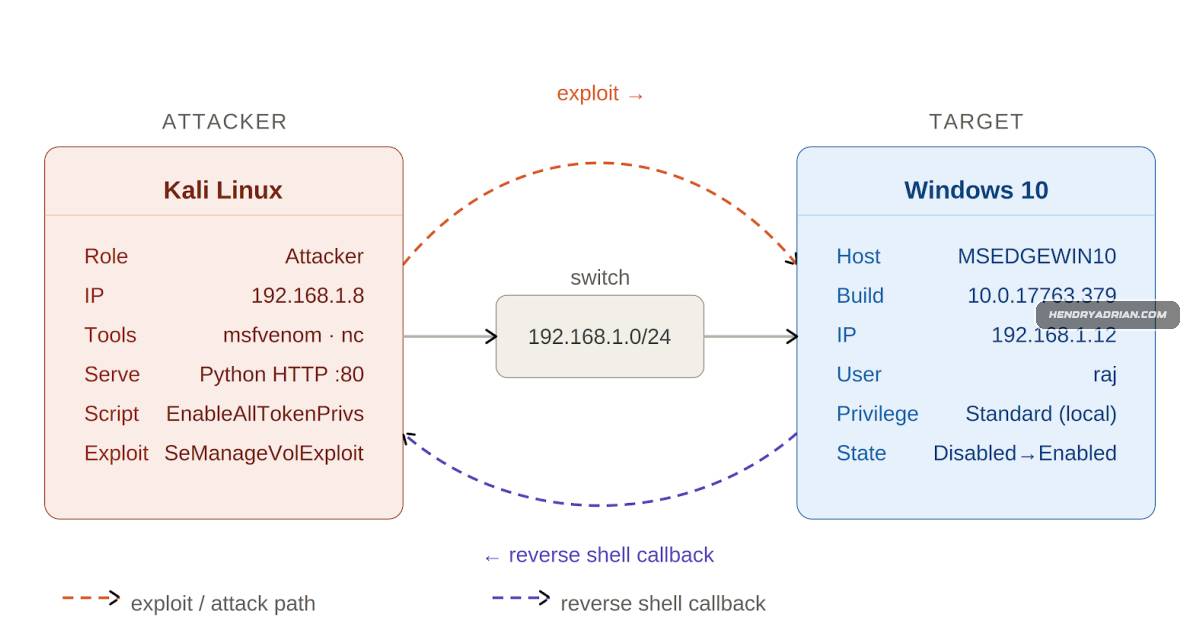
Summary
A Windows 10 walkthrough shows how attackers can abuse a misassigned SeManageVolumePrivilege to change C:\Windows permissions and escalate privileges through DLL hijacking. It also outlines monitoring and mitigation measures.
Key points
- The walkthrough demonstrates abuse of SeManageVolumePrivilege, the Windows “Perform volume maintenance tasks” right, when assigned to a standard user.
- After enabling the token privilege, an attacker can use SeManageVolumeExploit to change ACLs across C:\Windows, granting BUILTIN\Users write access.
- The article shows Print Spooler DLL hijacking and Windows Error Reporting abuse to obtain SYSTEM-level access.
- A separate WBEM DLL hijacking path obtains a NETWORK SERVICE shell, which the article describes as a stepping stone to SYSTEM.
- Restrict the right to administrators or explicitly required service accounts, and audit user-right assignments for unintended grants.
- Monitor token privilege activation and protected-directory ACL changes; the article cites Windows Event IDs 4703 and 4670.
- The article recommends DLL-loading controls, hardening or disabling unnecessary Print Spooler and WER exposure, and EDR monitoring.
Article Details
- Topic
- Privilege escalation through a misconfigured SeManageVolumePrivilege user right and DLL hijacking on Windows 10
Indicators of compromise
| Type | Indicator | Context |
|---|---|---|
| IPV4 | 192[.]168[.]1[.]8 | Attacker's Kali Linux host used to stage attack files and receive reverse-shell callbacks in the lab. |
| URL | hxxp[:]//192[.]168[.]1[.]8/EnableAllTokenPrivs[.]ps1 | Attacker-hosted script fetched to enable disabled token privileges. |
| URL | hxxp[:]//192[.]168[.]1[.]8/phoneinfo[.]dll | Attacker-hosted reverse-shell DLL planted for the Windows Error Reporting attack. |
| URL | hxxp[:]//192[.]168[.]1[.]8/Printconfig[.]dll | Attacker-hosted reverse-shell DLL planted for Print Spooler hijacking. |
| URL | hxxp[:]//192[.]168[.]1[.]8/Report[.]wer | Attacker-hosted crafted error report fetched to trigger malicious DLL loading. |
| URL | hxxp[:]//192[.]168[.]1[.]8/SeManageVolumeExploit[.]exe | Attacker-hosted exploit executable fetched to modify Windows directory ACLs. |
| URL | hxxp[:]//192[.]168[.]1[.]8/tzres[.]dll | Attacker-hosted reverse-shell DLL planted for WBEM hijacking. |
| URL | hxxp[:]//192[.]168[.]1[.]8/WerTrigger[.]exe | Attacker-hosted exploit tool fetched for the Windows Error Reporting attack. |
MITRE ATT&CK
T1059.001 · PowerShellThe attacker uses PowerShell to execute a privilege-enabling script and trigger the Print Spooler COM object.T1105 · Ingress Tool TransferThe attacker downloads scripts, exploit components, and DLL payloads from an attacker-hosted HTTP server to the target.T1222.001 · Windows PermissionsThe attacker modifies Windows file and directory ACLs to grant BUILTIN\Users write access.T1574.001 · DLLThe attacker plants malicious DLLs in system paths for privileged processes to load.
Vendors
Products
Tools
EnableAllTokenPrivsEnabling the Privilege with EnableAllTokenPrivsmsfvenomThe attacker uses msfvenom to generate a 64-bit reverse TCP shell DLL named Printconfig.dll, setting LHOST to 192.168.1.8 (Kali) and LPORT to 4444.netcatThe attacker starts a netcat listener on port 443 with the following command and then checks privileges.SeManageVolumeExploitRunning SeManageVolumeExploitWerTriggerThe walkthrough covers three distinct exploitation paths: Print Spooler DLL hijacking, WBEM tzres.dll substitution, and Windows Error Reporting abuse via WerTrigger.