
How to Secure AI-Generated Code: Three Checks for Vibe Coding
Summary
AI coding can introduce hardcoded secrets, hallucinated dependencies and insecure code. The article recommends secret scanning, package checks, security rules and Semgrep, while noting logic flaws still need human review or dynamic testing.
Key points
- The article identifies hardcoded credentials, hallucinated dependencies and insecure code patterns as key risks in AI-generated applications.
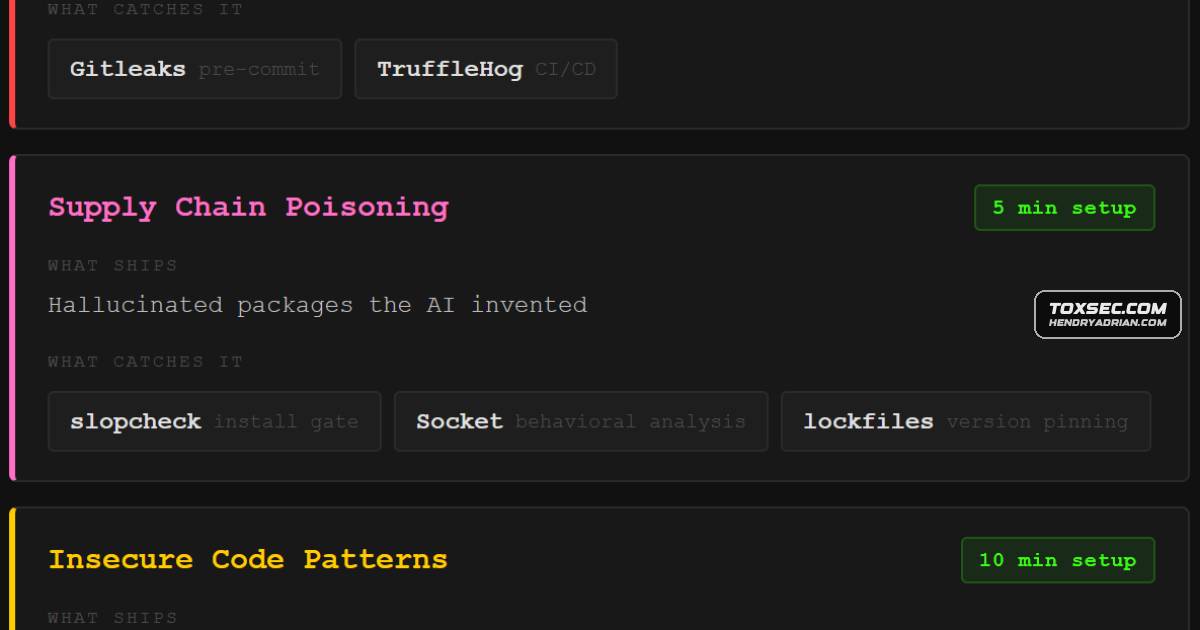
- It recommends Gitleaks for pre-commit secret scanning and TruffleHog for scanning repositories and other sources, including checks for active credentials.
- Slopsquatting involves registering package names that AI tools repeatedly hallucinate; the article recommends slopcheck to check dependencies against package registries.
- Socket is presented as a complementary tool that inspects packages for behavioral and other supply-chain risk signals.
- Security rules files can guide code generation, while Semgrep can scan generated code; the article cautions that rules files themselves should be reviewed and trusted.
- Static scans may miss logic flaws and context-dependent vulnerabilities, which the article says require human review or dynamic testing.
Article Details
- Defense Focus
- Prevent hardcoded-secret exposure, malicious or hallucinated dependencies, and insecure AI-generated code from reaching production.
- Detection Methods
- Run secret-pattern scans before commits and across Git history; verify whether discovered credentials are still active.
- Check dependency names against live package registries and flag nonexistent, recently created, low-download, or suspiciously named packages.
- Inspect packages for supply-chain risk signals such as obfuscated code, suspicious network activity, and install scripts that run on import.
- Run static analysis on generated code to identify known vulnerability patterns, including injection flaws and missing validation or authentication checks.
- Use human review or dynamic testing for logic flaws and context-dependent vulnerabilities that static scans may miss.
- Data Sources
- Source code and generated code
- Git repositories and commit history
- Dependency manifests and package registries
- S3 buckets
- Docker images
- Slack workspaces
- CI/CD logs
- Rule Types
- Pre-commit secret-scanning hooks
- Project-level AI security rules files
- Semgrep static-analysis rules
- Automated IDE scan hooks
- Platforms
- MCP-compatible IDEs
- Defensive Actions
- Add Gitleaks as a pre-commit check and scan existing repositories and history with TruffleHog.
- Rotate confirmed live credentials and keep environment-variable files such as .env out of version control.
- Check suggested dependencies against package registries before installation; use slopcheck to flag suspicious or nonexistent packages and Socket for deeper package inspection.
- Commit lockfiles and regularly audit dependencies with npm audit or pip audit.
- Add reviewed security rules to the AI coding project, including requirements for parameterized SQL, input validation and sanitization, credential handling, and authentication middleware.
- Scan generated code with Semgrep before accepting it, and manually review or dynamically test logic and authorization flows.
MITRE ATT&CK
T1195.002 · Compromise Software Supply ChainThe article describes adversaries registering AI-hallucinated package names with malicious code so developers or AI agents may install them.T1552.001 · Credentials In FilesThe article describes API keys, database passwords, and tokens hardcoded in source code or committed to public repositories, where attackers may use exposed credentials.
Products
Cursor#GitleaksVS Codeis the MCP (Model Context Protocol) integration: you can wire Semgrep directly into Cursor, Windsurf, VS Code, or any MCP-compatible IDE so that every chunk of code the AI generates gets scanned before you accept it.Windsurfin 2026 is the MCP (Model Context Protocol) integration: you can wire Semgrep directly into Cursor, Windsurf, VS Code, or any MCP-compatible IDE so that every chunk of code the AI generates gets scanned before you
Tools
gitleaksFree tools like Gitleaks, TruffleHog, slopcheck, Socket, and Semgrep can catch these issues before production with only a few minutes of setup.SemgrepFree tools like Gitleaks, TruffleHog, slopcheck, Socket, and Semgrep can catch these issues before production with only a few minutes of setup.slopcheckFree tools like Gitleaks, TruffleHog, slopcheck, Socket, and Semgrep can catch these issues before production with only a few minutes of setup.SocketFree tools like Gitleaks, TruffleHog, slopcheck, Socket, and Semgrep can catch these issues before production with only a few minutes of setup.TruffleHogFree tools like Gitleaks, TruffleHog, slopcheck, Socket, and Semgrep can catch these issues before production with only a few minutes of setup.