
How SOC Teams Can Investigate Phishing with Sandboxing and Threat Intelligence
Summary
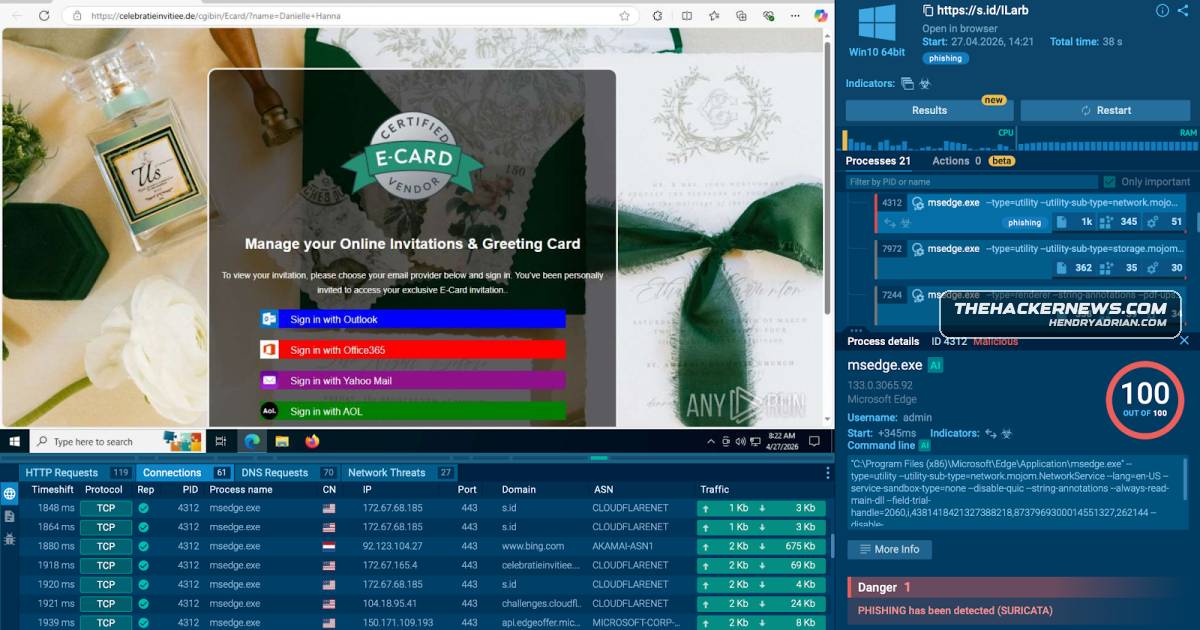
A sponsored article describes an ANY.RUN analysis of a fake-invitation phishing campaign targeting U.S. organizations and outlines using sandboxing and threat intelligence to find related activity and inform SOC response.
Key points
- The article says the campaign targeted U.S. organizations, including education, banking, government, technology, and healthcare.
- The phishing flow reportedly used a fake invitation, CAPTCHA, and event-themed page, with potential credential and OTP capture or delivery of legitimate RMM tools.
- The article describes sandbox analysis revealing redirects, fake pages, credential prompts, downloads, and possible remote-access activity.
- Reported recurring page patterns included requests to /favicon.ico and /blocked.html, and resources under /Image/*.png.
- The proposed workflow uses threat intelligence to connect related pages and infrastructure, then shares behavior-based indicators with tools such as SIEM, SOAR, NDR, and firewalls.
- Performance figures, including faster triage and reduced response times, are presented as reports from ANY.RUN users.
Article Details
- Defense Focus
- Detect and validate phishing behavior early, enrich findings with campaign context, and use that intelligence to find and contain related exposure across the organization.
- Detection Methods
- Analyze suspicious emails, attachments, and URLs in an interactive sandbox; follow redirects and phishing flows to observe behavior beyond the original message.
- Correlate repeated phishing-page patterns, requests, domains, and URL paths to identify related campaign activity.
- Use behavior-based indicators and campaign context to hunt for related domains, URL paths, suspicious requests, downloaded files, and possible RMM activity across the security environment.
- Data Sources
- Suspicious emails, attachments, and URLs
- Sandbox-observed redirects, phishing pages, credential prompts, and downloads
- Repeated requests for /favicon.ico, /blocked.html, and resources under /Image/*.png
- Email, network, endpoint, identity, and cloud security data
- Indicators and campaign context from threat intelligence
- Platforms
- SIEM
- TIP
- SOAR
- NDR
- Firewalls
- Defensive Actions
- Safely validate suspicious links and attachments in an interactive sandbox before determining exposure.
- Enrich findings with threat intelligence and check whether related domains, pages, or infrastructure indicate wider campaign activity.
- Push relevant behavior-based indicators into existing security tools for detection, blocking, enrichment, and response.
- Hunt across users, departments, and security data sources for related activity, including suspicious requests, downloads, or possible RMM activity.
- Escalate or contain affected accounts and endpoints when investigation findings support action.
MITRE ATT&CK
Vendors
Products
Interactive SandboxANY.RUN shows how an interactive sandbox and threat intelligence can expose a fake invitation phishing campaign targeting U.S.Threat IntelligenceANY.RUN shows how an interactive sandbox and threat intelligence can expose a fake invitation phishing campaign targeting U.S.TI FeedsANY.RUN’s TI Feeds provides fresh, behavior-based IOCs across security stack
Countries
Industries
Bankingorganizations, especially in high-exposure industries such as Education, Banking, Government, Technology, and Healthcare.Educationorganizations, especially in high-exposure industries such as Education, Banking, Government, Technology, and Healthcare.Governmentorganizations, especially in high-exposure industries such as Education, Banking, Government, Technology, and Healthcare.Healthcareorganizations, especially in high-exposure industries such as Education, Banking, Government, Technology, and Healthcare.Technologyorganizations, especially in high-exposure industries such as Education, Banking, Government, Technology, and Healthcare.