
Sysdig Report Warns Vulnerability Growth Is Outpacing Security Teams
Summary
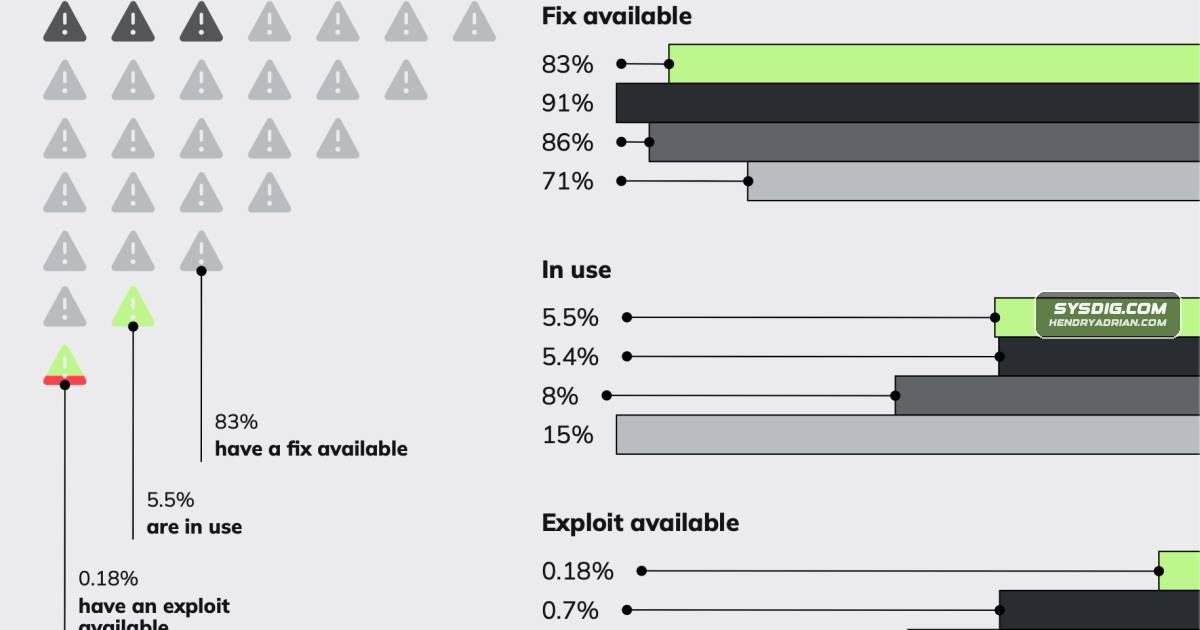
Sysdig’s 2026 report says exploitable in-use vulnerabilities among its users fell 75% year over year, but vulnerability growth is outpacing teams. The article urges stronger runtime defenses and agentic AI remediation under human-set guardrails.
Key points
- Sysdig’s 2026 Cloud-Native Security and Usage Report says exploitable in-use vulnerabilities among its users fell 75% year over year.
- The article says in-use vulnerabilities without a known exploit have plateaued at 5%, while the overall volume of vulnerabilities continues to grow.
- Citing VulnCheck, it reports that vulnerability weaponization timelines fell from nearly a year in 2018 to eight days in 2023; it also cites exploitation of React2Shell within hours of disclosure and CVE-2026-39987 in under 10 hours.
- The article warns that AI could further shorten weaponization timelines, making the absence of a known exploit an unreliable safety signal.
- The report says more than 70% of organizations use behavior-based detections across 91% of environments, and 140% more organizations auto-kill processes when detections trigger.
- Sysdig advocates agentic AI remediation governed by human-defined policies, scoped permissions, rollback plans, audit logging, explainability, and risk thresholds.
Article Details
- Publisher
- Sysdig
- Report Period
- 2026
- Scope
- Vulnerability management and automated response adoption, including findings among Sysdig users and organizations.
- Key Statistics
- Sysdig reports a 75% year-over-year reduction in exploitable in-use vulnerabilities among its users.
- In-use vulnerabilities without a known exploit have plateaued at 5% since the previous year.
- CVE-2026-39987 reportedly took less than 10 hours to weaponize, with no proof of concept used as a reference.
- More than 70% of organizations use behavior-based detections across 91% of environments, according to the report.
- The report says 140% more organizations auto-kill processes when a detection is triggered.
- Recommendations
- Use runtime security and automated response alongside vulnerability prioritization.
- Govern agentic AI remediation with change limits, scoped permissions, deterministic rollback plans, audit logs, explainability, and risk thresholds informed by environmental context.
MITRE ATT&CK
CVE
Vendors
Anthropic[Organizations/Products ] security and detection tooling mentioned in context of vulnerability prioritization – Sysdig Risk Spotlight, Anthropic’s Project GlasswingSysdigThe report shows a 75% year-over-year reduction in exploitable in-use vulnerabilities among Sysdig users, but also warns that the overall volume of vulnerabilities is rising too fast for human teams to keep up.
Products
Project Glasswing[Organizations/Products ] security and detection tooling mentioned in context of vulnerability prioritization – Sysdig Risk Spotlight, Anthropic’s Project GlasswingRisk SpotlightRisk Spotlight helps users identify vulnerabilities that are in use, have an existing exploit, and have a fix available.