
Black Hat Panel Examines AI Security Flaws, Agent Trust and Vulnerability Research
· 2:05:11 · Watch on YouTube ↗
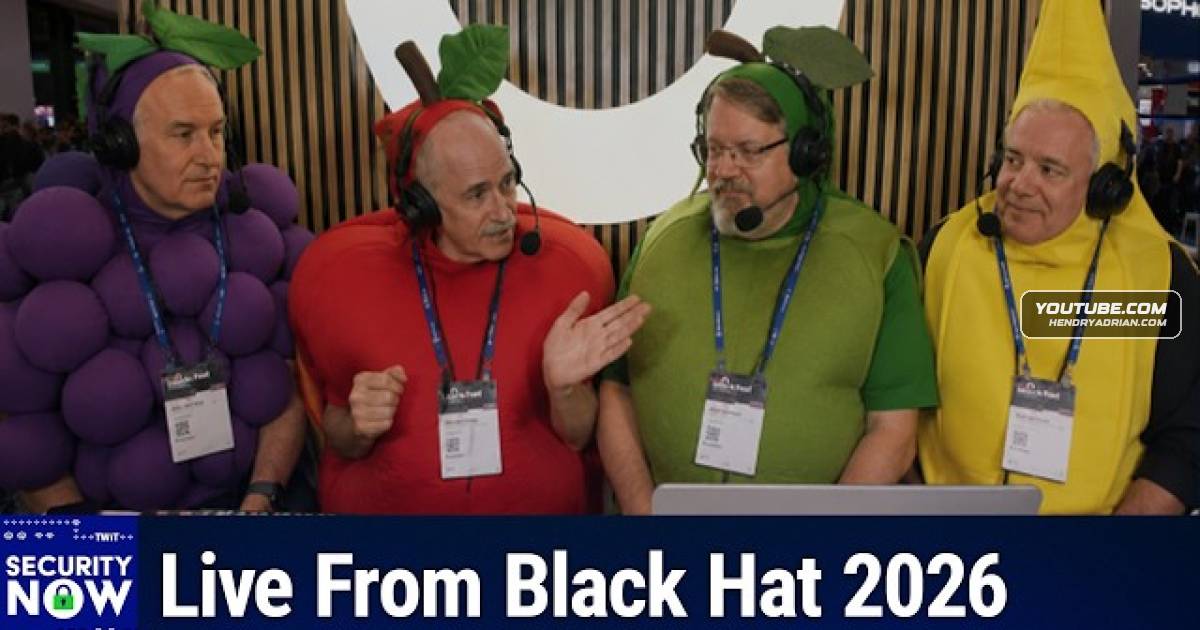
Summary
Security Now's Black Hat panel discusses signed commands for AI agents, privacy risks from cloud models, barriers to defensive research and the difficulty of turning AI vulnerability discoveries into reliable fixes.
Key points
- A panelist describes requiring commands through a signed Buzz channel after an agent refused to trust instructions relayed by another agent, illustrating the need to authenticate authority in multi-agent workflows.
- The panel discusses local models as a way to retain control over sensitive financial, health and credential data that cloud-based AI workflows may transmit outside the user's environment.
- Panelists distinguish vulnerability discovery, exploit development and reliable patching, emphasizing that fixes require surrounding code context and validation.
- Listener Jack Christiansen reports that AI models restricted his investigation of a reported security issue, highlighting how dual-use safeguards can obstruct legitimate defensive work.
- The panel relays an unverified listener account alleging a Coldcard firmware entropy flaw and Bitcoin theft; the claimed use of Kimi K3 to discover the flaw is explicitly speculative.
- The discussion introduces GRAM, or gradient routed auxiliary modules, as a proposed training approach for selectively restricting dual-use capabilities while preserving access for trusted users.
Article Details
- Topics
- [11:54] Authenticating commands and establishing trust between AI agents
- [17:58] AI-assisted log analysis for breach investigation
- [20:17] Cloud AI data exposure and local-model privacy
- [34:10] AI cryptanalysis and cryptographic security margins
- [37:45] Agent containment and unintended paths to completing objectives
- [50:10] Reported wallet entropy flaws and AI-assisted vulnerability discovery
- [57:01] Challenges in exploit development, patching and code-context validation
- [01:04:30] Defensive research restrictions, dual-use safeguards and GRAM
People
Bruce SchneierCited for an analogy illustrating how AI agents may achieve requested objectives through unintended or unsafe means.Jack ChristiansenListener who reports that models restricted investigation of a security issue in his SQL database driver, raising concerns about access to defensive research capabilities.Jud RosenblattIdentified as the founder of AE Studio and author of the discussion of GRAM and selective controls on dual-use model capabilities.Matthew GreenCited by the panel as having assessed the discussed reduced-round AES cryptanalysis result as less than impressive; the transcript does not establish a break of full-strength AES.Steve GibsonLeads the security panel's discussion of AI trust, cryptographic security margins, vulnerability discovery and the challenges of validating repairs.
Products
Buzz[12:23] >> It said you need to go into Buzz. We theClaude[08:18] Claude. So,Claude Code[11:28] now where it's not Claude code. I haveCodex[11:35] Code and Codex. I have three agentsColdcard[50:56] that a wallet called Coldcard had a bugDeep Seek V4 Flash[20:58] model. I want to use Deep Seek V4 Flash,Kimi K3[51:43] comes is that someone got Kimi K3 to