
GRC Engineering: What Compliance Software Automates—and What Still Requires Human Judgment
· 8:36 · Watch on YouTube ↗
Summary
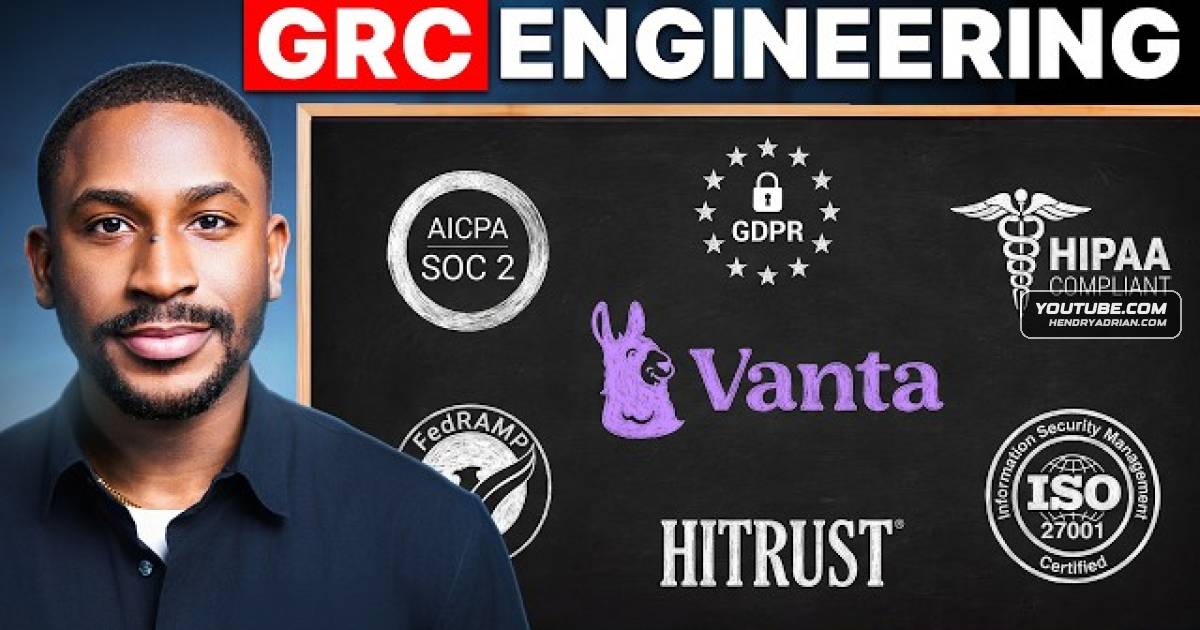
A sponsored video explains five criteria for evaluating GRC engineering: continuous checks, integration depth, framework reuse, automation beyond testing, and clear limits. It says Vanta automates recurring tasks, while people retain policy, risk, and exception judgment
Key points
- GRC engineering applies software engineering practices to compliance, including encoding controls as tests and checking them continuously.
- The video says Vanta runs more than 1,400 automated tests hourly and can flag a failing control within an hour.
- For integrations, it recommends checking whether controls map to recognized benchmarks; Vanta is described as integrating with more than 40 AWS resources and mapping checks to the CIS AWS Foundations Benchmark.
- The video says Vanta can reuse evidence across SOC 2 Type II, ISO 27001, HIPAA, GDPR, NIST CSF, and CMMC.
- Vanta's AI agent is described as drafting tailored SOC 2 policies, generating a public trust center, and supporting vendor risk reviews; the video notes that vendor approval remains a human decision.
- People still need to approve security policies, make business-specific risk judgments, conduct vendor due diligence, and decide whether to accept control failures.
Article Details
- Topics
- [00:28] GRC engineering compared with compliance checklists
- [02:01] Continuous control testing and monitoring
- [03:02] Cloud integration depth and benchmark mapping
- [03:51] Reusing evidence across compliance frameworks
- [04:51] AI-assisted policy drafting, trust centers, and vendor risk management
- [06:14] What GRC automation does not replace and where human judgment remains necessary