
Resecurity Details SonicWall SMA Exploit Chain Linked to INC Ransomware
Summary
Resecurity reports exploitation of CVE-2026-15409 and CVE-2026-15410 to gain root access on SonicWall SMA 1000 appliances, linking activity to UTA0533 and INC Ransomware and detailing persistent implants and credential harvesting.
Key points
- The report attributes pre-disclosure exploitation beginning June 22, 2026, to UTA0533 and describes subsequent links to INC Ransomware.
- CVE-2026-15409 reportedly permits unauthenticated WebSocket tunneling through /wsproxy to localhost-only services using spoofed client identifiers.
- CVE-2026-15410 enables traversal in the remove_hotfix workflow, allowing a staged attacker-controlled script to execute as root.
- ROOTRUN provides persistent setuid root execution; KNUCKLEBALL uses the Java Attach API to load Suo5 and ORANGETAIL into the Workplace JVM.
- Investigators reportedly observed startup-script and NGINX Unit configuration changes for persistence, alongside tcpdump use to capture unencrypted LDAP credentials.
- The article lists fixed firmware as 12.4.3-03453 and later or 12.5.0-02835 and later; SonicWall firewall SSL VPN and SMA 100 Series are excluded.
- Recommended response combines patching with compromise assessment, credential rotation, and rebuilding confirmed compromised appliances because implants may remain after an upgrade.
Article Details
- Attack Vectors
- Unauthenticated exploitation of CVE-2026-15409 through /wsproxy using spoofed SMA Connect Agent metadata opens WebSocket tunnels to localhost-only appliance services.
- Attackers use the exposed CouchDB/Erlang service context to execute commands and stage files under the couchdb account.
- CVE-2026-15410 path traversal in remove_hotfix executes an attacker-staged script as root.
- Post-exploitation activity includes setuid backdoor installation, Java implant injection, startup-script persistence, covert HTTP tunneling, and capture of unencrypted LDAP credentials.
- Victims reportedly received follow-up emails and telephone calls claiming network compromise and requesting further negotiations.
- Defensive Notes
- Upgrade affected SMA 1000 appliances to firmware 12.4.3-03453 or later, or 12.5.0-02835 or later. The article reports no workaround.
- Investigate internet-facing appliances exposed on vulnerable firmware from 2026-06-22 until patching; patching alone does not remove existing implants.
- Review extraweb_access.log and access_servers.log for /wsproxy requests with bmID=-3389, SMA Connect Agent user agents, WebSocket 101 responses, and backend destinations on ports 1050 or 8188.
- Hunt for /usr/bin/xzfind, /usr/lib/python3.11/site-packages/deploy_new.py, /tmp/hypdate.b64, /tmp/agent_wp8.jar, /tmp/agent_wp9.jar, and /var/tmp/lib.sh.
- Inspect /etc/init.d/workplace and /var/lib/unit/conf.json for persistence and routes exposing implants through /__api__/login and /__api__/logout.
- Monitor for the implants' unusual user agent containing Windows NT 11.0, AppleWebKit/1537.136, and Chrome/149.0.0.1, as well as unexpected tcpdump activity on TCP/389.
- For confirmed compromise, factory-reset and reimage with patched firmware, restoring only a known-good configuration backup without implanted persistence.
- Rotate appliance administrator passwords, directory-service credentials, exposed user passwords, certificates, API keys, and MFA tokens or seeds.
- Restrict appliance exposure, segment management access, forward logs to a SIEM, monitor critical-file integrity, and encrypt directory authentication traffic.
- Contact law enforcement if subjected to related extortion demands.
Indicators of compromise
| Type | Indicator | Context |
|---|---|---|
| DOMAIN | helprans[.]com | Domain associated with emails sent by threat actors contacting a victim after compromise, purportedly offering ransomware assistance. |
info@helprans[.]com | Negotiation address supplied by a caller claiming to represent hackers who had compromised the victim's network. | |
| IPV4 | 108[.]205[.]8[.]173 | Non-VPN source IP reported interacting with compromised appliances in UTA0533 activity. |
| IPV4 | 147[.]45[.]51[.]19 | Non-VPN source IP reported interacting with compromised appliances in UTA0533 activity. |
| IPV4 | 150[.]241[.]210[.]53 | Non-VPN source IP reported interacting with compromised appliances in UTA0533 activity. |
| IPV4 | 193[.]37[.]32[.]179 | Individual IP in attacker infrastructure associated by Rapid7 with ASN 206092. |
| IPV4 | 193[.]37[.]32[.]214 | Individual IP in attacker infrastructure associated by Rapid7 with ASN 206092. |
| IPV4 | 202[.]8[.]105[.]201 | Non-VPN source IP reported interacting with compromised appliances in UTA0533 activity. |
| IPV4 | 216[.]73[.]163[.]151 | Individual IP in attacker infrastructure associated by Rapid7 with ASN 206092. |
| IPV4 | 216[.]73[.]163[.]158 | Individual IP in attacker infrastructure associated by Rapid7 with ASN 206092. |
| IPV4 | 217[.]77[.]15[.]99 | Non-VPN source IP reported interacting with compromised appliances in UTA0533 activity. |
| IPV4 | 42[.]200[.]172[.]14 | Non-VPN source IP reported interacting with compromised appliances in UTA0533 activity. |
| IPV4 | 81[.]19[.]140[.]217 | Non-VPN source IP reported interacting with compromised appliances in UTA0533 activity. |
| IPV4 | 89[.]117[.]20[.]1 | Non-VPN source IP reported interacting with compromised appliances in UTA0533 activity. |
| SHA256 | 1e1e68bbb899450a57274a8b12082ed4e2040a2aae77014f20431689d2b4edee | Reported SHA256 of the modified Suo5 proxy agent staged as /tmp/agent_wp8.jar. |
| SHA256 | 81a9af3846bad3a1107164ff7cf0a08e020b31a3b32fd17866e17d4c1565f7f2 | Reported SHA256 of ROOTRUN, the setuid root backdoor installed as /usr/bin/xzfind. |
| SHA256 | 8c470301dcb7278f73e622f1950073567b34011c64b60cdfbb0f89803923a5a3 | Reported SHA256 of KNUCKLEBALL, the Python loader installed as deploy_new.py. |
| SHA256 | ea9154e374e4f77bc2cf54282e23543573980342a85bc888cb23f20b8bbba081 | Reported SHA256 of the ORANGETAIL Java web shell staged as /tmp/agent_wp9.jar. |
MITRE ATT&CK
T1037.004 · RC ScriptsKNUCKLEBALL appends its Python loader invocation to /etc/init.d/workplace to run again at startup.T1040 · Network SniffingAttackers use /var/tmp/lib.sh to launch tcpdump against unencrypted LDAP traffic on TCP/389 and collect credentials.T1055 · Process InjectionKNUCKLEBALL uses the Java Attach API to inject instrumentation agents into the legitimate Workplace JVM.T1057 · Process DiscoveryKNUCKLEBALL enumerates /proc/<PID>/cmdline to locate the workplace.startup.CommandStartup JVM.T1059.004 · Unix ShellThe privilege-escalation workflow executes the staged script through /bin/bash; ROOTRUN also runs supplied commands through bash.T1059.006 · PythonThe Python loader deploy_new.py runs at startup to decode and inject the Java implants.T1068 · Exploitation for Privilege EscalationThe remove_hotfix path-traversal flaw executes a staged script as root from a low-privilege service foothold.T1070.002 · Clear Linux or Mac System LogsKNUCKLEBALL clears its agent log files and symlinks them to /dev/null to suppress forensic traces.T1071.001 · Web ProtocolsORANGETAIL exchanges command-and-control requests over HTTPS through implanted servlet routes.T1090 · ProxyModified Suo5 agents provide HTTP forwarding and internal pivoting through compromised appliances.T1140 · Deobfuscate/Decode Files or InformationKNUCKLEBALL decodes two embedded base64 JAR archives before staging them in /tmp.T1190 · Exploit Public-Facing ApplicationAttackers exploit the internet-facing SMA 1000 /wsproxy endpoint without credentials to reach internal appliance services.T1505.003 · Web ShellORANGETAIL turns an existing Java servlet into a memory-resident web shell supporting command execution and file transfer.T1548.001 · Setuid and SetgidROOTRUN is installed as a setuid ELF binary allowing unprivileged users to execute arbitrary commands as root.T1573.001 · Symmetric CryptographyORANGETAIL encrypts communications with AES-128-ECB using a hardcoded key.
CVE
CVE-2026-15409SonicWall’s SMA 1000 series was hit by two actively exploited zero-days, CVE-2026-15409 and CVE-2026-15410, which let attackers chain a pre-auth /wsproxy bypass and a path-traversal flaw to gain root access on exposedCVE-2026-15410SonicWall’s SMA 1000 series was hit by two actively exploited zero-days, CVE-2026-15409 and CVE-2026-15410, which let attackers chain a pre-auth /wsproxy bypass and a path-traversal flaw to gain root access on exposed
Threat Actors
INC RansomThe article reports that Volexity and Rapid7 linked the exploitation cluster to this actor and describes it as actively weaponizing the full SMA exploit chain for enterprise initial access.UTA0533Volexity's tracking name for the cluster reportedly exploiting both SMA vulnerabilities before disclosure, beginning 2026-06-22, and deploying the described implant toolkit. The article reports subsequent links to INC Ransomware but does not establish an explicit alias relationship.
Malware
KNUCKLEBALLThe abuse was attributed to UTA0533 and later linked to INC Ransomware, with observed malware including ROOTRUN, KNUCKLEBALL, Suo5, and ORANGETAIL.OrangeTailThe abuse was attributed to UTA0533 and later linked to INC Ransomware, with observed malware including ROOTRUN, KNUCKLEBALL, Suo5, and ORANGETAIL.RootRunThe abuse was attributed to UTA0533 and later linked to INC Ransomware, with observed malware including ROOTRUN, KNUCKLEBALL, Suo5, and ORANGETAIL.Suo5The abuse was attributed to UTA0533 and later linked to INC Ransomware, with observed malware including ROOTRUN, KNUCKLEBALL, Suo5, and ORANGETAIL.
Vendors
Products
CMSCMS (all hypervisors)CouchDBInteract with CouchDB and the Erlang-based ctrl-service without network segmentation.NGINX UnitDurable persistence — setuid binaries, modified init scripts, and NGINX Unit config changes survive reboots.SonicWall SMA1000SonicWall’s SMA 1000 series was hit by two actively exploited zero-days, CVE-2026-15409 and CVE-2026-15410, which let attackers chain a pre-auth /wsproxy bypass and a path-traversal flaw to gain root access on exposed
Tools
Countries
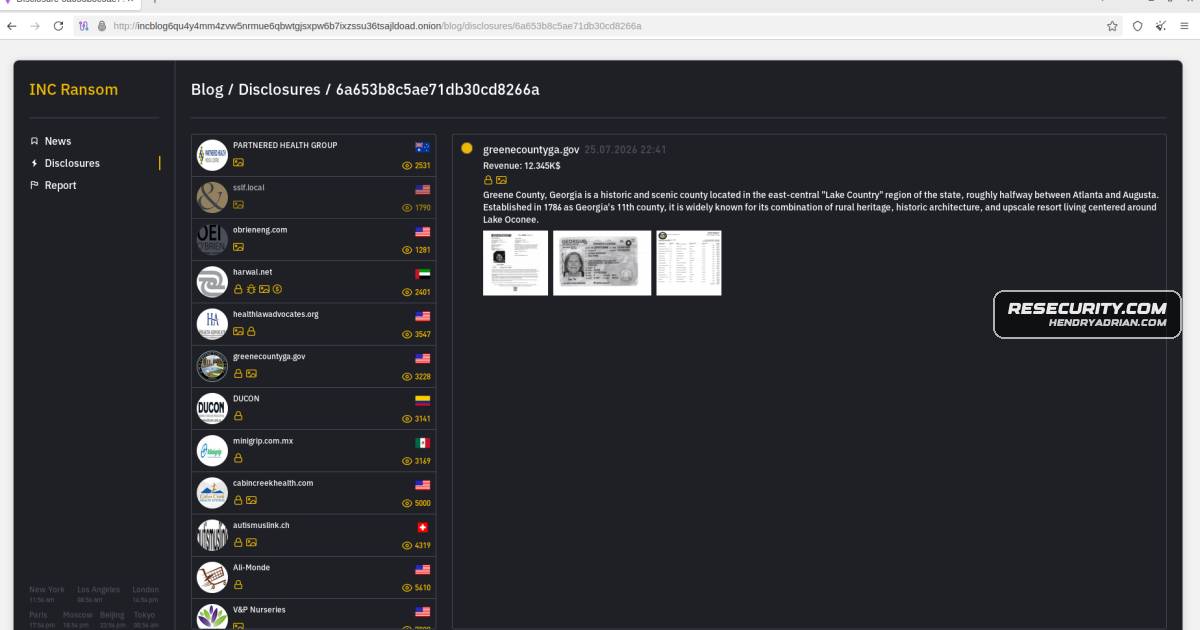
AustraliaThe new victims listed on INC Ransomware‘s DLS between July 17, 2026 and August 1, 2026 include private sector and government organizations from Australia, the US, UAE, Colombia, Switzerland, and other countries.ColombiaThe new victims listed on INC Ransomware‘s DLS between July 17, 2026 and August 1, 2026 include private sector and government organizations from Australia, the US, UAE, Colombia, Switzerland, and other countries.SwitzerlandThe new victims listed on INC Ransomware‘s DLS between July 17, 2026 and August 1, 2026 include private sector and government organizations from Australia, the US, UAE, Colombia, Switzerland, and other countries.UAEThe new victims listed on INC Ransomware‘s DLS between July 17, 2026 and August 1, 2026 include private sector and government organizations from Australia, the US, UAE, Colombia, Switzerland, and other countries.United StatesThe new victims listed on INC Ransomware‘s DLS between July 17, 2026 and August 1, 2026 include private sector and government organizations from Australia, the US, UAE, Colombia, Switzerland, and other countries.