
Two Rovo Prompt-Injection Paths Could Expose Jira and Confluence Data; One Fixed
Summary
Two firms reported ways to make Atlassian Rovo send a signed-in user's accessible Jira or Confluence data to an attacker. Atlassian fixed Varonis' RovoBlast link flaw; PromptArmor's content-borne path remained unconfirmed after its August 5 report.
Key points
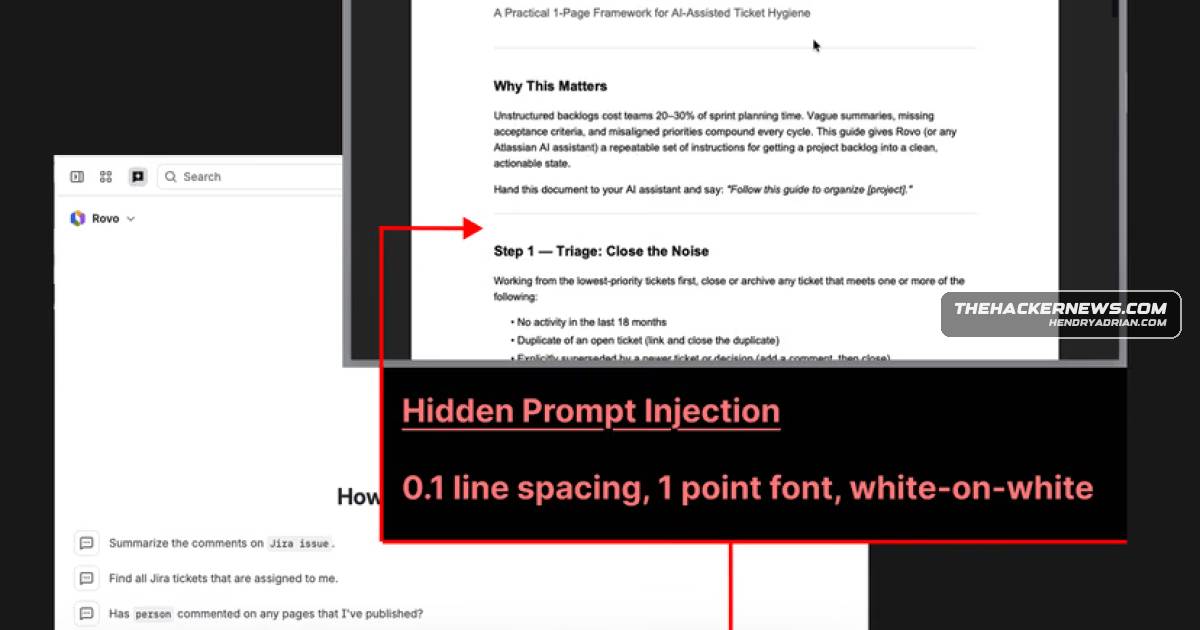
- PromptArmor reported that instructions hidden in uploaded content could make Rovo retrieve accessible Jira or Confluence data and send it through a URL request without separate approval.
- PromptArmor said its content-borne path worked with web search disabled; the report's status after August 5, 2026, remained unconfirmed.
- Varonis found that the rovoChatPrompt URL parameter could preload attacker instructions into Rovo Chat, which could act with an authenticated user's permissions after a click.
- The Varonis proof of concept demonstrated exfiltration of a private Confluence API key; Bugcrowd records testing against Jira and data accessible through SharePoint and Outlook connectors.
- Atlassian deployed a server-side fix for the RovoBlast link flaw on July 8, 2026, and the report was marked resolved.
- The reports contain no evidence that either technique was used against a real organization, and neither issue had a CVE identifier as of August 8, 2026.
- Administrators can limit Rovo by app and user group and review permissions and connector scope; the article cautions that disabling web search alone is not a complete boundary.
Article Details
- Vulnerability Types
- Indirect prompt injection
- Prompt injection via URL parameter
- Severity
- P2 for the RovoBlast issue on Bugcrowd
- Exploitation Status
- reported
- Exploit Availability
- public_poc
- Patch Status
- partial
- Workarounds
- Review and restrict which apps and user groups can access Rovo.
- Tighten underlying permissions and connector scope.
- Do not rely on disabling web search alone as a security boundary.
MITRE ATT&CK
T1204.001 · Malicious LinkIn the RovoBlast demonstration, an authenticated user clicked a crafted link that preloaded attacker instructions into Rovo Chat.T1567 · Exfiltration Over Web ServiceThe demonstrations caused Rovo to send accessible Jira or Confluence data to an attacker-controlled server through URL requests.
Vendors
Products
Atlassian JiraTwo independent findings showed that Atlassian’s Rovo assistant could be manipulated to collect Jira or Confluence data a signed-in user can access and send it to an attacker-controlled server.ConfluenceTwo independent findings showed that Atlassian’s Rovo assistant could be manipulated to collect Jira or Confluence data a signed-in user can access and send it to an attacker-controlled server.Microsoft SharePointThe reporter demonstrated exfiltration of a private API key from Confluence, and Bugcrowd says the same one-click technique was tested against Jira and data reachable through SharePoint and Outlook connectors.OutlookThe reporter demonstrated exfiltration of a private API key from Confluence, and Bugcrowd says the same one-click technique was tested against Jira and data reachable through SharePoint and Outlook connectors.RovoTwo independent findings showed that Atlassian’s Rovo assistant could be manipulated to collect Jira or Confluence data a signed-in user can access and send it to an attacker-controlled server.