
QPACK Flaws Enable HTTP/3 Server Crashes and Up to 4,000× Memory Amplification
Summary
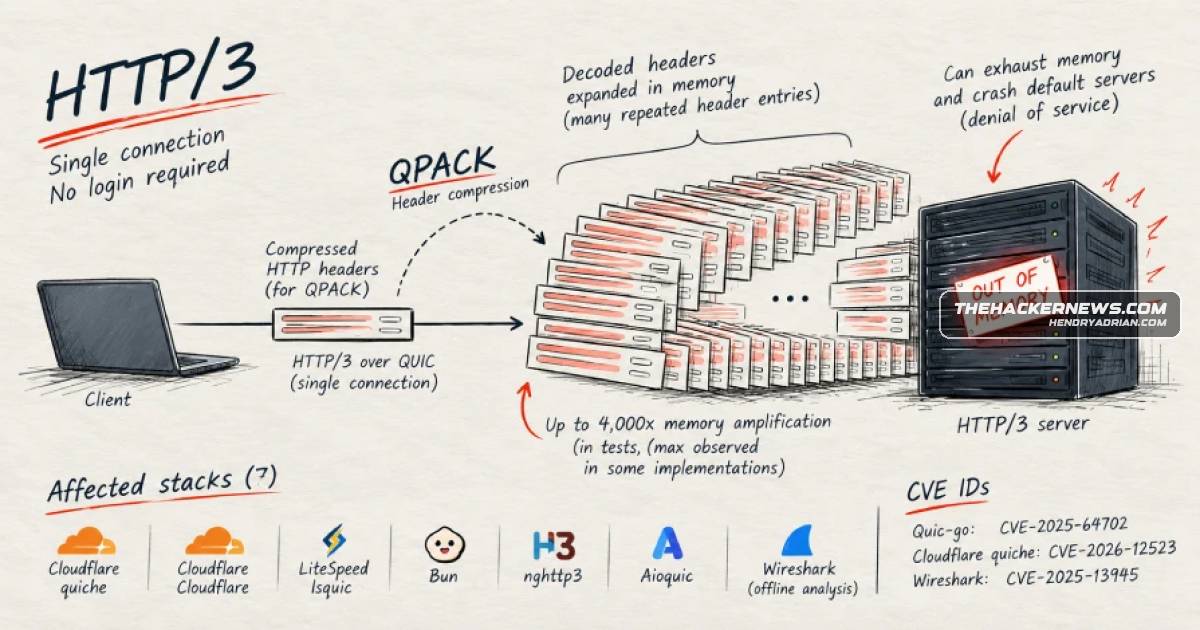
FoxIO disclosed QPACK flaws affecting 7 of 10 tested HTTP/3 stacks. Unauthenticated requests can cause denial of service through memory amplification; fixes and interim mitigations vary by implementation.
Key points
- FoxIO found the same QPACK flaw class in 7 of 10 HTTP/3 stacks tested: compressed headers can expand substantially without an effective cap on unpacked size.
- An unauthenticated attacker can send a small compressed header batch that consumes far more server memory and may cause denial of service; no data theft, code execution, or in-the-wild attacks were reported.
- FoxIO measured memory amplification of about 4,000× on Bun and 600–1,800× on lsquic using repeated references to a stored header.
- In Bun, FoxIO reported that header-size counter overflow after unpacked headers exceed 2 GB can cause an unrecoverable 100% CPU loop, blocking new requests.
- Fixes were available for quic-go, Cloudflare quiche, lsquic, and Wireshark; Bun, the h3 Rust library, and aioquic were still unpatched at disclosure.
- FoxIO said IIS, Envoy, ngtcp2/nghttp3, and Google's quiche were not affected because they limit unpacked headers during decoding.
- Recommended interim steps include not exposing Bun's HTTP/3 server, disabling HTTP/3 in mitmproxy, and setting max_field_section_size for the h3 Rust library.
Article Details
- Vulnerability Types
- HTTP/3 QPACK header decompression memory-amplification denial of service
- Integer overflow causing an infinite loop and CPU denial of service
- Severity
- The flaws can cause denial of service; FoxIO measured up to 4,000-fold memory amplification on Bun. No data theft or code execution was reported.
- Exploitation Status
- not_reported
- Exploit Availability
- public_poc
- Patch Status
- partial
- Workarounds
- On Bun, do not expose an HTTP/3 server.
- On mitmproxy, disable HTTP/3 with --set http3=false.
- For the h3 Rust library, set a sensible limit with max_field_section_size.
People
Vendors
Products
aioquicFixes are out for quic-go, Cloudflare quiche, lsquic and Wireshark, but Bun, the h3 Rust library and aioquic were still unpatched at disclosure.Bunreports of attacks in the wild. Fixes are out for quic-go, Cloudflare quiche, lsquic and Wireshark, but Bun, the h3 Rust library and aioquic were still unpatched at disclosure.CaddyThe reach is wide because these stacks sit under common software. quic-go is the Go library behind Caddy, Traefik and cloudflared; lsquic is LiteSpeed's library, used in LiteSpeed Web Server and OpenLiteSpeed; and Bun'sCloudflare quichetheft or code execution and no public reports of attacks in the wild. Fixes are out for quic-go, Cloudflare quiche, lsquic and Wireshark, but Bun, the h3 Rust library and aioquic were still unpatched at disclosure.Cloudflaredbecause these stacks sit under common software. quic-go is the Go library behind Caddy, Traefik and cloudflared; lsquic is LiteSpeed's library, used in LiteSpeed Web Server and OpenLiteSpeed; and Bun's HTTP/3 serverEnvoyFoxIO lists IIS, Envoy, ngtcp2/nghttp3, and Google's quiche as not affected, each because it caps the unpacked headers while decoding rather than after.h3 Rust libraryin the wild. Fixes are out for quic-go, Cloudflare quiche, lsquic and Wireshark, but Bun, the h3 Rust library and aioquic were still unpatched at disclosure.IISFoxIO lists IIS, Envoy, ngtcp2/nghttp3, and Google's quiche as not affected, each because it caps the unpacked headers while decoding rather than after.LiteSpeed Web Serveris the Go library behind Caddy, Traefik and cloudflared; lsquic is LiteSpeed's library, used in LiteSpeed Web Server and OpenLiteSpeed; and Bun's HTTP/3 server runs on lsquic.lsquicexecution and no public reports of attacks in the wild. Fixes are out for quic-go, Cloudflare quiche, lsquic and Wireshark, but Bun, the h3 Rust library and aioquic were still unpatched at disclosure.mitmproxyFor the stacks with no fix, FoxIO gives interim steps: on Bun, do not expose an HTTP/3 server; on mitmproxy, turn off HTTP/3 by passing --set http3=false; and for the h3 Rust library, set a sensible limit withngtcp2/nghttp3FoxIO lists IIS, Envoy, ngtcp2/nghttp3, and Google's quiche as not affected, each because it caps the unpacked headers while decoding rather than after.OpenLiteSpeedCaddy, Traefik and cloudflared; lsquic is LiteSpeed's library, used in LiteSpeed Web Server and OpenLiteSpeed; and Bun's HTTP/3 server runs on lsquic.quic-goevidence of data theft or code execution and no public reports of attacks in the wild. Fixes are out for quic-go, Cloudflare quiche, lsquic and Wireshark, but Bun, the h3 Rust library and aioquic were still unpatchedTraefik ProxyThe reach is wide because these stacks sit under common software. quic-go is the Go library behind Caddy, Traefik and cloudflared; lsquic is LiteSpeed's library, used in LiteSpeed Web Server and OpenLiteSpeed; and Bun'sWiresharkand no public reports of attacks in the wild. Fixes are out for quic-go, Cloudflare quiche, lsquic and Wireshark, but Bun, the h3 Rust library and aioquic were still unpatched at disclosure.