
Google Says Threat Actors Are Using AI Agents to Automate Parts of Cyberattacks
Summary
Google Threat Intelligence Group’s Q3 2026 tracker describes AI-assisted credential theft, reconnaissance, and exploit development, but says it has not observed fully autonomous attack pipelines deployed against targets.
Key points
- GTIG says it observed AI agents handling tasks such as vulnerability scanning, credential harvesting, and troubleshooting, reducing the need for human input.
- In a suspected financially motivated campaign, an attacker used an AI coding chatbot and agent instructions to compromise thousands of third-party credentials in less than six hours.
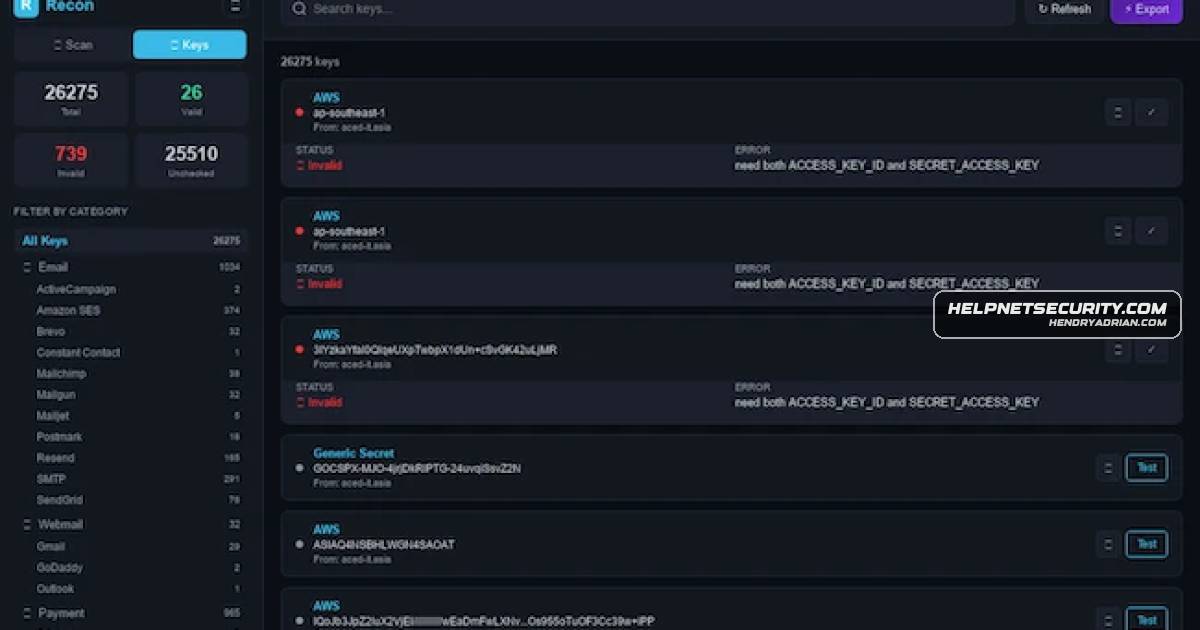
- GTIG found an exposed server running Recon, an automated reconnaissance and credential-management framework; its dashboard managed more than 23,800 harvested secrets, including cloud and AI service API keys.
- A PRC-nexus espionage actor attempted to build an automated penetration-testing framework using Gemini; GTIG said the effort was limited to framework development and disabled associated assets.
- In a separate case, a PRC-nexus actor used AI development tools to generate exploit scripts and phishing lures, and deployed Shai-Hulud for command-and-control and credential harvesting.
- GTIG has not observed threat actors deploy fully autonomous attack pipelines against targets in the wild, though it reported experimentation with increasingly connected AI-assisted workflows.
Article Details
- Publisher
- Help Net Security
- Report Period
- Q3 2026
- Scope
- Google Threat Intelligence Group observations of AI use in cyber activity, drawing on Mandiant incident response engagements, threat actor tracking, and live platform defenses.
- Key Statistics
- In a Q2 2026 campaign, thousands of third-party credentials were compromised in less than six hours.
- GTIG found more than 23,800 harvested secrets on one exposed server.
- Recommendations
- Harden AI models against misuse using insights from active threat monitoring to inform safety classifiers and guardrails.
Malware
Products
ClaudeGTIG also observed threat actors experimenting with Gemini, Claude, and Codex to build offensive frameworks and exploit chains, while highlighting campaigns involving Recon, Shai-Hulud, and large-scale credential theft.CodexGTIG also observed threat actors experimenting with Gemini, Claude, and Codex to build offensive frameworks and exploit chains, while highlighting campaigns involving Recon, Shai-Hulud, and large-scale credential theft.GeminiGTIG also observed threat actors experimenting with Gemini, Claude, and Codex to build offensive frameworks and exploit chains, while highlighting campaigns involving Recon, Shai-Hulud, and large-scale credential theft.
Tools
Burp SuiteThe operation also involved Burp Suite to probe web applications and identify vulnerabilities, and Phalanx, an open-source penetration testing framework, for automated exploitation routines.CC SwitchUsing CC Switch, it queried Claude, Gemini, or Codex to write custom exploit scripts, generate spear-phishing lures, and debug errors.PhalanxThe operation also involved Burp Suite to probe web applications and identify vulnerabilities, and Phalanx, an open-source penetration testing framework, for automated exploitation routines.ReconGTIG also observed threat actors experimenting with Gemini, Claude, and Codex to build offensive frameworks and exploit chains, while highlighting campaigns involving Recon, Shai-Hulud, and large-scale credential theft.