Inside Wazza: Device Code Phishing Kit Targets Microsoft 365 Accounts
Summary
LevelBlue SpiderLabs traced Wazza phishing campaigns active since at least July 2026. The kit uses PDF lures, layered redirects, browser checks and Microsoft device code authentication to seek access to Microsoft 365 accounts.
Key points
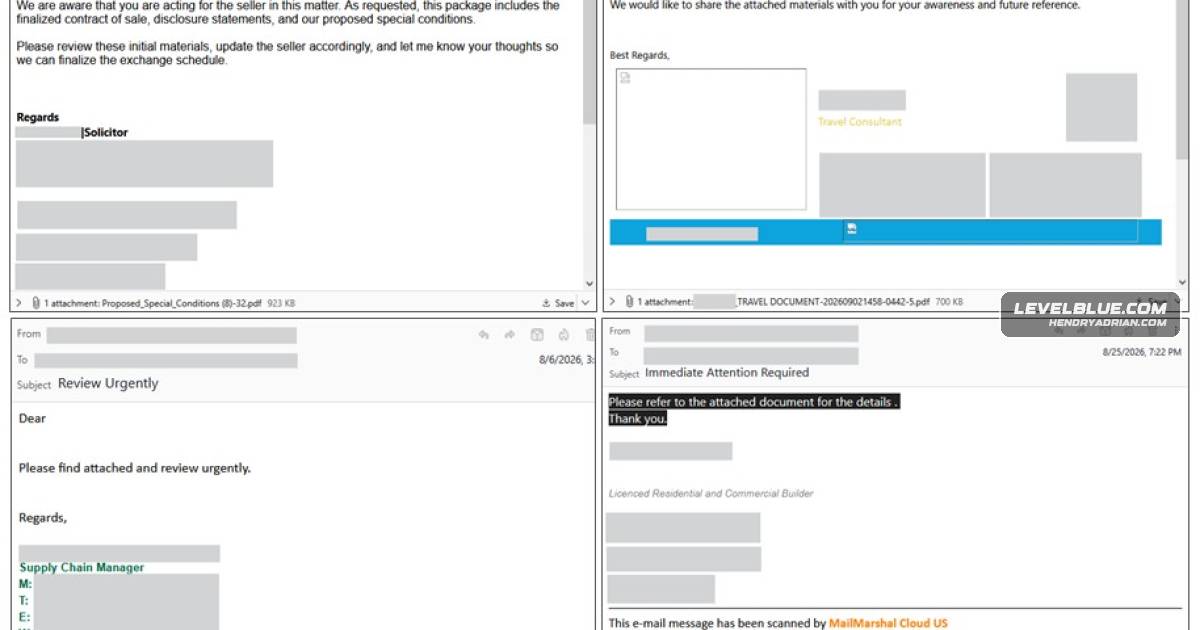
- Researchers observed multiple campaign waves, active since at least early July 2026 and ongoing at the time of writing, using compromised email accounts to deliver business-themed PDF lures.
- Embedded PDF links lead directly to phishing infrastructure or through Google Sites wrappers, with Cloudflare Workers hosting the final device code phishing pages.
- The staging framework generates routing tokens and carries campaign parameters between stages. Earlier variants used rotating corporate decoys and subdomain gating; later waves removed those features.
- Client-side scripts check for automation, headless browsers and debugging artifacts, encrypt browser-environment data, and attach a browser challenge to protected requests.
- Adobe, DocuSign and OneDrive-themed pages present Microsoft OAuth device codes as document verification codes, directing victims through Microsoft authentication rather than collecting passwords in a fake login form.
- The backend initializes sessions, supplies verification codes and authentication URLs, and monitors completion or expiration. Encoded campaign data personalizes victim-facing document details.
- Researchers recommend disabling device code authentication where unnecessary, restricting its use through Conditional Access, inspecting PDF links, and correlating email, web and identity telemetry.
Article Details
- Attack Vectors
- Phishing emails sent from compromised accounts deliver business-themed PDF attachments containing malicious hyperlinks.
- PDF links lead either through Google Sites pages embedding attacker-controlled content or directly to phishing infrastructure, sometimes through trusted redirectors.
- Multi-stage routing uses victim-specific tokens, campaign parameters, decoy websites, browser checks, and Cloudflare Workers-hosted landing pages.
- Document-sharing impersonation persuades victims to enter an attacker-supplied Microsoft OAuth device code into a legitimate authentication flow, with the goal of obtaining account access.
- Defensive Notes
- Disable device code authentication in Microsoft Entra ID where unnecessary; otherwise restrict it through Conditional Access policies.
- Correlate email attachment access, suspicious document-sharing visits, and subsequent device code authentication activity.
- Inspect externally supplied PDFs for embedded hyperlinks, trusted-service branding, and multi-domain redirect chains.
- Monitor Wazza parameters tok, tgm, m, tg, thm, and ch, particularly alongside /r?key= and /meline redirects.
- Monitor requests to /api/wazza-config, /api/mint-token, /api/fire-mint, /api/klam-kadity, /api/queltz-narvik, /bb-landing, and /api.php?svc=.
- Investigate suspicious .EU domains, randomized Workers subdomains, and decoy redirects using /onlsbdmn, /onfqdn, /eprfx, or /prfxmsmach. The article reports that routing checks and decoy content were removed in later variants.
- Train users that entering an unexpected device code can authorize an external application to access their account.
Indicators of compromise
| Type | Indicator | Context |
|---|---|---|
| DOMAIN | beton-beton[.]eu | Domain identified in the IOC table as Wazza phishing infrastructure. |
| DOMAIN | bike-msca[.]eu | Domain identified in the IOC table as Wazza phishing infrastructure. |
| DOMAIN | bodi-project[.]eu | Domain identified in the IOC table as Wazza phishing infrastructure. |
| DOMAIN | bruoth-family[.]eu | Domain identified in the IOC table as Wazza phishing infrastructure. |
| DOMAIN | cardamomo[.]eu | Domain identified in the IOC table as Wazza phishing infrastructure. |
| DOMAIN | coppietersrecherche[.]eu | Domain identified in the IOC table as Wazza phishing infrastructure. |
| DOMAIN | diabetesnet[.]eu | Domain identified in the IOC table as Wazza phishing infrastructure. |
| DOMAIN | dymowski[.]eu | Domain identified in the IOC table as Wazza phishing infrastructure. |
| DOMAIN | electroloys[.]com | Domain identified in the IOC table as Wazza phishing infrastructure. |
| DOMAIN | euniverza[.]eu | Domain identified in the IOC table as Wazza phishing infrastructure. |
| DOMAIN | hacsg[.]com | Domain identified in the IOC table as Wazza phishing infrastructure. |
| DOMAIN | hutspotmaken[.]eu | Wazza domain used for staging, routing, browser protection, and redirects toward the final phishing page. |
| DOMAIN | illuminatedminds[.]eu | Domain identified in the IOC table as Wazza phishing infrastructure. |
| DOMAIN | jetcapital[.]eu | Domain identified in the IOC table as Wazza phishing infrastructure. |
| DOMAIN | languagesforwork[.]eu | Domain identified in the IOC table as Wazza phishing infrastructure. |
| HOSTNAME | beacon-surge-sync[.]beacon-surge-sync[.]workers[.]dev | First-wave beacon endpoint queried by the preloader to obtain a value carried into subsequent Wazza requests. |
| HOSTNAME | beaconoflinenew[.]lastfightlink[.]workers[.]dev | Second-wave beacon endpoint queried during Wazza's validation preloader. |
| HOSTNAME | c5id-pc17-fffoub1-bul3-ahv1-r00kubt[.]ondrv-pwrbi3-s3ntln-quesvxs-l0gsvx-entr-m365s-cmplncx-ehubn[.]workers[.]dev | Workers-hosted final phishing landing page listed in the article's IOCs. |
| HOSTNAME | d3m9a-goo2ns-wx0g-jzhuc2-t9r2b9i[.]dvps-azbl-fnapp-trc3svc-synpx-quesvxs-purv3-siemsvx-cmplncx[.]workers[.]dev | Workers-hosted final phishing landing page listed in the article's IOCs. |
| HOSTNAME | dv0psh-purv3w-azfn-b2c0-msauth3-m365svc-s3ntln-4zrfn3x-cntnrx[.]workers[.]dev | Workers-hosted final phishing landing page listed in the article's IOCs. |
| HOSTNAME | purv3w3-t3ms4pp-certs-intun3-sbussvx-4zredg-siemsv-pip3ln-0ffc3[.]workers[.]dev | Workers-hosted final phishing landing page listed in the article's IOCs. |
| HOSTNAME | ssosvc-m365s-kvl-dv0pshb-s3ntln-c0mply-4zrmonx-apimgwx-evnthb[.]workers[.]dev | Workers-hosted final phishing landing page listed in the article's IOCs. |
| HOSTNAME | unhf69e-e0ppo-l0qoo-a12bcfj-ig1sa4v[.]wndws-pip3ln-sql3-waf3-purv3-gdprsx-dfn-azfn-appsvc-0ffapx[.]workers[.]dev | Final device code phishing host reached after Wazza's /meline redirect. |
| HOSTNAME | wndws-pip3ln-sql3-waf3-purv3-gdprsx-dfn-azfn-appsvc-0ffapx[.]workers[.]dev | Workers-hosted final phishing infrastructure identified in the IOC table. |
| URL | hxxps[:]//fgwhjmdaurspxvznk[.]hutspotmaken[.]eu/B4fWRuA | Attacker-controlled resource embedded by the Google Sites wrapper; serves Wazza's staging and routing script. |
| URL | hxxps[:]//sites[.]google[.]com/view/kjvcfdswqazxcfvghjoplkjmnbvcf/home | Specific Google Sites staging page embedding attacker-controlled Wazza phishing content. |
MITRE ATT&CK
T1027 · Obfuscated Files or InformationThe tg parameter encodes campaign and victim data using Base62 and an XOR-based keystream; the final phishing page decodes it locally with a hard-coded secret and salt.T1204.001 · Malicious LinkVictims follow hyperlink annotations in PDF lures to Google Sites staging pages or directly to Wazza phishing infrastructure.T1497.001 · System ChecksWazza checks WebDriver, Selenium, headless-browser indicators, automation artifacts, WebGL information, and DevTools signals before allowing access to protected phishing endpoints.T1566.001 · Spearphishing AttachmentCompromised email accounts send business-themed phishing messages carrying PDF attachments with links into Wazza infrastructure.
Vendors
CloudflarePhishing infrastructure: Campaign leverages Google Sites (sites.google.com), CloudFlare Workers (workers.dev), .COM and .EU top-level domains (TLDs).GooglePhishing infrastructure: Campaign leverages Google Sites (sites.google.com), CloudFlare Workers (workers.dev), .COM and .EU top-level domains (TLDs).MicrosoftLevelBlue SpiderLabs has been tracking multiple waves of Wazza, a newly observed multi-stage phishing kit that deploys device code phishing targeting Microsoft 365 accounts.
Products
Cloudflare TurnstileThe API endpoint, service identifier, Cloudflare Turnstile site key, and browser-side storage key are defined at the beginning of the client-side code:Cloudflare WorkersPhishing infrastructure: Campaign leverages Google Sites (sites.google.com), CloudFlare Workers (workers.dev), .COM and .EU top-level domains (TLDs).Google SitesPhishing infrastructure: Campaign leverages Google Sites (sites.google.com), CloudFlare Workers (workers.dev), .COM and .EU top-level domains (TLDs).Microsoft 365 Apps for EnterpriseLevelBlue SpiderLabs has been tracking multiple waves of Wazza, a newly observed multi-stage phishing kit that deploys device code phishing targeting Microsoft 365 accounts.Microsoft Entra IDDisable the device code flow in Microsoft Entra ID where it is not operationally required.