Huntress Details RedCurl-Linked Intrusions at Three Organizations in Canada
Summary
Huntress investigated three intrusions at organizations wholly or partly in Canada, linking activity to RedCurl through malware, infrastructure and tradecraft. Attackers used scheduled tasks, Python reverse proxies and cloud storage for suspected exfiltration.
Key points
- Huntress uncovered the intrusions in mid-to-late 2024, with observed host activity dating back to November 2023; the initial infection method was not established.
- Scheduled tasks resembling legitimate Windows tasks used pcalua.exe to launch malicious executables and Python scripts, providing persistence and indirect execution.
- Python scripts matched the RPivot proxy tool and established reverse tunnels to remote IP addresses.
- PowerShell scripts downloaded password-protected archives from bora[.]teracloud[.]jp/dav and uploaded collected files using HTTP PUT; 7zip encrypted archives and deleted original files.
- A backdoor Huntress calls RedLoader used rolling XOR string decryption, dynamic DLL resolution and AES-related cryptographic routines to conceal functionality.
- Shared infrastructure, distinctive script patterns and similarities to previously documented malware supported the RedCurl association, rather than definitive attribution.
- Defensive guidance includes baselining pcalua.exe usage, reviewing Task Scheduler execution logs, and hunting Python network connections and suspicious PowerShell-to-7zip process chains.
Article Details
- Attack Vectors
- Initial access was not established; Huntress did not observe all intrusions from their beginning, and malware quickly deleted many files.
- Scheduled tasks launched malicious executables and Python reverse-proxy scripts through pcalua.exe. Task names resembled legitimate Windows tasks.
- Batch scripts used PowerShell HTTP GET requests to download password-protected archives, which were extracted with 7zip.
- Python scripts matching RPivot established reverse-proxy connections to remote servers.
- Scripts collected directory listings and running-process information, encrypted and archived output with 7zip, and uploaded files to cloud storage using PowerShell HTTP PUT requests.
- RedLoader provided basic backdoor capabilities and concealed DLL and function names using encrypted strings and dynamic resolution.
- Defensive Notes
- Baseline legitimate pcalua.exe execution and investigate unusual use, especially scheduled tasks launching executables or Python scripts through it.
- Enable Microsoft-Windows-TaskScheduler/Operational logging. Inspect event IDs 129, 200, and 201 for pcalua.exe in Path or ActionName fields. Event ID 129 records task execution, not task creation; Security Event ID 4698 typically records creation.
- Extend the Scheduled Task Executed Uncommon LOLBin Sigma rule to include paths ending in \pcalua.exe.
- Hunt for python.exe or pythonw.exe making network connections or receiving IP addresses in command-line arguments, while filtering established legitimate activity.
- Investigate 7zip extraction of password-protected archives and archive creation combining password protection with the -sdel option.
- Hunt for PowerShell spawning 7zip and correlate that activity with scheduled tasks, file collection, and outbound transfers.
- Baseline normal scripting activity and retain process, command-line, network, and scheduled-task telemetry. Make hunting queries case-insensitive where supported.
Indicators of compromise
| Type | Indicator | Context |
|---|---|---|
| HOSTNAME | cdn[.]wgroadcdn[.]workers[.]dev | Specific hosted hostname listed as proxy or C2 infrastructure in the article's network indicators. |
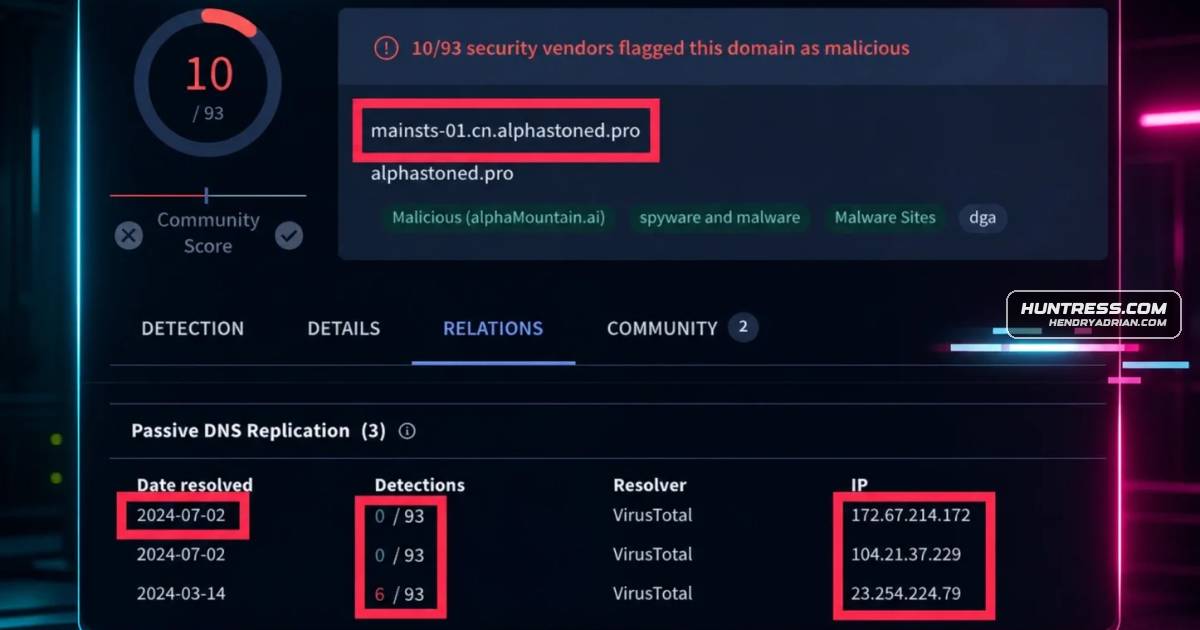
| HOSTNAME | mainsts-01[.]cn[.]alphastoned[.]pro | Hostname found in recovered files and linked by Huntress to infrastructure associated with RedCurl. |
| HOSTNAME | sup[.]wgsphere[.]workers[.]dev | Specific hosted hostname listed as proxy or C2 infrastructure in the article's network indicators. |
| IPV4 | 188[.]130[.]207[.]253 | Remote reverse-proxy endpoint supplied to the Python cl.py script with port 10310. |
| IPV4 | 193[.]176[.]158[.]30 | Remote RPivot endpoint stored in a recovered script with port 40141. |
| IPV4 | 23[.]254[.]224[.]79 | Address associated with the observed malicious hostname; Huntress identified it as a connection to previously reported RedCurl infrastructure. |
| SHA256 | 01d94de4d104f6df121f97bae9cbbfada5a9cd4c3af0e1c403271d8284815cad | Hash of 9b1ab911.dat in the DiskCleanup directory, listed as an intrusion artifact. |
| SHA256 | 1935692d1c4492f99c969d11d81481aea736f3899b1f55af9c8f6cf6ca9b839c | Hash of 9b1aa6a9.dat in the USB directory, listed as an intrusion artifact in the IOC table. |
| SHA256 | 4af2c0c6087f9410cf57af4cf7eb09b5a3038bb78f4e50625402e32ad9662e66 | Hash of the deployed cl.py script under ControlsUp; Huntress identified the script as matching RPivot client.py and used for reverse-proxy tunneling. |
| SHA256 | 574a55706697d7e0109cf920ae6e0047cd7a802c9ad457e3b68e7802f3f902ef | Hash of mbda76918700ee0725.exe, the malicious executable launched by the WiFiTask scheduled task. |
| SHA256 | 5a8314cbdccc7362a100b9db92b05597dad37c13b4cbb7b0fd1ef58d625dd454 | Hash of 9b1a4231.dat in the Multimedia directory, listed as an intrusion artifact. |
| SHA256 | 6d85ad9e14a23ed6bf700f636273b30f53c54267d0f624c8ff7bc0008f7db4f7 | Hash of 9b1a7691.dat in the WCM directory, listed as an intrusion artifact in the IOC table. |
| SHA256 | 904669bd897dbb99561ef080d9818ff4bc9c106aa476d25b992439cdea4d1b0b | Hash of om6db9110b3989a881.exe, launched through pcalua.exe by the malicious SilentCleanup scheduled task. |
| SHA256 | 9bdf91507fb4f3772a6d66a78f0f1f44075eefba4af65094c374f9d72e25bade | Hash of 133ngc.bat in the DiskCleanup directory, listed as an intrusion script artifact. |
| SHA256 | 9d667de8a99e757176cea1aa0af0d81972005d4abf3b7aff942d8c30fb151e35 | Hash of mx0342315bc04edd2c.exe, launched through pcalua.exe by the malicious SystemSoundsService scheduled task. |
| SHA256 | c75048a4933c3061f6cd02c8ca96ed524166fce4cc4b9e0c7ea6ac8295dc3c47 | Hash of qpybfa6a97da7711221.exe, the executable referenced by the malicious Usb-Notifications scheduled task. |
| SHA256 | ff3706e94d9b769f78e4271928382426cb034b11c5a0f6a8ffea35726cc03692 | Hash of afs1f549b1aa7893d03.exe in the DiskCleanup directory, listed among the intrusion's file indicators. |
MITRE ATT&CK
T1027 · Obfuscated Files or InformationRedLoader concealed strings with rolling XOR and AES-based decryption and included junk C2 addresses.T1027.007 · Dynamic API ResolutionRedLoader decrypted DLL and function names and dynamically resolved functions using GetProcAddress.T1036.004 · Masquerade Task or ServiceMalicious scheduled tasks used legitimate-looking names such as SystemSoundsService, WiFiTask, and SilentCleanup.T1053.005 · Scheduled TaskScheduled tasks maintained execution of malicious binaries and, on some hosts, Python reverse-proxy scripts.T1057 · Process DiscoveryA recovered script used WMIC to collect currently running processes and write the results to a file.T1059.001 · PowerShellBatch scripts invoked PowerShell to download archives through HTTP GET requests and upload collected data through HTTP PUT requests.T1059.003 · Windows Command ShellMalicious executables launched batch scripts that coordinated payload extraction, collection, transfers, and cleanup.T1059.006 · Pythonpython.exe and pythonw.exe executed RPivot scripts, including cl.py and client.py.T1070.004 · File DeletionScripts deleted original collected files, created directories, and themselves; archive commands also used the -sdel option.T1083 · File and Directory DiscoveryA recovered script generated a directory listing and saved the output before archiving it.T1090 · ProxyRPivot Python scripts established reverse-proxy tunnels to remote IP addresses and ports specified in scripts.T1105 · Ingress Tool TransferPowerShell downloaded revtun1.tmp and revtun2.tmp from cloud storage before extracting their contents with 7zip.T1202 · Indirect Command Executionpcalua.exe indirectly launched malicious executables and Python commands, including a command using headless conhost.exe.T1560.001 · Archive via Utility7zip created password-protected archives of collected information, including a command enabling encrypted headers and 50 MB volumes.T1567.002 · Exfiltration to Cloud StorageHuntress observed evidence of archived information being uploaded to legitimate cloud storage using PowerShell HTTP PUT requests.
People
Threat Actors
Malware
RedCurl.Extractorthem (as well as archiving files and uploading those files). These functions were carried out in the past by RedCurl.Extractor and RedCurl.FSABIN (modulesRedCurl.FSABINthem (as well as archiving files and uploading those files). These functions were carried out in the past by RedCurl.Extractor and RedCurl.FSABIN (modulesRedLoaderIn addition to pcalcula.exe being used to run Python scripts, RedCurl also brings a piece of malware we’re calling RedLoader, which has simple backdoor capabilities. It employs a
Products
7ZipThe Huntress Security Operations Center (SOC) received an alert on a host that had recently installed the Huntress agent: a 7zip binary executed from a suspicious location, which triggered an alert.Microsoft WindowsWindows Program Compatibility Assistant (pcalua.exe), which then executed a malicious binary. We later identified other tasks that used pcalua.exe to run Python scripts. The Python script used in the
Tools
Countries
Industries
Constructionlarge wholesale retailers in the past as well as companies in the finance, tourism, insurance, construction, and consulting industries.Consultinglarge wholesale retailers in the past as well as companies in the finance, tourism, insurance, construction, and consulting industries.financelarge wholesale retailers in the past as well as companies in the finance, tourism, insurance, construction, and consulting industries.Insurancelarge wholesale retailers in the past as well as companies in the finance, tourism, insurance, construction, and consulting industries.Tourismlarge wholesale retailers in the past as well as companies in the finance, tourism, insurance, construction, and consulting industries.