Rapid7 details five Zimbra flaws enabling password guessing, email impersonation, mailbox access and mail exfiltration
Summary
Rapid7 analyzes five Zimbra flaws that enable unauthenticated password guessing, sender impersonation, cross-user mailbox reads and persistent email exfiltration. Fixes are available for three; no public fix is listed for two.
Key points
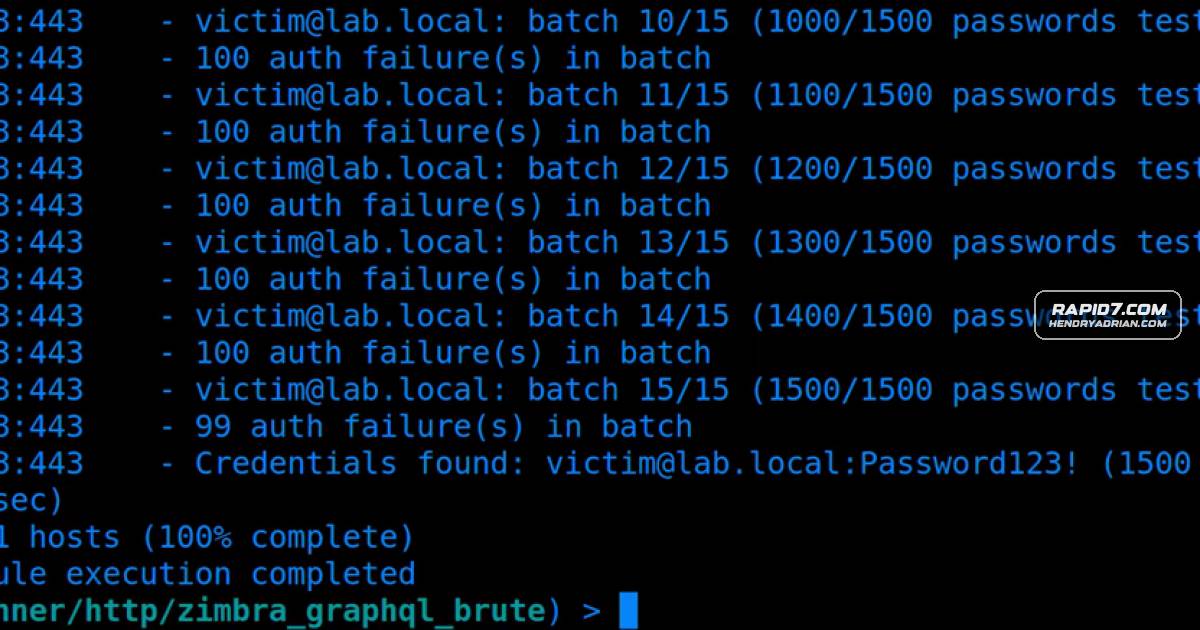
- A GraphQL authentication flaw bypasses Zimbra's source-IP failed-login counter, allowing batched password guesses; the article reports 10,000 candidates tested in under two minutes in one deployment.
- A separate LDAP filter injection can expose an external-directory password oracle under a specific lazy-provisioning configuration and can combine with GraphQL to evade both IP and local-account lockouts.
- An authenticated user can exploit SaveDraftRequest to send mail as another local user without send-as rights; Zimbra also saves the message in the impersonated user's Sent folder.
- An EWS flaw lets an EWS-enabled account read other users' mail, attachments, drafts, contacts and calendar data by supplying a target mailbox identifier.
- A Sieve notify policy bypass can send selected headers and message text to an external address, persisting after session expiry or a password change; it does not send attachments or raw MIME.
- Zimbra fixed the impersonation flaw in ZCS 10.1.17 and the EWS and Sieve flaws in ZCS 10.1.20. Rapid7 lists no public fixed release for the two authentication-related flaws.
- Rapid7 recommends upgrading to the latest supported release and checking stored incoming and outgoing filter rules for unauthorized notify actions; Modern's Filters view may not show them.
Article Details
- Attack Vectors
- An unauthenticated user can batch password guesses through Zimbra Modern's GraphQL authenticate mutation at /service/extension/graphql, bypassing the source-IP failed-login counter. In the stated external-LDAP and lazy auto-provisioning configuration, CVE-2026-93635 can also make authentication responses distinguish a correct directory password.
- An ordinary authenticated user can exploit CVE-2026-73571 through SaveDraftRequest to send a message as another local user without send-as authorization; Zimbra also records the message in that user's Sent folder.
- An EWS-enabled account can exploit CVE-2026-10631 by supplying another user's UUID in a composite folder ID, allowing FindItem to read that user's mailbox items and folders.
- An authenticated user can exploit CVE-2026-50055 to install a Sieve notify rule that sends selected message headers and text bodies to an external address, bypassing a policy that disables mail forwarding in filters.
- Defensive Notes
- Apply ZCS 10.1.17 or later to address CVE-2026-73571, and ZCS 10.1.20 or later to address CVE-2026-10631 and CVE-2026-50055. The article reports no publicly listed fixed release for CVE-2026-93635 or CVE-2026-93637 at publication.
- Inspect stored incoming and outgoing filter rules for external notify and RFC-compliant notify actions that violate forwarding policy; the article notes that Modern's Filters view may not display these rules.
- Review EWS logs for cross-user operations involving different account UUIDs, and inspect saved notify rules and outbound notification traffic for evidence of Sieve-based exfiltration.
- A reverse proxy or web application firewall that inspects request bodies can look for multiple authenticate aliases in a single anonymous GraphQL request.
MITRE ATT&CK
T1087.003 · Email AccountThe EWS PoC uses authenticated GetAccountInfoRequest or SearchGalRequest lookups to obtain a target user's UUID before crafting a mailbox folder ID.T1110.001 · Password GuessingThe GraphQL authentication flaw allows repeated password guesses against an account without triggering Zimbra's source-IP suspension; the external-LDAP configuration can also distinguish a correct candidate password.T1114.002 · Remote Email CollectionCVE-2026-10631 allows an EWS-enabled account to use FindItem to read complete items, including message bodies and attachments, from other users' mailboxes.T1114.003 · Email Forwarding RuleCVE-2026-50055 allows an authenticated user to install a persistent Sieve notify rule that sends selected headers and message text to an external address.T1656 · ImpersonationCVE-2026-73571 lets an authenticated user submit a SaveDraftRequest that sends a message as a selected local user without the required send-as authorization.
CVE
CVE-2026-10631EWS cross-user mailbox access (CVE-2026-10631)CVE-2026-50055and what they can do with the recipient's session. A script can install the Sieve forwarding rule (CVE-2026-50055); another path preserves direct mailbox access after the original session expires or the victimCVE-2026-73571direct mailbox access after the original session expires or the victim changes their password. CVE-2026-73571 makes these attacks more credible by placing the message in the mailbox as any chosen local user.CVE-2026-93635CVE-2026-93635 and external LDAPCVE-2026-93637GraphQL authentication rate-limit bypass (CVE-2026-93637)
People
Vendors
Products
Exchange Web Services (EWS)users. Zimbra Desktop and Zimbra Connector for Outlook are separate client applications, while Exchange Web Services (EWS) is a separately licensed server feature for Outlook compatibility.Zimbra Collaboration SuiteDuring a broader assessment of Zimbra Collaboration Suite (ZCS), Rapid7 reported more than 80 vulnerabilities spanning authentication, mailbox authorization, calendar processing, web clients, document services, and the