Exposed Directory Reveals FortiGate and MeshCentral Intrusion Targeting Thai Broadband Provider
Summary
An exposed directory revealed an intrusion targeting 3BB, including exploitation of FortiGate CVE-2024-21762, MeshCentral persistence, connected agents, credential-harvesting tools, and evidence of root-level access.
Key points
- Hunt.io found 298 files in an exposed directory containing exploit scripts, credentials-related tools, persistence mechanisms, and an inventory of compromised devices.
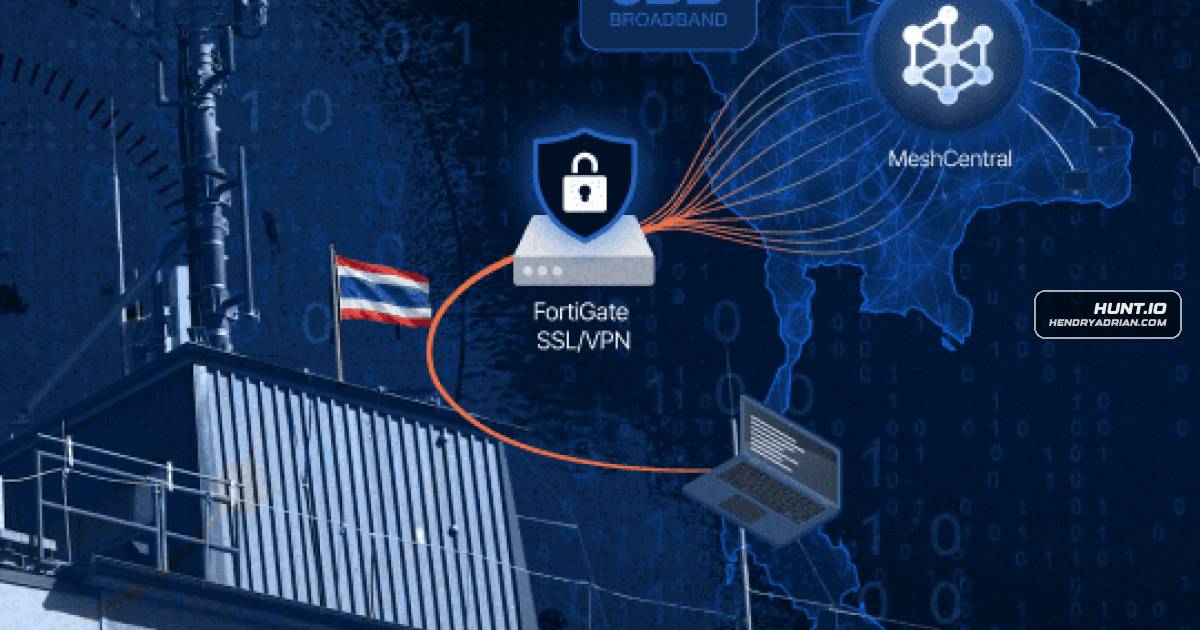
- The scripts show exploitation of FortiGate SSL-VPN CVE-2024-21762 at mail.3bb.co.th, with a reverse-shell callback to the staging server.
- MeshCentral was configured for persistence under the TH-3BB group; the device inventory showed multiple connected agents running with root privileges.
- Artifacts indicate root-level compromise of an internal Linux server and reconnaissance and lateral-movement activity across 3BB systems.
- Scripts targeted RADIUS databases for credential extraction; the directory also contained a Triple T Broadband OpenVPN certificate and active session tokens for Jasmine-branded systems.
- A cleanup script was prepared to erase logs and exploitation artifacts while preserving MeshCentral access.
- The report recommends patching FortiGate appliances, auditing unauthorized MeshCentral agents and access, rotating potentially exposed credentials, and preserving forensic evidence.
Article Details
- Attack Vectors
- The actor fingerprinted the 3BB FortiGate SSL-VPN, tested several vulnerabilities, and prepared a CVE-2024-21762 exploit that used a crafted chunked HTTP request, heap spraying, and a ROP chain to launch a reverse shell.
- Scripts attempted credential brute-forcing against the FortiGate VPN and 3BB agent portal, and SSH password spraying against more than 55 internal hosts.
- The actor probed the agent portal for session forgery, file-upload weaknesses, SQL injection, path traversal, open redirects, and HTTP request smuggling.
- Scripts probed an F5 BIG-IP appliance for known vulnerabilities and targeted an internal Pentaho server with a Ghostcat file-disclosure exploit.
- Post-compromise tooling prepared PwnKit and Dirty COW privilege escalation, harvested keys and credentials, targeted RADIUS databases, and used MySQL file operations to deploy web shells and inject SSH keys.
- The actor deployed MeshCentral for persistent remote access and prepared a cleanup script to remove logs and exploitation artifacts while retaining persistence.
- Defensive Notes
- Check FortiGate SSL-VPN exposure to CVE-2024-21762 and update appliances to supported, fully patched firmware.
- Review VPN accounts, configuration changes, authentication attempts, and administrative activity for unauthorized access.
- Audit MeshCentral installations for unauthorized agents, unexpected WebSocket connections, and unapproved management servers.
- Rotate potentially exposed SSH keys, database passwords, VPN certificates, RADIUS credentials, and application secrets.
- Review RADIUS servers, VPN services, and identity systems for unauthorized access or credential extraction.
- Hunt for hidden SUID binaries, web shells, SSH key changes, unauthorized scheduled tasks, and newly installed remote-management software.
- Preserve forensic evidence before remediation when compromise is suspected; the recovered cleanup script was designed to erase logs and artifacts.
Indicators of compromise
| Type | Indicator | Context |
|---|---|---|
| HOSTNAME | www[.]ayuthayatech[.]com | Actor-designated MeshCentral management and C2 server for deployed agents. |
| IPV4 | 92[.]63[.]180[.]133 | Attacker VPS hosting the exposed operational toolkit and serving as the CVE-2024-21762 exploit's reverse-shell callback host. |
MITRE ATT&CK
T1021.004 · SSHScripts attempted SSH access across internal hosts, including attempts using stolen IDC keys.T1068 · Exploitation for Privilege EscalationThe toolkit prepared PwnKit and Dirty COW exploits to obtain root privileges on Linux hosts.T1070.002 · Clear Linux or Mac System Logscleanup_target.sh was designed to delete Linux system and service logs while preserving the installed MeshCentral agent.T1070.003 · Clear Command Historycleanup_target.sh cleared user shell histories to conceal activity.T1078 · Valid AccountsThe recovered toolkit attempted SSH access using stolen IDC keys and included a corporate OpenVPN client certificate whose continued validity was unconfirmed.T1098 · Account ManipulationThe MySQL exploitation scripts included SSH key injection and modification of database privileges to expand or retain access.T1110.001 · Password GuessingScripts tried username and password combinations against the 3BB FortiGate VPN and agent portal.T1110.003 · Password SprayingThe brute.sh, brute2.sh, and brute3.sh scripts performed SSH password spraying against more than 55 internal hosts.T1190 · Exploit Public-Facing ApplicationThe recovered CVE-2024-21762 exploit targeted the public-facing FortiGate SSL-VPN to execute a reverse shell.T1219 · Remote Access ToolsThe actor deployed MeshCentral agents for persistent remote administration of compromised systems.T1505.003 · Web ShellScripts used MySQL INTO OUTFILE to deploy PHP web shells on targeted servers.T1552 · Unsecured Credentialscred_hunt.sh searched compromised hosts for SSH private keys, PHP configuration files, database credentials, SNMP community strings, and shell history.T1574.006 · Dynamic Linker HijackingThe PwnKit payloads used GCONV_PATH hijacking to execute commands with root privileges.T1595 · Active ScanningThe actor probed FortiGate SSL-VPN endpoints and fingerprinted the appliance and firmware before exploitation.
CVE
CVE-2016-5195dcow.cExploitDirty COW (CVE-2016-5195) privilege escalation via /etc/passwd overwrite.CVE-2018-13379through /remote/hostcheck_validate), CVE-2023-27997 (XORtigate pre-authentication heap overflow), CVE-2018-13379 (path traversal via fgt_lang?lang=/../../../../etc/passwd), and CVE-2024-21762, indicating that theCVE-2020-1938ghostcat.pyExploitExploitation of CVE-2020-1938 (Ghostcat) for AJP file disclosure against an internal Pentaho server.CVE-2021-22986f5_test.sh, f5_2.shRecon / ExploitEnumeration and exploitation of F5 BIG-IP vulnerabilities (CVE-2021-22986, CVE-2022-1388, and CVE-2023-46747).CVE-2021-4034evil.c, evil2.c, evil3.cExploitShared library payloads for exploiting PwnKit (CVE-2021-4034).CVE-2022-1388f5_test.sh, f5_2.shRecon / ExploitEnumeration and exploitation of F5 BIG-IP vulnerabilities (CVE-2021-22986, CVE-2022-1388, and CVE-2023-46747).CVE-2022-42475known FortiGate vulnerabilities rather than focusing on a single exploit. The script probes for CVE-2022-42475 (heap overflow through /remote/hostcheck_validate), CVE-2023-27997 (XORtigate pre-authentication heapCVE-2023-27997exploit. The script probes for CVE-2022-42475 (heap overflow through /remote/hostcheck_validate), CVE-2023-27997 (XORtigate pre-authentication heap overflow), CVE-2018-13379 (path traversal viaCVE-2023-46747f5_test.sh, f5_2.shRecon / ExploitEnumeration and exploitation of F5 BIG-IP vulnerabilities (CVE-2021-22986, CVE-2022-1388, and CVE-2023-46747).CVE-2024-21762The threat actor used CVE-2024-21762 to target a FortiGate 60F SSL-VPN at mail.3bb.co[.]th.
Vendors
Bangmod Enterprise Co., Ltd.AttackCapture⢠discovered an open directory hosted at 92.63.180[.]133:8888, a server on Bangmod Enterprise Co., Ltd. infrastructure in Thailand. Bangmod is the hosting provider for this IP address, not aF5f5_test.sh, f5_2.shRecon / ExploitEnumeration and exploitation of F5 BIG-IP vulnerabilities (CVE-2021-22986, CVE-2022-1388, and CVE-2023-46747).Fortinetvalidation. The fw_get.sh script contains the FortiGate serial number FGT60FTK2209FY0V within a crafted Fortinet Distribution Network (FDN) request, indicating an attempt to impersonate the target appliance and
Products
F5 BIG-IPf5_test.sh, f5_2.shRecon / ExploitEnumeration and exploitation of F5 BIG-IP vulnerabilities (CVE-2021-22986, CVE-2022-1388, and CVE-2023-46747).FortiGate 60FThe threat actor used CVE-2024-21762 to target a FortiGate 60F SSL-VPN at mail.3bb.co[.]th.FortiOSfingerprinting through forti4.sh and forti5.sh, which download the fgt_lang.js file and identify the FortiOS version by counting version-specific strings, including references to ZTNA (introduced in FortiOS 7.0),MeshCentral3, 2026, including exploitation scripts, privilege escalation tools, brute-force utilities, a live MeshCentral agent configuration, and a device inventory of already-compromised machines, all targeting 3BB (TripleMySQLmulti_attack.shLateral MovementAutomated SSH brute-forcing, anonymous FTP access, and MySQL weak-credential testing across the internal network.OpenVPNA valid OpenVPN certificate issued by Triple T Broadband's own PKI was found in the directory, that would provide VPN access to the Jasmine network if still valid.Pentahoghostcat.pyExploitExploitation of CVE-2020-1938 (Ghostcat) for AJP file disclosure against an internal Pentaho server.