How to Interpret Memory Artifacts Without Overstating What They Prove
Summary
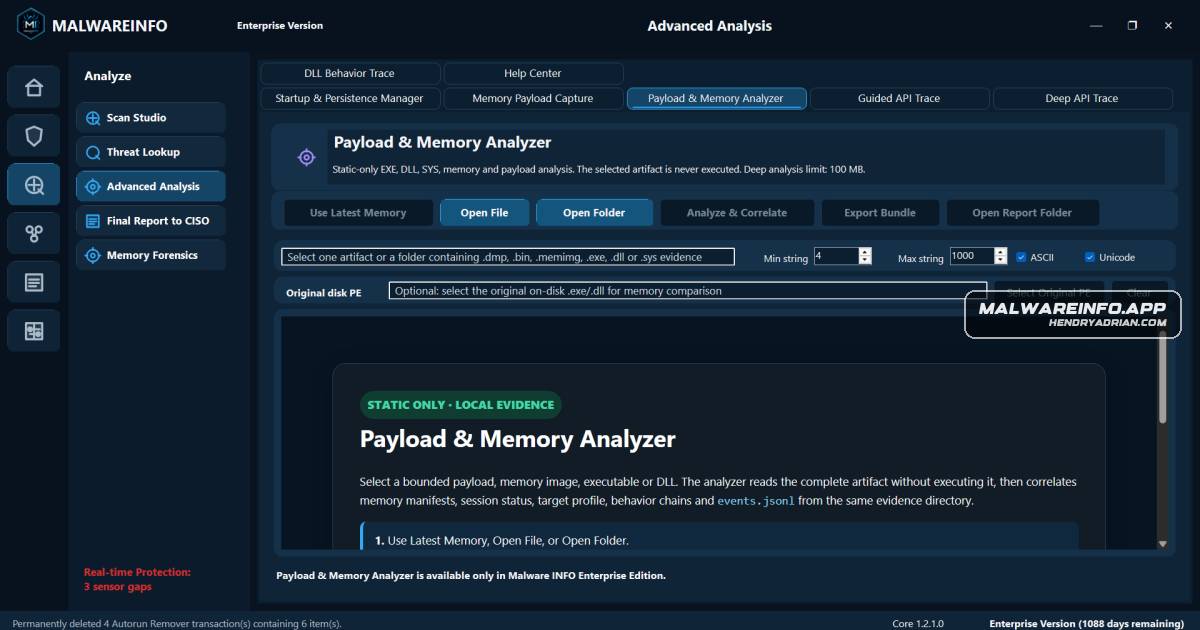
A guide to Malware INFO Payload & Memory Analyzer explains bounded local analysis, provenance and runtime-correlation limits, sensitive memory data, and why static indicators or incomplete results do not prove execution or malicious activity.
Key points
- The analyzer inspects supported artifacts locally without executing them or loading them as libraries; selected files are capped at 1 GiB, while several analysis features retain up to 16 MiB.
- Preflight records producer, format, provenance, and the identities of selected and analyzed artifacts. Manifests can strengthen attribution but do not prove execution or create a malware verdict.
- Static indicators such as strings, imports, executable bytes, changed pages, or enrichment matches do not by themselves prove runtime use, malicious activity, or a malware family.
- Runtime attribution requires verified compound identity and source integrity. In the captured example, 366 timeline rows included 160 context-only rows and zero attributable artifact bindings; this did not prove no API activity occurred.
- Memory dumps and reports may contain credentials, keys, personal data, and other sensitive material. The guide advises controlled storage and authorized review before sharing.
- The article describes a 76-artifact example and reports that YARA enrichment failed while other sources had separate coverage states; the failure remained visible rather than being treated as a clean result.
- The analyzer’s reports preserve coverage gaps, contradictions, and limitations; analysts are advised to gather missing evidence rather than strengthen conclusions from partial or context-only results.
Article Details
- Topic
- Forensic analysis of payload and memory artifacts using Malware INFO Payload & Memory Analyzer
Vendors
Products
API Hook TraceGuided API Trace, Deep API Trace, API Hook Trace, Process Memory Capture, and Payload & Memory Analyzer can contribute to one investigation, but they do not have the same authority.Deep API Traceretained Deep API Trace memory or PE artifacts through their verified session and snapshot evidence; andFinal Report to CISOWhen the source family is eligible, let Final Report to CISO independently verify the package on analyst request.Guided API TraceGuided API Trace, Deep API Trace, API Hook Trace, Process Memory Capture, and Payload & Memory Analyzer can contribute to one investigation, but they do not have the same authority.Payload & Memory AnalyzerWhat Payload & Memory Analyzer isProcess Memory Capturesix Process Memory Capture kinds: Windows MiniDump, Full User-Mode Dump, Raw Process Memory Image, Individual Memory Region, PE Image, and MalwareInfo Custom .mimem;