Huntress Details Defense Evasion Tactics in Two Gentlemen Ransomware Incidents
Summary
Huntress analyzed two Gentlemen ransomware incidents involving scheduled tasks, PowerShell, Windows log clearing, and attempts to disable Microsoft Defender. One incident included a SOCKS proxy connecting to attacker-controlled IP addresses.
Key points
- Huntress investigated two incidents in April and May; post-incident agent deployment limited visibility into initial access and attack activity.
- In both incidents, attackers cleared the Security, System, and Application event logs and used scheduled tasks and PowerShell.
- In one incident, an attacker connected over RDP using a compromised account; Microsoft Defender blocked an initial encryptor attempt, but a later payload was deployed from a NETLOGON share.
- In the second incident, PowerShell commands attempted to disable Defender and add antivirus exclusions before ransomware was redeployed.
- A scheduled task launched disguised malware that established a SOCKS proxy to 193.233.202[.]17:44729; another attempted task referenced 77.110.122[.]137:37182.
- Huntress recommends enforcing MFA, restricting RDP, monitoring scheduled tasks and Defender changes, and treating log clearing as an escalation trigger.
Article Details
- Attack Vectors
- Attackers established RDP connections using a compromised user account in the shipping and transportation incident; this was the first observed activity, not confirmed initial access.
- In both investigated incidents, attackers used Scheduled Tasks and PowerShell. In one incident, a task launched a SOCKS proxy binary from the Windows Temp folder to maintain remote access.
- Attackers attempted to deploy ransomware executables from the Documents folder and Downloads folder; one payload was also executed from a NETLOGON share.
- In the construction-company incident, PowerShell commands attempted to disable Microsoft Defender protections and add process and path exclusions.
- Defensive Notes
- Enforce MFA, restrict RDP, and investigate unusual logons to high-value systems.
- Monitor Scheduled Task creation and repeated task failures for signs of persistence or ransomware execution.
- Enable Microsoft Defender tamper protection and investigate attempts to disable it or add exclusions.
- Treat clearing of Security, System, and Application Event Logs as an immediate escalation trigger.
- Maintain an asset inventory, reduce the attack surface, and deploy monitoring broadly.
Indicators of compromise
| Type | Indicator | Context |
|---|---|---|
| IPV4 | 193[.]233[.]202[.]17 | C2 IP address used by the malicious Scheduled Task's SOCKS proxy connection. |
| IPV4 | 77[.]110[.]122[.]137 | Alternate address specified in a command to create a malicious Scheduled Task running the SOCKS proxy binary. |
| SHA256 | f918535f974591ef031bd0f30a8171e3da27a6754e6426a8ba095f83195661c8 | SHA-256 hash identified in the IOC table for the second incident's ransomware encryptor. |
MITRE ATT&CK
T1021.001 · Remote Desktop ProtocolIn the shipping and transportation incident, the first observed activity was an RDP connection using a compromised user account; the article cautions that this does not establish initial access.T1053.005 · Scheduled TaskAttackers created Scheduled Tasks to run ransomware and a SOCKS proxy binary, including a task configured to recur every two minutes.T1059.001 · PowerShellPowerShell commands attempted to disable Microsoft Defender protections and add antivirus exclusions.T1070.001 · Clear Windows Event LogsAttackers cleared the Security, System, and Application Windows Event Logs in both investigated incidents.T1090.001 · Internal ProxyThe binary svchost32.exe established a SOCKS proxy connection to a reported C2 IP address.
CVE
People
Threat Actors
Malware
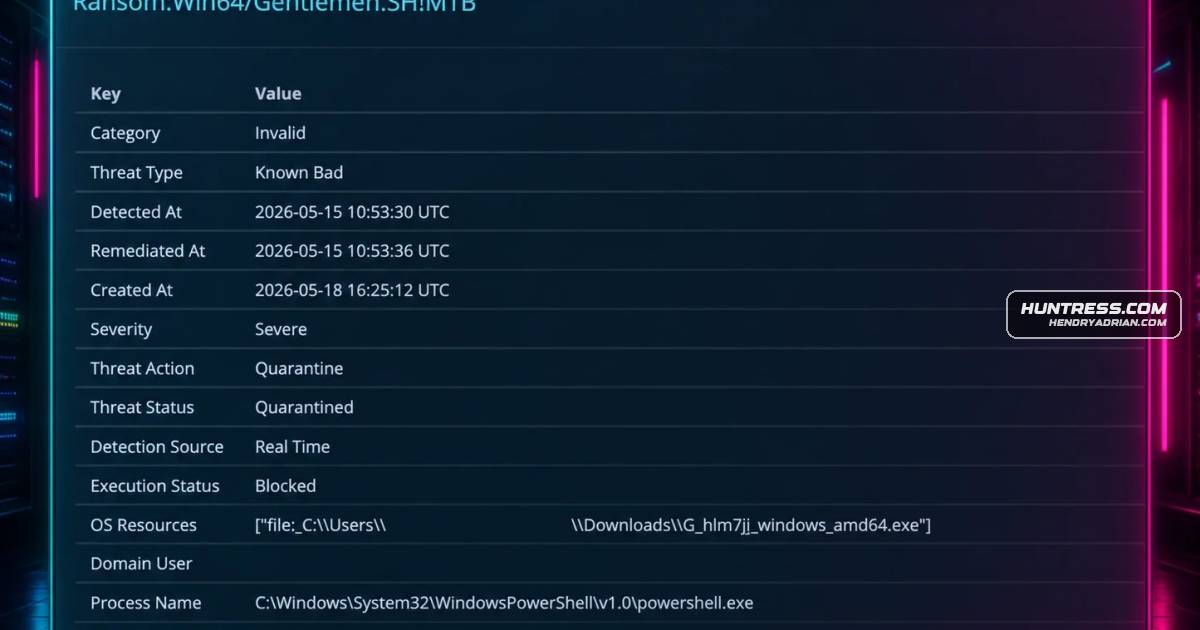
Gentlemen ransomwareAs seen in Figure 2, the threat actor’s first attempt to execute the encryptor was picked up by Microsoft Defender on that date as well (Ransom:Win64/Gentlemen.SH!MTB).The GentlemenThe Gentlemen (Ransomware) in Disguise: Defense Evasion and other TTPsTrojan:Win32/MpTamperBulkExcl.HThe logs also showed Defender detecting and blocking Trojan:Win32/MpTamperBulkExcl.H, a PowerShell script that was executed and attempted to tamper with antivirus exclusions.
Vendors
Products
Microsoft Defender Antimalware PlatformSecurity, System, and Application Event Logs were cleared, and PowerShell commands aimed to disable Microsoft Defender and add antivirus exclusionsMicrosoft WindowsA more recent leak of the operation’s internal database, in early May, further revealed its operators relying on a group of tools dedicated to security tool evasion, and techniques for abusing Windows logging.