
PolinRider Loader Was Force-Pushed Into Pull Requests at Three Projects; CircuitVerse CI Ran It
Summary
StepSecurity reports that PolinRider was force-pushed into pull requests at AsyncAPI, CircuitVerse and Open Food Facts. CircuitVerse confirmed CI ran it and deleted 40 installers; Open Food Facts CI also ran the payload, but all four runs failed.
Key points
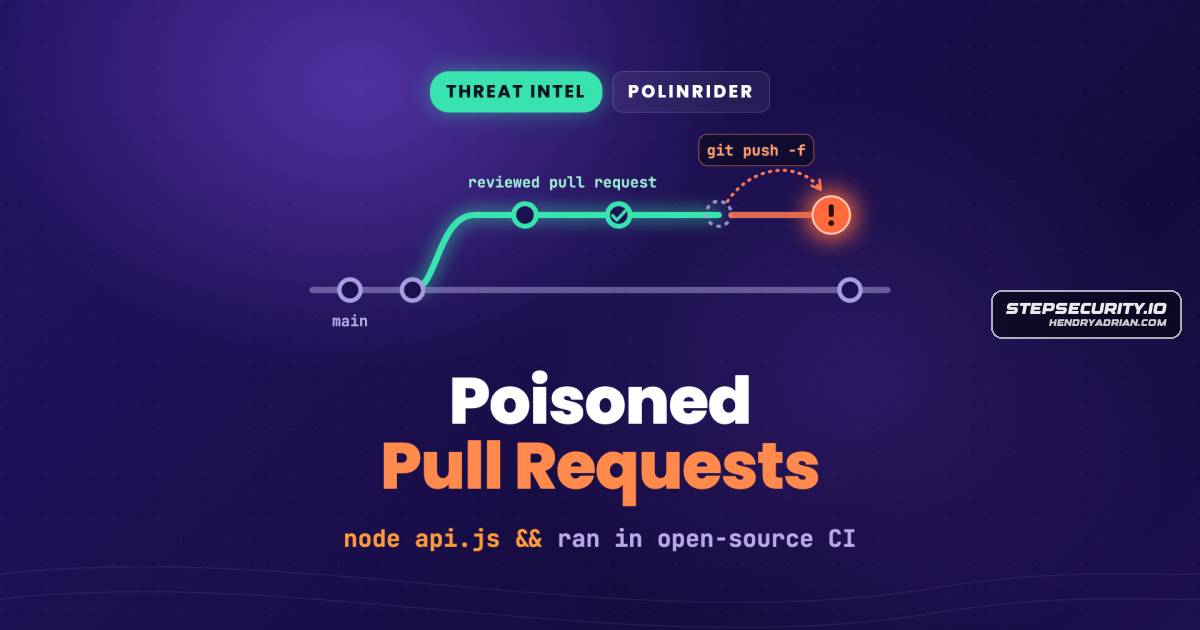
- On October 19, unsigned rewritten commits containing the loader were force-pushed into open pull requests at AsyncAPI Generator, CircuitVerse and Open Food Facts; long whitespace concealed code in diffs.
- None of the 145 merged pull requests opened by the Eternity0207 account contained the loader, according to the maintainers’ reviews. The malicious commits were present in still-open pull requests.
- The decoded 16,674-byte loader could run through build or test commands, configuration files, or a hidden VS Code folder-open task. It reads server addresses from an Ethereum wallet and downloads later stages over plain HTTP on port 443.
- CircuitVerse confirmed its CI ran the loader and published 40 installers; maintainers deleted them on November 25. Open Food Facts CI also ran on four poisoned commits, but all four runs failed, and a secret was rotated.
- AsyncAPI CI did not run the payload because fork pull-request workflows required maintainer approval. The article says no project reported stolen secrets.
- Of 622 repositories examined, 576 carried the loader across 311 GitHub accounts, according to StepSecurity’s analysis.
- Recommended defenses include requiring approval for fork workflows, withholding artifact publication from fork pull requests, and reviewing force-pushed commits rather than relying only on the final diff.
Article Details
- Attack Vectors
- Malicious, unsigned commits were force-pushed into open pull requests, with obfuscated JavaScript concealed in long lines in api.js, jest.config.js, postcss.config.js, and a fake font file.
- Build and development scripts in package.json were changed to run node api.js before the projects’ normal commands; tests and builds could also load the payload through configuration files.
- A hidden VS Code folder-open task could run the payload when an infected project was opened with automatic tasks enabled.
- Fork pull-request CI workflows ran the code in CircuitVerse and Open Food Facts; CircuitVerse’s workflow published infected installers.
- The loader queried an Ethereum wallet for server addresses, then downloaded additional stages over plain HTTP on port 443.
- Defensive Notes
- Require approval before workflows run on fork pull requests, and do not publish artifacts from fork pull-request builds.
- Require approval of the most recent reviewable push and inspect pull-request timelines for force-pushes, not just the final diff.
- Review long or apparently empty lines, new node <file> prefixes in package.json scripts, and changes to jest.config.js, postcss.config.js, or .vscode/.
- Keep VS Code Restricted Mode enabled for unreviewed code; the article says it prevents workspace tasks from running.
- Block unexpected build-time outbound connections to Ethereum services and plain HTTP requests to the reported server IPs on port 443.
- On potentially affected machines, inspect for the reported background node processes and rotate GitHub, npm, SSH, and cloud credentials from a clean machine.
Indicators of compromise
| Type | Indicator | Context |
|---|---|---|
| IPV4 | 103[.]179[.]143[.]219 | Earlier PolinRider stage server address listed in the wallet’s transaction history. |
| IPV4 | 166[.]88[.]134[.]75 | First PolinRider server address posted by the wallet, according to the article. |
| IPV4 | 23[.]27[.]13[.]72 | PolinRider stage server address listed in the wallet’s transaction history. |
| IPV4 | 95[.]135[.]181[.]151 | PolinRider stage server address used from October 16 to November 12, including when the pull requests were poisoned. |
| IPV4 | 95[.]135[.]181[.]84 | Current PolinRider stage server address, posted by the wallet on November 25. |
| SHA256 | 3ae470cabb9412bf5f0e64e1f71b458e14eb10b19070845597d5b8230b27d552 | SHA-256 of the malicious fake font file public/fonts/fa-solid.lkf found in CircuitVerse. |
| SHA256 | 41a69ba3946396d2d1c15f2e43be705f0793e8773dee0f3dda89a541d31c00d9 | SHA-256 of the malicious api.js loader variant found in Open Food Facts. |
| SHA256 | b02a81974810532fff8f76903e09b20431857bfaff00f2473421f4a4fb8162b5 | SHA-256 of the malicious api.js loader found in AsyncAPI and CircuitVerse. |
MITRE ATT&CK
T1027 · Obfuscated Files or InformationThe loader is obfuscated and concealed in unusually long lines in project files and a fake font file.T1036.008 · Masquerade File TypeObfuscated JavaScript was named as a font file, including public/fonts/fa-solid.lkf.T1059.003 · Windows Command ShellThe article says PolinRider drops temp_auto_push.bat on infected Windows machines to amend and force-push repository commits.T1059.007 · JavaScriptThe payload is obfuscated JavaScript executed through Node.js, including by node api.js and a hidden VS Code task.T1071.001 · Web ProtocolsThe loader communicates with its stage server using HTTP requests.T1105 · Ingress Tool TransferThe loader downloads additional stages from the reported server addresses and starts them as background processes.T1195.001 · Compromise Software Dependencies and Development ToolsThe loader was force-pushed into open-source project pull requests and could execute in affected projects’ CI workflows.T1555.001 · KeychainThe article reports that later stages read credentials from the macOS keychain.T1555.003 · Credentials from Web BrowsersThe article reports that later stages read saved passwords and keys from browsers.T1571 · Non-Standard PortThe loader uses plain HTTP to download stages on port 443.
People
Malware
Vendors
Products
AsyncAPI GeneratorOn November 25, Lukasz Gornicki, a maintainer of AsyncAPI Generator, opened heads-up issues in eight open-source projects, including Meshery, Jitsi Meet, Jaeger, stdlib and PipeCD. The issues reported that the GitHubCircuitVerseloader were force-pushed from the Eternity0207 account into open pull requests at AsyncAPI Generator, CircuitVerse and Open Food Facts. The commits are unsigned and use a different committer name than the account'sGitHub ActionsHarden-Runner monitors network traffic from each step of a GitHub Actions job. A build step that calls 1rpc.io, eth.drpc.org or ethereum-rpc.publicnode.com, then fetches from a bare IP address on port 443 over plainOpen Food Factsfrom the Eternity0207 account into open pull requests at AsyncAPI Generator, CircuitVerse and Open Food Facts. The commits are unsigned and use a different committer name than the account's usual signed commits.VS CodeMalware: PolinRider. One 16,674-byte loader, hidden in api.js, appended to jest.config.js and postcss.config.js, and in a fake font file started by a hidden VS Code task.