
North Korea-Linked PolinRider Campaign Estimated in 7,609 GitHub Repositories
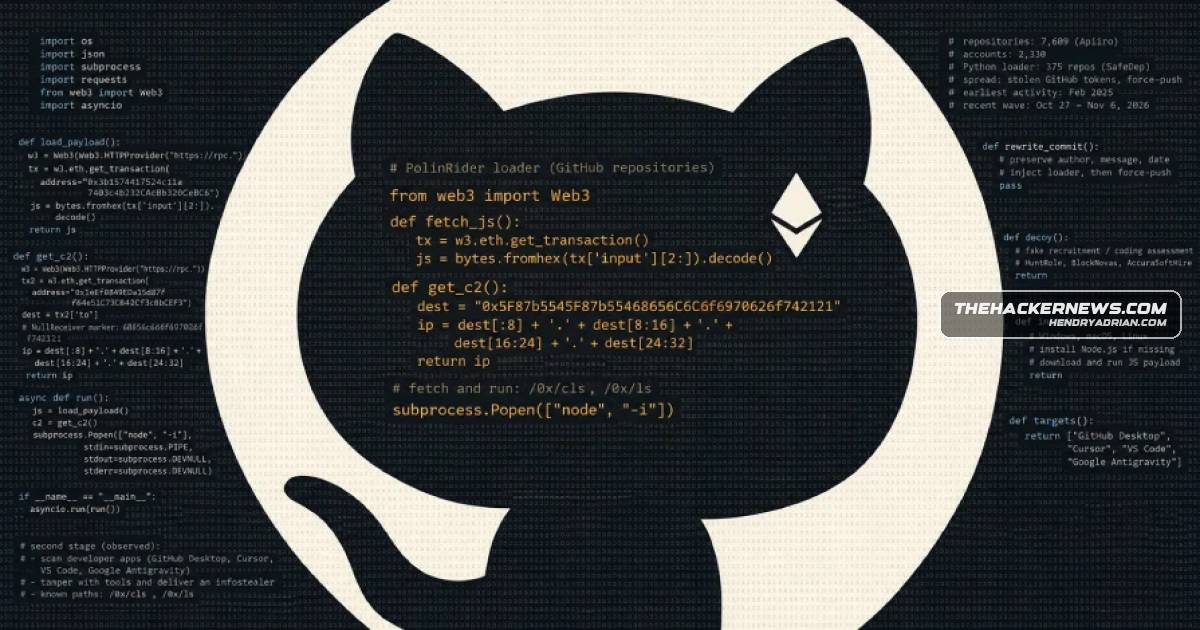
Summary
Researchers link PolinRider to North Korean actors and estimate it was detected in 7,609 GitHub repositories across 2,330 accounts. The campaign uses Python loaders and Ethereum transactions to retrieve JavaScript payloads; the latest payloads’ exact nature remains und
Key points
- SafeDep found the Python loader in 375 public repositories across 260 accounts; it found no evidence of distribution through PyPI or npm.
- Apiiro estimates PolinRider was detected in 7,609 GitHub repositories across 2,330 accounts, with 2,040 repositories receiving the loader from October 27 to November 6, 2026.
- The loader reads an Ethereum transaction to obtain JavaScript, which consults another wallet for the C2 server and starts a detached Node.js environment.
- The worm reportedly uses stolen GitHub access to rewrite existing commits while preserving their author, message, and date, then hides a loader in a build configuration.
- The campaign scans for developer applications and tampers with frequently used tools to run attacker-controlled code. The exact latest payloads are unknown; earlier waves reportedly harvested environment secrets, browser passwords, cookies, and wallet data.
- Researchers identified a May 2025 attack targeting nine packages; the packages reportedly used EtherHiding and JADESNOW to deliver InvisibleFerret, a Socket.IO RAT, and a Python stealer.
Article Details
- Event Type
- Supply-chain malware campaign involving poisoned GitHub repositories and developer packages
- Impact
- Apiiro estimates PolinRider was detected in at least 7,609 GitHub repositories belonging to 2,330 accounts, mostly developers; it also reports that 2,040 repositories were poisoned between October 27 and November 6, 2026. SafeDep identified the loader in 375 public repositories belonging to 260 accounts. The campaign uses stolen GitHub access to alter commits and distribute malware. Reported prior payloads include a stealer that harvests environment secrets, browser passwords, cookies, and wallet data. The exact nature of the latest payloads remains unknown.
Indicators of compromise
| Type | Indicator | Context |
|---|---|---|
| IPV4 | 95[.]135[.]181[.]84 | C2 server address extracted by the loader through its Ethereum-wallet lookup process. |
MITRE ATT&CK
T1059.006 · PythonA Python loader executes when imported or when a project is built.T1059.007 · JavaScriptThe loader decodes and runs JavaScript, which retrieves and passes along payloads.T1078 · Valid AccountsThe article says stolen GitHub access was used to rewrite commits and push loaders.T1195.002 · Compromise Software Supply ChainThe campaign poisons repositories and packages to distribute malicious code through software supply chains.
People
Jenn GileSecurity researcher who, with Paul McCarty, reported a May 2025 PolinRider attack and described evidence dating attacker activity to February 2025.Paul McCartySecurity researcher who, with Jenn Gile, reported a May 2025 PolinRider attack and described evidence dating attacker activity to February 2025.Shmulik CohenApiiro researcher who described how the worm uses stolen GitHub access to rewrite developer commits and conceal a loader in build configuration.
Malware
InvisibleFerretto NullReceiver, to retrieve a JavaScript downloader called JADESNOW, which is then used to deliver InvisibleFerret, a Python-based backdoor used in Contagious Interview campaigns, along with a Socket.IO RAT and aJADESNOWfound to leverage EtherHiding, a precursor to NullReceiver, to retrieve a JavaScript downloader called JADESNOW, which is then used to deliver InvisibleFerret, a Python-based backdoor used in Contagious InterviewNullReceiverA defining aspect of NullReceiver is the marker "68656c6C6f6970626f742121" in the made-up destination wallet address that consistently translates to "helloipbot!!."
Products
Cursorpayload that scans the infected host for installed developer applications, such as GitHub Desktop, Cursor, VS Code, and Google Antigravity, and tampers with the most frequently used tools to executeGitHubThe threat actors behind the PolinRider campaign have been observed planting a Python loader in GitHub repositories, as evidence emerges that the activity may have started as far back as February 2025.GitHub DesktopNode.js payload that scans the infected host for installed developer applications, such as GitHub Desktop, Cursor, VS Code, and Google Antigravity, and tampers with the most frequently used tools to executeGoogle Antigravityinfected host for installed developer applications, such as GitHub Desktop, Cursor, VS Code, and Google Antigravity, and tampers with the most frequently used tools to execute attacker-controlled code and deliverNode.jswallet sent to itself. It decodes the input data of that transaction as JavaScript and runs it with Node.js."VS Codethat scans the infected host for installed developer applications, such as GitHub Desktop, Cursor, VS Code, and Google Antigravity, and tampers with the most frequently used tools to execute attacker-controlled