
Fake PrusaSlicer and Affinity Installers Hide a Backdoor in GitHub Desktop
Summary
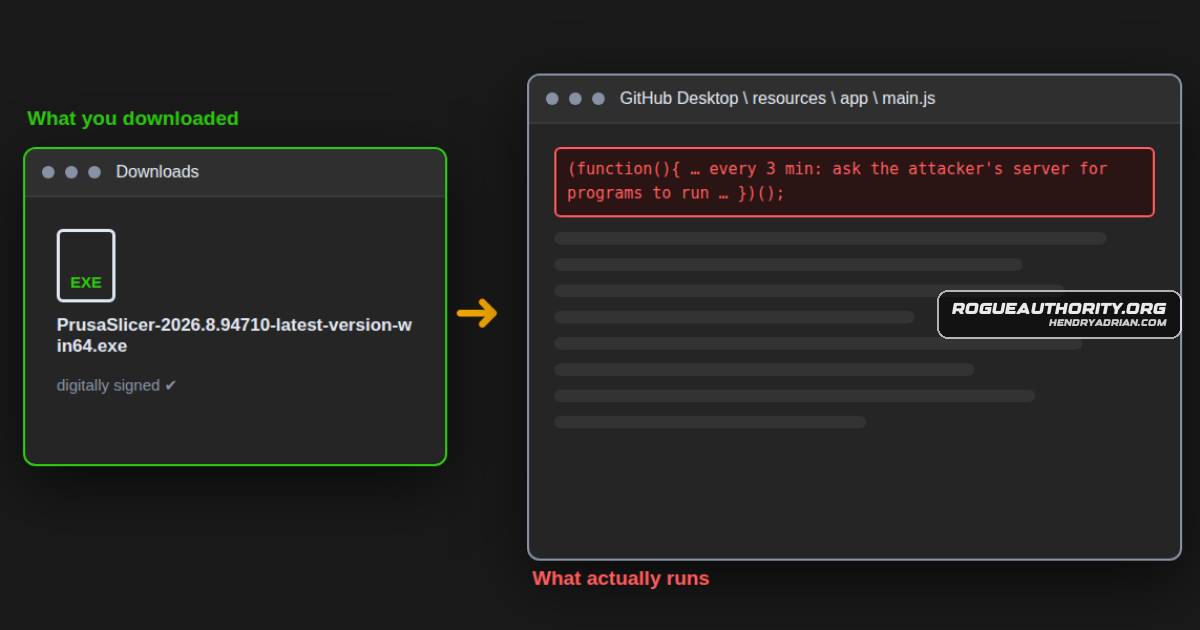
Fake PrusaSlicer and Affinity installers deploy modified GitHub Desktop, which fetches payloads leading to HijackLoader, SectopRAT and SnappyClient. Sandbox analysis traced credential and wallet theft, but did not confirm that stolen data uploads completed.
Key points
- Three fake installers silently place a genuine GitHub Desktop copy on the system; its main.js file is modified while the other application files largely match the real release.
- The modified script checks in every 180 seconds, sends device and campaign details, executes returned JavaScript or files, and sets persistence through a Run key. The GitHub Desktop window does not open.
- Sandbox runs showed two follow-on packages using DLL side-loading: doctored DLLs load HijackLoader alongside genuine signed Waves and ASUS programs.
- The payloads lead to SectopRAT and SnappyClient. SectopRAT can obtain a backup server address from a Binance Smart Chain smart contract.
- SnappyClient was observed collecting browser logins, cookies and form data, along with wallet-related data and other files; it began uploading an archive, but the capture did not establish that the upload finished.
- The fake EXE had a valid signature from a short-lived certificate, while the MSI signing certificates were revoked. Genuine signed applications were used to host malicious components.
- Suggested checks include comparing GitHub Desktop's main.js with the official release and hunting for unusual installation folders, persistence entries, scheduled tasks and the identified DLLs.
Article Details
- Attack Vectors
- Fake PrusaSlicer and Affinity installers silently place a genuine copy of GitHub Desktop in an unusual %LOCALAPPDATA% folder and launch it.
- A modified main.js in GitHub Desktop checks in with a server every three minutes, sends host and campaign details, and executes returned JavaScript or files.
- The modified application establishes logon persistence through the HKCU Run key.
- Downloaded packages use DLL side-loading: genuine signed programs load attacker-provided HijackLoader DLLs, which decrypt and launch later stages.
- The packages establish persistence with scheduled tasks and install SectopRAT and SnappyClient.
- SectopRAT obtains a backup server address by querying a smart contract on Binance Smart Chain.
- SnappyClient collects browser credentials, cookies, form data, wallet-related data, and text files that appear to contain wallet recovery phrases; it began uploading an archive, but completion was not confirmed.
- Defensive Notes
- Download PrusaSlicer and Affinity only from their official sources; be cautious of installers advertised as latest versions.
- If an installer was run, check for unexpected GitHub Desktop installations and the PririxCompute or KrilosControl folders under C:\ProgramData\.
- Hunt for GitHubDesktop.exe running from unusual %LOCALAPPDATA% folders and compare resources\app\main.js with the official release.
- Look for %APPDATA%\daemon.log and scheduled tasks named LEDSwitch or RealtimeRobotPlatforms.
- Alert on MaxxAudioAPOShell64.dll or cpprest141_2_10.dll loaded from %TEMP% or C:\ProgramData\.
- The article advises assuming browser passwords, cookies, and crypto wallets may have been taken, changing passwords from a clean device, signing out of sessions, and moving crypto to a new wallet with a new recovery phrase.
Indicators of compromise
| Type | Indicator | Context |
|---|---|---|
| IPV4 | 144[.]124[.]227[.]186 | SectopRAT backup server address recovered from an encrypted smart-contract value. |
| IPV4 | 85[.]239[.]149[.]174 | SnappyClient server used for communications on ports 3333 and 3334. |
| IPV4 | 93[.]152[.]220[.]219 | SectopRAT main server; the article reports that it accepted connections but did not reply during sandbox runs. |
| MD5 | e9dfaf2c4bde7b1af1a424a2cf71db75 | Hash of the edited GitHub Desktop main.js containing the backdoor. |
| SHA256 | 0177c92a85751a6ac261a530bb3ab822796bc2dce7583d2bdc1d126b0e022465 | Hash of the encrypted event.lib data file in the package that delivers SnappyClient. |
| SHA256 | 25e0264394fd3fb6ab8a37216b32e394614757c0ba26f2ffd582372fa16296f3 | Hash of the fake Affinity MSI installer. |
| SHA256 | 29b848e8f0c4a045cc51ea61d84446f6b5a3ebc48997ef67974b067104d5f3a6 | Hash of the fake PrusaSlicer MSI installer. |
| SHA256 | 5b70342e512d83cf76c6241736533b55424009a2f0d643e525f6a57f609ac304 | Hash of the cpprest141_2_10.dll identified as HijackLoader in package B. |
| SHA256 | 6ea4f81209aa2c17b80eb0ee493c4dbb8e1176022a96c01f8270ac1684b12f0f | Hash of the SnappyClient 0.1.34 sample recovered from memory. |
| SHA256 | 83eb3df2b070968ce002635ac3feefee6703cd6569951fe55e9e9a2f09c020d7 | Hash of the encrypted stackpolicy.conf data file in the package that delivers SectopRAT. |
| SHA256 | bafbe12e86011ba3e7d523644da3086dc7faca1e166219f0ac84ba4e9057ea4d | Hash of the MaxxAudioAPOShell64.dll identified as HijackLoader in package A. |
| SHA256 | d5a2d062f0df351fbe4726e2fbb223029010e2c3d531941f855b42a5d74c99da | Hash of the SectopRAT sample recovered from memory. |
| SHA256 | dba93a0a010043b6ca620e7bd63f111359832083c14b987c6900eb6b7de1c3b3 | Hash of the fake PrusaSlicer EXE installer. |
| URL | hxxps[:]//randomrandomicanseeyou[.]com/kdf/ | Check-in URL used by the modified GitHub Desktop to send host details and receive JavaScript or files. |
MITRE ATT&CK
T1005 · Data from Local SystemSnappyClient collects browser data, installed-software information, and text files that appear to contain wallet recovery phrases.T1027 · Obfuscated Files or InformationThe package data files and the smart-contract server-address value are encrypted.T1041 · Exfiltration Over C2 ChannelSnappyClient began uploading the archive, although the article says the capture did not establish whether the upload finished.T1053.005 · Scheduled TaskThe HijackLoader stages set up scheduled tasks named LEDSwitch and RealtimeRobotPlatforms.T1059.007 · JavaScriptThe modified GitHub Desktop main.js runs JavaScript returned by the check-in server.T1071.001 · Web ProtocolsThe modified application checks in with an HTTPS URL, and the article identifies server communications by URL and port.T1105 · Ingress Tool TransferThe backdoor saves files returned by its server and starts them; sandboxed machines also received two packages.T1140 · Deobfuscate/Decode Files or InformationHijackLoader decrypts a next stage stored in package data files, and SectopRAT decrypts a server address recovered from a smart contract.T1539 · Steal Web Session CookieSnappyClient collects browser cookies.T1547.001 · Registry Run Keys / Startup FolderThe backdoor registers at logon under the HKCU Run key name electron.app.GitHub Desktop.T1552.001 · Credentials In FilesSnappyClient searches for .txt files that appear to contain 12-word wallet recovery phrases.T1555.003 · Credentials from Web BrowsersSnappyClient copies saved logins from Chrome, Edge, and Firefox.T1560.001 · Archive via UtilitySnappyClient packs collected browser data into a password-protected 7-Zip archive.T1574.002 · DLL Side-LoadingHijackLoader DLLs are placed beside genuine Waves and ASUS programs, which load the attacker-provided DLLs.
Malware
ArechClient2SectopRAT (also known as ArechClient2) is a .NET remote-access tool that also steals browser and wallet data.HijackLoaderEach pairs a genuine signed program with a doctored DLL (the well-known HijackLoader), and they end in two data stealers:SectopRATSectopRAT, a remote-access tool and browser and wallet stealer.SnappyClientSnappyClient 0.1.34, which was told to collect browser passwords and cookies, crypto-wallet browser extensions, desktop wallet and messenger apps, and text files containing seed phrases.
Products
AffinityThree signed installers posing as PrusaSlicer (3D-printing software) and Affinity (design software) don’t install either program.GitHub DesktopEach one silently copies a complete, genuine copy of GitHub Desktop onto the computer and starts it.PrusaSlicerThree signed installers posing as PrusaSlicer (3D-printing software) and Affinity (design software) don’t install either program.