
CVE-2026-123890: VMware vCenter Zero-Day Requires Patching and Follow-Up
Summary
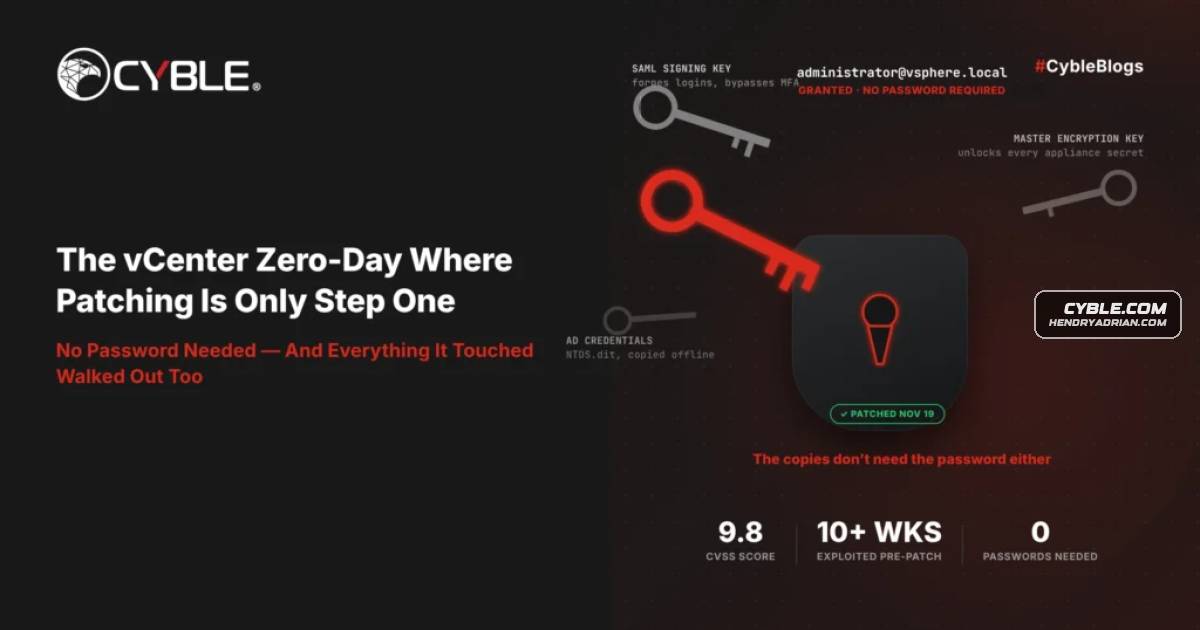
Mandiant and GTIG report suspected China-nexus group ARMORY CASTLE exploited CVE-2026-123890, a vCenter authentication bypass, from September. Broadcom patched it Nov. 19; the article covers affected versions, the reported attack chain, hunting and credential resets.
Key points
- CVE-2026-123890 is a critical authentication bypass in VMware vCenter’s directory service. The article says a network-reachable attacker could obtain an authenticated session through TCP port 2012 without a password.
- Mandiant and GTIG say suspected China-nexus group ARMORY CASTLE exploited the flaw as a zero-day from early September 2026; this is attributed reporting, not independent confirmation in the article.
- Mandiant’s investigation describes attackers pivoting from a compromised BeyondTrust support appliance, stealing vCenter secrets, forging SAML logins, reaching ESXi hosts, and extracting Active Directory data from a virtual machine disk.
- Broadcom released fixes Nov. 19 in VMSA-2026-0009. The article lists fixed builds for vCenter 9.1, 9.0 and 8.0, plus VMware Cloud Foundation 5.2.5; it says vCenter 7.0 has no public fix.
- The article recommends restricting vCenter management access, patching, investigating activity back to early September, and rotating credentials and signing keys if compromise is confirmed or cannot be ruled out.
- Suggested investigation leads include unexpected TCP 2012 connections, new SSO administrator accounts, changes to appliance SSH access, unexplained ESXi SSH keys, and named tools and backdoors from Mandiant’s analysis.
Article Details
- Vulnerability Types
- Authentication bypass via an alternate path in VMware Directory Service
- Severity
- Critical (CVSS 9.8)
- Affected Versions
- vCenter 9.1.x
- vCenter 9.0.x
- vCenter Server 8.0
- VMware Cloud Foundation 5.x
- vCenter Server 7.0
- vCenter 6.5
- vCenter 6.7
- Exploitation Status
- active
- Exploit Availability
- none_reported
- Patch Status
- partial
- Workarounds
- Restrict network access to TCP port 2012 until an upgrade or fix is available.
Indicators of compromise
| Type | Indicator | Context |
|---|---|---|
| IPV4 | 103[.]147[.]251[.]5 | One of 11 suspected obfuscation-network IPs referenced in GTIG's report. |
| IPV4 | 176[.]9[.]89[.]66 | One of 11 suspected obfuscation-network IPs referenced in GTIG's report. |
MITRE ATT&CK
T1003.003 · NTDSA Python tool extracted NTDS.dit and registry hives from a virtual machine disk to obtain Active Directory password hashes.T1021.004 · SSHThe attackers enabled SSH on the vCenter appliance and used SSH to access it and ESXi hosts.T1046 · Network Service DiscoveryFrom a compromised support appliance, the attackers scanned the internal network for VMware ports including 443, 2012, 5480, and 9080.T1071.001 · Web ProtocolsThe LAZYBONES backdoor received commands through Slack.T1078 · Valid AccountsThe attackers used the newly created SSO administrator account and logged in to ESXi hosts as vpxuser and root.T1098 · Account ManipulationThe attackers created a new vCenter SSO administrator account and could grant Global Administrator rights on the vCenter root folder.T1098.004 · SSH Authorized KeysThe attackers added their own SSH key to the ESXi root account's authorized_keys.T1210 · Exploitation of Remote ServicesThe group exploited the vCenter directory-service RPC interface over internal TCP port 2012.T1505.003 · Web ShellThe attackers dropped web shells named ActiveSer.jsp and u.jsp on internal Linux appliances.T1548.001 · Setuid and SetgidThe attackers set the SUID bit on /bin/env using gdb to become root on internal Linux appliances.T1552.001 · Credentials In FilesThe attackers read vCenter files containing its master encryption key and PostgreSQL password.T1606.002 · SAML TokensSAWSNAKE used the stolen vCenter SAML signing key to forge administrator SAML tokens.
CVE
CVE-2026-102764BeyondTrust · Remote SupportThe group, formerly tracked as UNC5221, first exploited a separate zero-day in BeyondTrust Remote Support, CVE-2026-102764.CVE-2026-123890VMware · Telco Cloud Infrastructure; VMware · Telco Cloud Platform; +1 moreCVE-2026-123890 is a critical authentication bypass in VMware vCenter’s directory service, rated 9.8 out of 10.CVE-2026-59309VMware · Cloud Foundation; VMware · Telco Cloud Infrastructure; +3 moreIt’s a different bug from CVE-2026-59309, the vCenter authentication bypass Broadcom fixed in July.
Threat Actors
Malware
BEARBONESTwo backdoors kept the door open: BEARBONES, a modified Dropbear SSH server that accepts a hardcoded password, and LAZYBONES, which takes commands through Slack.LAZYBONESTwo backdoors kept the door open: BEARBONES, a modified Dropbear SSH server that accepts a hardcoded password, and LAZYBONES, which takes commands through Slack.
Vendors
BeyondTrustThe group, formerly tracked as UNC5221, first exploited a separate zero-day in BeyondTrust Remote Support, CVE-2026-102764.BroadcomBroadcom patched it on Nov. 19, and CISA gave U.S.VMwareCVE-2026-123890 is a critical authentication bypass in VMware vCenter’s directory service, rated 9.8 out of 10.
Products
BeyondTrust Remote SupportThe group, formerly tracked as UNC5221, first exploited a separate zero-day in BeyondTrust Remote Support, CVE-2026-102764.ESXiIt logged in to ESXi hosts as vpxuser and root, added its own SSH key, and used a Python tool to extract the Active Directory database (NTDS.dit) and registry hives straight from a virtual machine’s disk.VMware Cloud FoundationVMware Cloud Foundation 5.x 5.x 5.2.5VMware vCenter ServerCVE-2026-123890 is a critical authentication bypass in VMware vCenter’s directory service, rated 9.8 out of 10.vSphereThe result is an authenticated session as [email protected], the most powerful account in a vSphere environment.
Tools
BonesawA custom Go tool Mandiant calls BONESAW exploited CVE-2026-123890 over port 2012, created a new SSO administrator account, copied the directory database and extracted the token-signing key.SAWSNAKEA second tool, SAWSNAKE, used the stolen key to sign SAML tokens as the administrator, a “Golden SAML” attack that bypasses passwords and MFA.VCSA Hardening & Logging ToolMandiant recommends its VCSA Hardening & Logging Tool, which applies default-deny iptables rules at the operating-system level, filters outbound traffic and forwards blocked connections and shell commands to a SIEM.