
Mandiant Details ARMORY CASTLE’s Exploitation of a vCenter Zero-Day
Summary
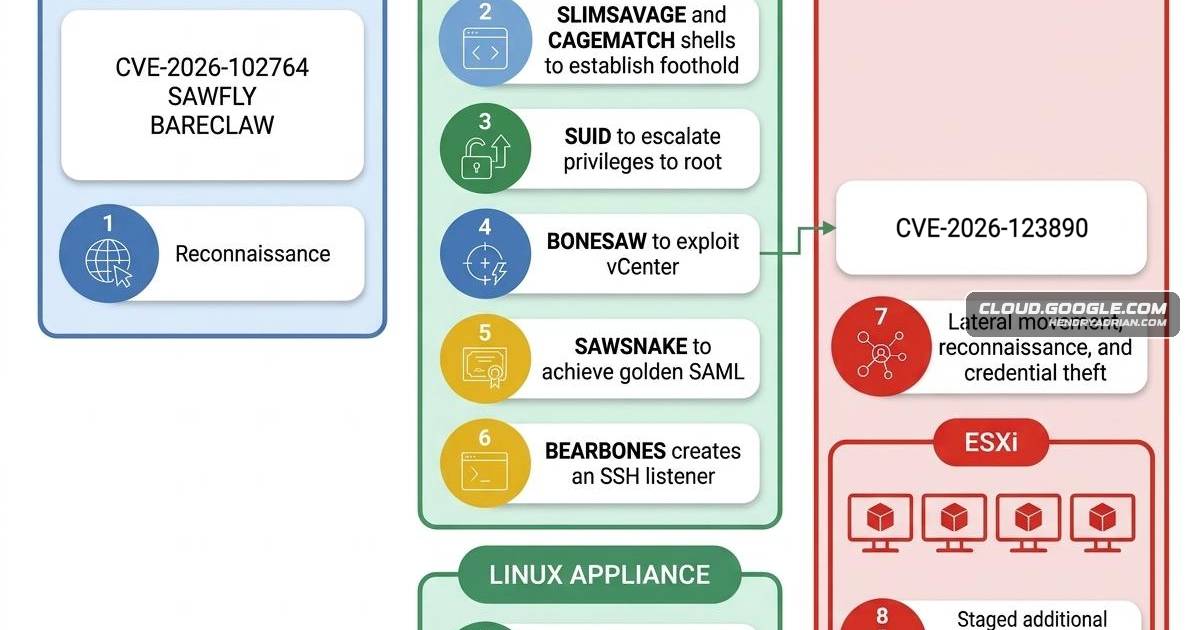
Mandiant reports suspected PRC-linked ARMORY CASTLE exploited VMware vCenter CVE-2026-123890 with BONESAW to create SSO administrator access and extract LMDB data, then used custom malware for persistence, credential theft and ESXi data theft.
Key points
- GTIG attributes the activity to suspected PRC-nexus actor ARMORY CASTLE, formerly tracked as UNC5221, based on tooling and TTPs aligned with previously observed activity.
- Mandiant says the actor exploited CVE-2026-123890, an unauthenticated vCenter SRP-6a session-key disclosure flaw over DCE/RPC, to establish an administrator session.
- The Go utility BONESAW exploited the flaw to access vCenter’s LMDB database, hijack SAML signing capabilities and create an SSO administrator account.
- Mandiant observed custom tools and malware including SLIMSAVAGE and CAGEMATCH webshells, the BEARBONES backdoor, and the SAWSNAKE SAML utility.
- BEARBONES could bypass password authentication and log plaintext credentials; LAZYBONES used Slack for command-and-control and supported command execution and file transfer.
- The actor accessed ESXi systems and extracted guest-VM files, including NTDS and Windows registry data. The article says the actor likely exfiltrated staged data.
- Mandiant recommends promptly applying Broadcom’s patch and describes hardening measures including restrictive firewall rules, egress filtering and remote logging.
Article Details
- Attack Vectors
- ARMORY CASTLE moved laterally from a Remote Support appliance to internal Linux appliances, then used nmap to discover VMware-related services and ports.
- The group exploited CVE-2026-123890 over vCenter's DCE/RPC interface on port 2012 to disclose an SRP session key, bypass authentication, and create an SSO administrator account.
- SLIMSAVAGE provided shell command execution on a Linux appliance; CAGEMATCH accepted uploaded files and staged them in /tmp.
- The group enabled SUID permissions on /bin/env using gdb to run commands as root.
- BEARBONES provided an SSH listener with password-authentication bypass and plaintext credential logging.
- ARMORY CASTLE forged SAML assertions and used SSH to access vCenter and ESXi, enumerate VMFS data, and extract files.
- The group used SCP and staged archives to move collected data; the article says it likely exfiltrated the data through the Remote Support appliance.
- LAZYBONES used Slack over HTTPS for command-and-control, command execution, and file transfer.
- Defensive Notes
- Promptly apply the official Broadcom patch for CVE-2026-123890 to affected systems.
- Mandiant recommends the VCSA Hardening & Logging Tool, strict default-deny iptables policies, granular inbound and egress filtering, and remote forwarding of kernel and command logs to a SIEM.
- Do not rely on the VAMI-managed host firewall alone; the article notes limitations in port-specific controls, egress filtering, and remote forensic visibility.
- Test iptables changes rigorously and use formal change control before production deployment.
Indicators of compromise
| Type | Indicator | Context |
|---|---|---|
| IPV4 | 103[.]147[.]251[.]5 | Listed as a suspected obfuscation network IP in the article's network indicators. |
| IPV4 | 103[.]190[.]38[.]3 | Listed in the article's Network Indicators IOC set; an individual role is not specified. |
| IPV4 | 118[.]174[.]128[.]34 | Listed in the article's Network Indicators IOC set; an individual role is not specified. |
| IPV4 | 118[.]174[.]128[.]36 | Listed in the article's Network Indicators IOC set; an individual role is not specified. |
| IPV4 | 118[.]174[.]128[.]38 | Listed in the article's Network Indicators IOC set; an individual role is not specified. |
| IPV4 | 176[.]9[.]89[.]66 | Listed in the article's Network Indicators IOC set; an individual role is not specified. |
| IPV4 | 185[.]71[.]15[.]109 | Listed in the article's Network Indicators IOC set; an individual role is not specified. |
| IPV4 | 220[.]121[.]128[.]41 | Listed in the article's Network Indicators IOC set; an individual role is not specified. |
| IPV4 | 222[.]108[.]77[.]44 | Listed in the article's Network Indicators IOC set; an individual role is not specified. |
| IPV4 | 61[.]216[.]56[.]127 | Listed in the article's Network Indicators IOC set; an individual role is not specified. |
| IPV4 | 81[.]45[.]89[.]43 | Listed in the article's Network Indicators IOC set; an individual role is not specified. |
MITRE ATT&CK
T1003.003 · NTDSThe group extracted the NTDS directory from a guest VM stored on an ESXi filesystem.T1021.004 · SSHARMORY CASTLE used SSH to access the vCenter and ESXi appliances and move between systems.T1046 · Network Service DiscoveryARMORY CASTLE used nmap to scan internal systems for open VMware-related ports.T1048.002 · Exfiltration Over Asymmetric Encrypted Non-C2 ProtocolThe group used SCP over SSH to transfer staged data from the ESXi filesystem; the article says onward exfiltration was likely.T1059.004 · Unix ShellSLIMSAVAGE ran commands through /bin/sh using ProcessBuilder.T1102.002 · Bidirectional CommunicationLAZYBONES polled a Slack channel for commands and supported command execution and file transfer over HTTPS.T1105 · Ingress Tool TransferCAGEMATCH accepted uploaded payloads into /tmp, and the group used curl to download a staged RAR utility and archive.T1136.001 · Local AccountBONESAW created an SSO administrator account, and the group also created a local vCenter administrator account.T1210 · Exploitation of Remote ServicesThe group exploited CVE-2026-123890 remotely against an internal vCenter server.T1505.003 · Web ShellThe group deployed the SLIMSAVAGE and CAGEMATCH webshells on a Linux appliance.T1543.002 · Systemd ServiceARMORY CASTLE established LAZYBONES persistence with a systemd service configured to restart every 50 minutes.T1548.001 · Setuid and SetgidARMORY CASTLE enabled SUID permissions on /bin/env to execute commands as root.T1552.001 · Credentials In FilesThe group retrieved the vCenter master crypto key and PostgreSQL password file; BEARBONES also logged plaintext passwords.T1560.001 · Archive via UtilityARMORY CASTLE archived extracted files into o.tar.gz before transferring them.T1606.002 · SAML TokensSAWSNAKE extracted signing material and forged SAML assertions for administrative vCenter access.
CVE
CVE-2026-102764BeyondTrust · Remote Supportin which the suspected PRC-nexus threat actor ARMORY CASTLE (formerly tracked as UNC5221) exploited CVE-2026-102764, a zero-day vulnerability in BeyondTrust Remote Support, which was patched in BT26-05.CVE-2026-123890VMware · Telco Cloud Infrastructure; VMware · Telco Cloud Platform; +1 more19, 2026, VMware disclosed CVE-2026-123890, which impacts VMware vCenter Server deployments.CVE-2026-59309VMware · Cloud Foundation; VMware · Telco Cloud Infrastructure; +3 moreWhile CVE-2026-123890 shares some overlap with CVE-2026-59309, primarily the obtaining of the shared session key "K" without knowing the password, there are multiple key differences between them.
Threat Actors
ARMORY CASTLEGTIG attributes the reported activity to this suspected PRC-nexus espionage actor, which exploited vCenter and deployed the described malware and utilities.UNC6201The article describes UNC6201 as a suspected PRC-nexus actor involved in separate BRICKSTORM intrusions where Mandiant observed the same VAMI SSH-enablement technique.
Malware
BEARBONESARMORY CASTLE deployed five newly identified malware families and utilities: the SLIMSAVAGE and CAGEMATCH webshells, the BEARBONES backdoor, the BONESAW remote exploitation utility, and the SAWSNAKE SAML utility.CAGEMATCHARMORY CASTLE deployed five newly identified malware families and utilities: the SLIMSAVAGE and CAGEMATCH webshells, the BEARBONES backdoor, the BONESAW remote exploitation utility, and the SAWSNAKE SAML utility.LAZYBONESARMORY CASTLE also deployed the LAZYBONES backdoor, which Mandiant and GTIG previously observed in a separate ARMORY CASTLE intrusion.SLIMSAVAGEARMORY CASTLE deployed five newly identified malware families and utilities: the SLIMSAVAGE and CAGEMATCH webshells, the BEARBONES backdoor, the BONESAW remote exploitation utility, and the SAWSNAKE SAML utility.
Vendors
BeyondTrustARMORY CASTLE (formerly tracked as UNC5221) exploited CVE-2026-102764, a zero-day vulnerability in BeyondTrust Remote Support, which was patched in BT26-05.BroadcomWe strongly recommend that affected organizations immediately apply the security patches provided by Broadcom to remediate the vulnerability.VMwareIn this blog we describe additional post-compromise activity involving the exploitation of a vulnerability in VMware vCenter and the deployment of additional malware families.
Products
BeyondTrust Remote SupportCASTLE (formerly tracked as UNC5221) exploited CVE-2026-102764, a zero-day vulnerability in BeyondTrust Remote Support, which was patched in BT26-05.ESXivSphere consists of both ESXi (the hypervisor) and vCenter Server.SlackARMORY CASTLE deployed a Slack-based backdoor tracked as LAZYBONES (/usr/bin/vmtoolscs) to an additional Linux appliance alongside the /tmp/123.key SSH private key.VMware vCenter Server19, 2026, VMware disclosed CVE-2026-123890, which impacts VMware vCenter Server deployments.
Tools
BonesawARMORY CASTLE exploited this vulnerability in early September 2026 using BONESAW, according to forensic evidence.NmapThe group leveraged nmap to scan the internal environment for systems running open ports specific to VMware, namely ports 9080, 5480, and 2012.SAWSNAKEARMORY CASTLE deployed five newly identified malware families and utilities: the SLIMSAVAGE and CAGEMATCH webshells, the BEARBONES backdoor, the BONESAW remote exploitation utility, and the SAWSNAKE SAML utility.vCenter SAML Login ToolThe core functionality of SAWSNAKE is a custom Go-based port of the Python-based vCenter SAML Login Tool from vcenter_saml_login.py.VCSA Hardening & Logging ToolTo secure the vCenter control plane against advanced campaigns and future zero-days, Mandiant recommends utilizing the VCSA Hardening & Logging Tool.vmfs_browser.pypython vmfs_browser.py -d "/dev/disks/vml.<REDACTED>:1" ls .