
Researcher Demonstrates Database Server Code Execution via Low-Privilege Accounts
Summary
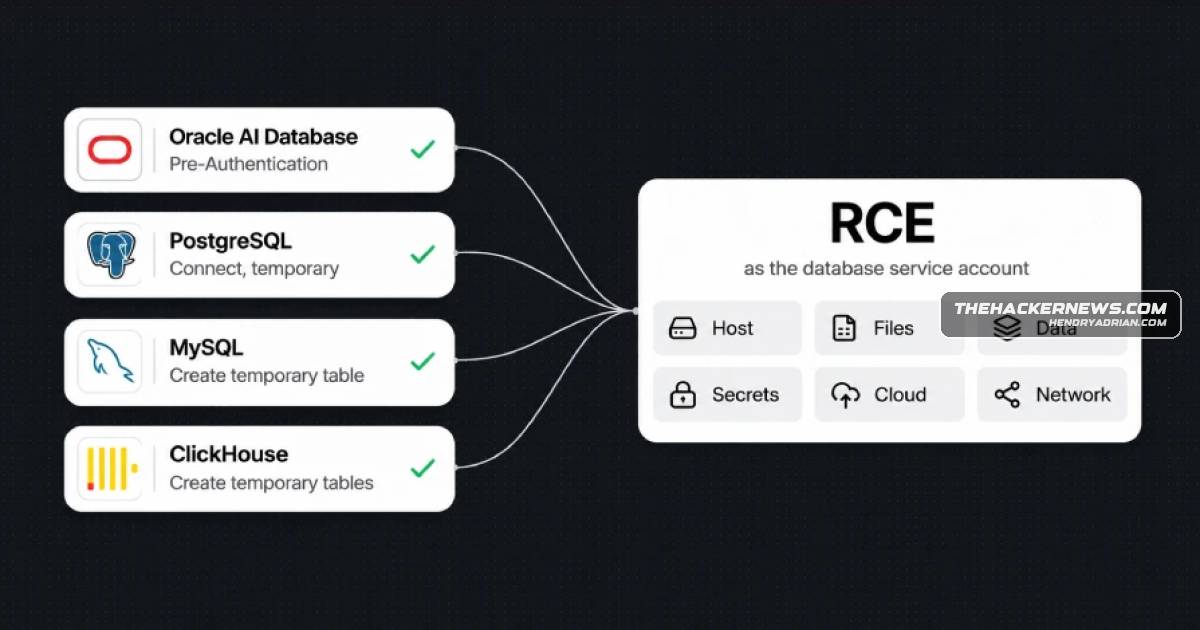
Zheng Yu demonstrated database server code-execution proofs of concept involving PostgreSQL, MySQL, ClickHouse and an unauthenticated Oracle chain. The research reports no real-world exploitation; some fixes are available, while ClickHouse's fix status is unclear.
Key points
- Researcher Zheng Yu demonstrated proofs of concept against PostgreSQL, MySQL and ClickHouse, plus a separate Oracle chain; none is known to have been used in a real attack.
- The research argues that limited SQL table permissions do not prevent accounts from reaching memory-unsafe database engine code.
- PostgreSQL CVE-2026-116331 lets an account able to create database objects run code as the database's operating-system user; it was fixed last week.
- MySQL CVE-2026-101786 affects Server and Cluster versions 26.7.0 to 26.7.1. The researcher demonstrated code execution with an account limited to creating temporary tables.
- The researcher says an exposed Oracle endpoint can chain Oracle Text CVE-2026-114819 and Oracle REST Data Services GraphQL flaw CVE-2026-91609 to run commands before login; Oracle patched them in its November and October updates, respectively.
- The ClickHouse demonstration used an integer-overflow write triggered by setting format_binary_max_string_size to zero. The article says there is no CVE or confirmed fixed version.
- Recommended steps include installing available updates and reviewing or restricting unnecessary TEMPORARY and temporary-table privileges; those measures do not address the unauthenticated Oracle path.
Article Details
- Attack Vectors
- A database account with permission to create temporary tables or objects can reach memory-corruption bugs through ordinary SQL and achieve code execution on the database server.
- A PostgreSQL login role with permission to create database objects can use objects in its temporary schema to trigger a type-confusion bug and run code as the database operating-system user.
- A MySQL account limited to creating temporary tables can trigger a query-optimizer flaw and achieve code execution.
- An unauthenticated Oracle attack chain combines a bug in Oracle Text with a GraphQL flaw in Oracle REST Data Services, reached through an exposed web endpoint.
- A ClickHouse user can trigger an integer-overflow write while the server reads a binary row format by setting format_binary_max_string_size to zero.
- Defensive Notes
- Install the available vendor updates for the PostgreSQL, MySQL, Oracle Text, and Oracle REST Data Services flaws.
- Review database-account capabilities, not only table-read permissions; remove TEMPORARY privileges and broad temporary-table rights from accounts that do not need them.
- For ClickHouse, contact the vendor to check for a fix because the article reports no confirmed fixed version.
MITRE ATT&CK
T1190 · Exploit Public-Facing ApplicationThe Oracle chain uses a GraphQL flaw in Oracle REST Data Services reached through an exposed web endpoint to run commands without login.T1210 · Exploitation of Remote ServicesThe research demonstrates code execution through flaws reached via SQL in PostgreSQL and MySQL database engines, and through a crafted binary row format in ClickHouse.
CVE
CVE-2026-101786Oracle Corporation · MySQL Cluster; Oracle Corporation · MySQL ServerMySQL has a similar flaw in its query optimizer, CVE-2026-101786, in Server and Cluster versions 26.7.0 to 26.7.1. Oracle's MySQL October advisory rates it as needing high privileges.CVE-2026-114819Oracle Corporation · Oracle Database ServerOracle patched the Oracle Text bug, CVE-2026-114819, rated 9.9, earlier this week in its November update, and the GraphQL flaw, CVE-2026-91609, in the October update. On their own, the company rates neither asCVE-2026-116331Vendor / Product unavailableIn PostgreSQL, the flaw CVE-2026-116331 allows an account that can create database objects to run code as the operating system user that runs the database.CVE-2026-91609Oracle Corporation · Oracle REST Data ServicesText bug, CVE-2026-114819, rated 9.9, earlier this week in its November update, and the GraphQL flaw, CVE-2026-91609, in the October update. On their own, the company rates neither as exploitable without a login.
People
Vendors
Products
ClickHouseThe exploits, published yesterday, are the researcher's proofs of concept against PostgreSQL, MySQL and ClickHouse, plus a separate Oracle chain that needs no login. None has been seen in a real attack.MySQLThe exploits, published yesterday, are the researcher's proofs of concept against PostgreSQL, MySQL and ClickHouse, plus a separate Oracle chain that needs no login. None has been seen in a real attack.Oracle DatabaseOracle Database is the one case where an attacker needs no account at all, the researcher says. A bug in Oracle Text and a flaw in the GraphQL interface of Oracle REST Data Services, chained against an exposed webOracle REST Data Servicesat all, the researcher says. A bug in Oracle Text and a flaw in the GraphQL interface of Oracle REST Data Services, chained against an exposed web endpoint, reach the engine code and run commands before anyOracle TextDatabase is the one case where an attacker needs no account at all, the researcher says. A bug in Oracle Text and a flaw in the GraphQL interface of Oracle REST Data Services, chained against an exposed webPostgreSQLThe exploits, published yesterday, are the researcher's proofs of concept against PostgreSQL, MySQL and ClickHouse, plus a separate Oracle chain that needs no login. None has been seen in a real attack.