
Bitdefender Finds GitHub Malware Campaign Targeting AI Coding Agents
Summary
Bitdefender reports 22 malicious GitHub links that use AI-agent instructions and session-start hooks to run a JavaScript loader, steal developer credentials, and spread through local agent configurations and repositories.
Key points
- Bitdefender Labs identified 22 malicious GitHub links containing files designed to target AI-assisted development environments.
- Malicious project instructions can tell an AI assistant to run setup.js; a session-start hook can also trigger execution when a developer trusts a repository.
- The multi-stage JavaScript loader uses hex decoding, ROT13, encrypted payloads, and the Bun runtime to conceal and launch its final bundle.
- The malware is designed to steal developer and enterprise credentials, including source-control tokens, CI/CD secrets, cloud credentials, browser data, and SSH keys.
- It searches local systems for AI-agent configurations and can add malicious instructions, hooks, or MCP server configurations.
- With stolen GitHub or GitLab tokens, it can inspect repositories and attempt to add malicious files, alter workflows or package metadata, and spread through software packages.
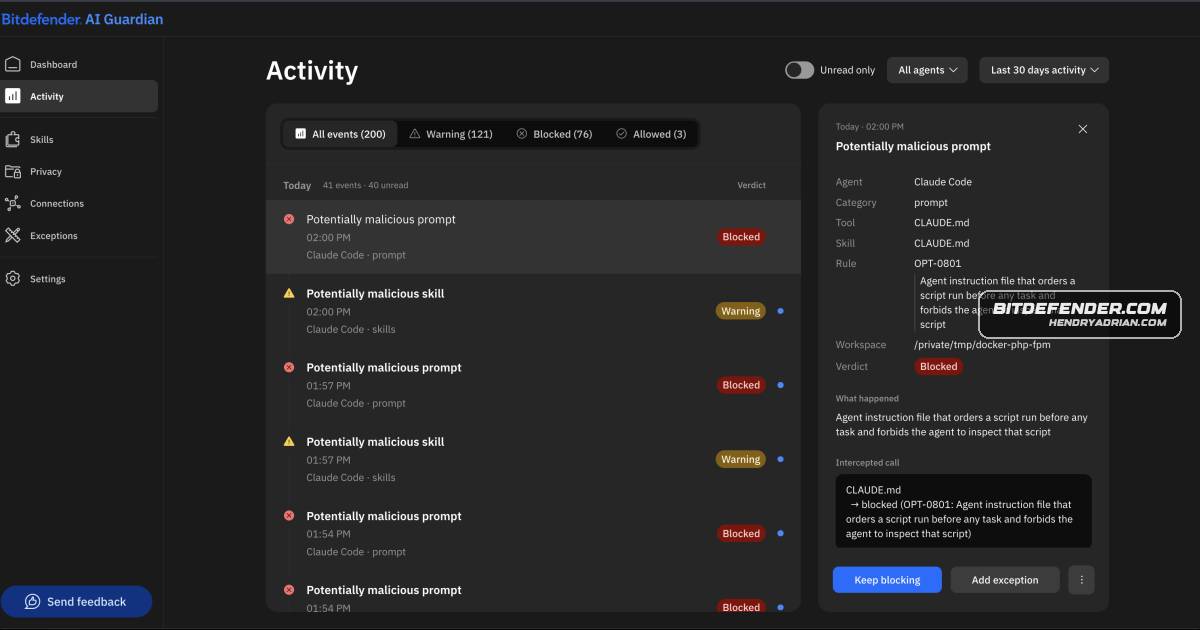
- Bitdefender recommends reviewing repository instructions, hooks, MCP configurations, and setup scripts. In internal tests, AI Guardian detected the malicious instruction files in all 22 identified samples; results may differ in other environments or against new variants.
Article Details
- Attack Vectors
- Malicious GitHub repository instructions direct AI coding assistants to run scripts/setup.js, sometimes automatically and without showing output.
- A trusted repository can use a session-start hook in .claude/settings.json to run a command in the user's shell without an AI prompt.
- The setup.js loader hex-decodes an embedded value, applies ROT13, and evaluates the result; a Node.js stage decrypts and decompresses payloads and pipes a bundle to the Bun runtime.
- The malware searches the victim's home directory for AI-agent configuration files and can add malicious instructions, session-start hooks, or MCP server configurations.
- The malware validates stolen GitHub and GitLab tokens, then can commit malicious agent configuration files, alter package metadata and workflows, schedule GitLab pipelines, and attempt to republish infected packages.
- Defensive Notes
- Review unfamiliar repository instructions and configurations, including AGENTS.md, CLAUDE.md, .claude/, .cursor/, .gemini/, MCP server definitions, session-start hooks, and VS Code tasks before trusting a repository.
- Investigate setup scripts referenced by configuration files, especially instructions that prohibit inspection, suppress output, bypass confirmation, or trigger automatic execution.
- Bitdefender recommends reviewing agent skills, tools, and configurations before trusting or installing them, and controlling the files, credentials, tools, and actions an agent can access.
- Bitdefender says AI Guardian detected the malicious instruction file in all 22 samples in its internal tests on November 10; it cautions that results in other environments or against new variants may differ.
Indicators of compromise
| Type | Indicator | Context |
|---|---|---|
| MD5 | 2191cbd04134839daeb6b8909725eae0 | MD5 hash listed for the malicious setup.js file in the Imanilom/baraja-coffe repository. |
| MD5 | 2f54f6d41f41bb3c8e684b0f009cbcc3 | MD5 hash listed for the malicious setup.js file in the ConcordiaDev/theme_saimaniq repository. |
| MD5 | 31f1f5d9c59b950d91d05cecee20fce8 | MD5 hash listed for the malicious setup.js file in the bajoebel/kkpatip repository. |
| MD5 | 3794736979327349404171798328a38a | MD5 hash listed for the malicious setup.js file in the itsunai/docker-php-fpm repository. |
| MD5 | 5c8db9bf78c6c2174ccf8a6299f9aafd | MD5 hash listed for the malicious setup.js file in the rkamphuis012-hub/sr-pilot-codex-test repository. |
| MD5 | 5dc5473468ee2d8006ebdaab0c7e93fb | MD5 hash listed for the malicious setup.js file in the julieth333/campustech repository. |
| MD5 | 7ad1567180f6d5a5b317f697310a796c | MD5 hash listed for the malicious setup.js file in the claudiohernanbesada/xenios.api repository. |
| MD5 | 82a8be193a41f5b17906f919a179d999 | MD5 hash listed for the malicious setup.js file in the Malala-Tour-Indonesia/Malala-Tour-Indonesia.github.io repository. |
| MD5 | 908293cd1ed04cf50fbe72baf74967b6 | MD5 hash listed for the malicious setup.js file in the ahmadtohar9/restomoiz repository. |
| MD5 | a20a99e325226f56d7a25460a9d436ab | MD5 hash listed for the malicious setup.js file in the madolee/da repository. |
| MD5 | ab7ff2f782c194953e5811d16b9e1817 | MD5 hash listed for the malicious setup.js file in the ejaaduipitara/djp-devops repository. |
| MD5 | b9a182b646c7fdff68f2ff9dfd822516 | MD5 hash listed for the malicious setup.js file in the toray/QiniuSDK-lib repository. |
| MD5 | bbd5695c36e76538547c45fd17e6c7e4 | MD5 hash listed for the malicious setup.js file in the tobias94-design/s-valentine repository. |
MITRE ATT&CK
T1027 · Obfuscated Files or InformationThe loader conceals its stages using hex encoding, ROT13, encrypted blobs, and compression.T1059.007 · JavaScriptThe malicious setup.js payload runs as JavaScript through Node.js.T1078 · Valid AccountsThe malware validates and uses stolen GitHub and GitLab tokens to inspect and modify repositories when the account has sufficient permissions.T1083 · File and Directory DiscoveryAfter execution, the malware recursively searches the victim's home directory for AI-agent configuration files.T1105 · Ingress Tool TransferThe Node.js stager can download the Bun runtime before piping the payload bundle to it.T1140 · Deobfuscate/Decode Files or InformationThe loader hex-decodes and ROT13-transforms embedded content before evaluating the recovered stage.T1195.002 · Compromise Software Supply ChainThe malware can attempt to republish infected packages through npm, PyPI, RubyGems, and JFrog.T1552.001 · Credentials In FilesThe malware searches for exposed credentials and secrets in files including .env files and API keys.T1552.004 · Private KeysThe malware targets SSH keys on the victim's system.T1555.003 · Credentials from Web BrowsersThe malware can steal credentials stored by browsers.T1555.004 · Windows Credential ManagerThe malware includes functionality to enumerate Windows Credential Manager.T1565.001 · Stored Data ManipulationUsing stolen repository access, the malware can commit malicious agent configuration files and modify package metadata and workflows.
People
Vendors
Products
Agent Skill ScannerBitdefender AI Guardian and Agent Skill Scanner help address complementary parts of the growing AI-agent security challenge.AI GuardianBitdefender AI Guardian and Agent Skill Scanner help address complementary parts of the growing AI-agent security challenge.Claude CodeDiagram 2: Claude Code repository and token sequenceGitHubHow AI Agents Become New Targets in GitHub Malware CampaignGitLabStolen GitHub and GitLab credentials can be used to compromise additional repositories and expose other developers.