
Hackers Claim Rosstat Breach; Leaked Death Records Offer a Partial View of Russia’s War Toll
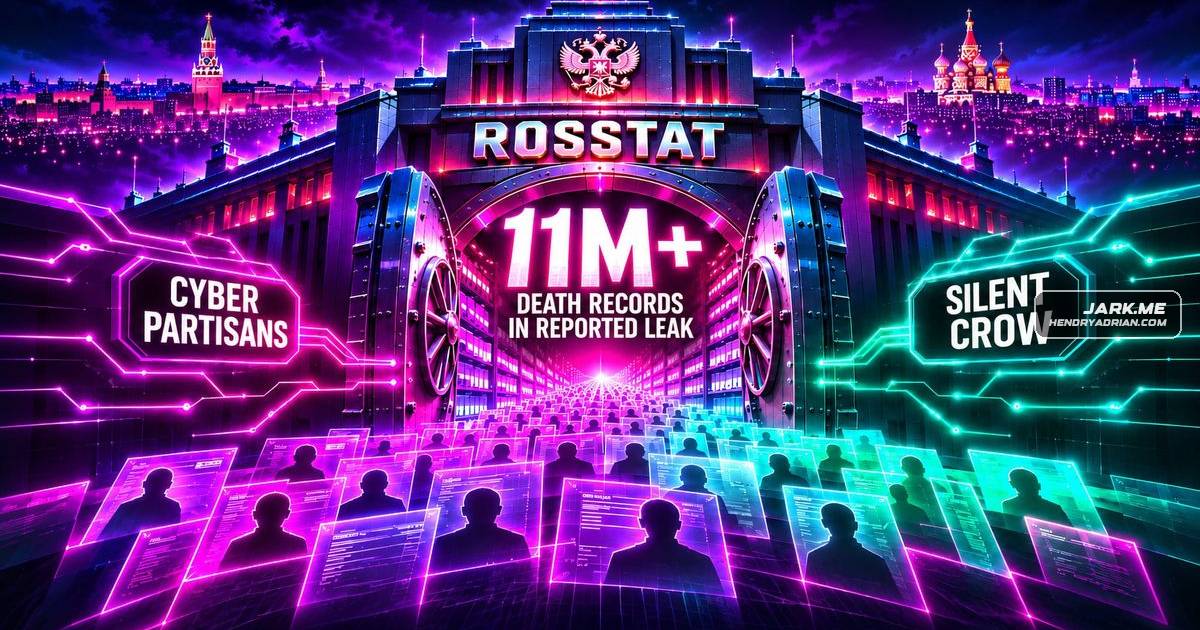
Summary
Rosstat acknowledged cyberattacks and service disruption but denies database compromise. Cyber Partisans and Silent Crow claim extensive access and data theft; reporters examined a death-record leak, whose authenticity and casualty totals remain uncertain.
Key points
- Rosstat acknowledged targeted cyberattacks from October 29 to November 1 and restored its website, while denying database compromise or protected information leaving its network.
- Cyber Partisans and Silent Crow claim a months-long intrusion, data theft, and destructive activity. Their estimates of stolen data differ, and the claimed scale is not forensically verified.
- Reporting described internal systems isolated for checks, missing statistical files, and delayed data releases—evidence the disruption extended beyond the defaced public portals.
- Bloomberg examined a dataset of more than 11 million death certificates and identified about 392,700 war-linked records; The Guardian reported 412,576, with the difference unreconciled.
- The article assesses the collection as probably substantially authentic but says no single published total is a reliable count of Russian military deaths; definitions, registration delays, and missing personnel complicate comparisons.
- The initial access method, duration of unauthorized access, exfiltration volume, and extent of destruction remain unresolved; no Rosstat intrusion indicators have been published.
Article Details
- Victim Organization
- Rosstat
- Victim Domain
- Not disclosed
- Incident Type
- Targeted cyberattacks and portal defacement; the claimed internal intrusion, data exfiltration, and destructive activity remain unverified.
- Incident Date
- 2026-10-29
- Disclosure Date
- 2026-11-01
- Data Types Exposed
- Death-certificate records, including cause-of-death codes and descriptions; Bloomberg reviewed a dataset of more than 11 million records reportedly obtained in the leak.
- Identity and demographic fields described in the article include age, residence, date of death, cause of death, and location; the article notes that copies supplied to recipients may differ.
- Production and import statistics involving industrial goods, including bearings and electronic components; access was claimed by a Cyber Partisans contact.
- Nonpublic statistics from occupied Ukrainian territories; access was claimed by the hacking groups.
- Affected Records
- A dataset of more than 11 million death certificates was reviewed by Bloomberg. The extent of the data allegedly exfiltrated from Rosstat has not been verified.
- Affected Data Size
- Cyber Partisans claimed more than 10 TB exfiltrated, while Silent Crow claimed about 23 TB. Dmitry Shchigelsky said the combined figure may include duplicated data; the volume is unverified.
- Operational Impact
- Rosstat acknowledged targeted attacks between October 29 and November 1, and its portals were defaced before the main site was restored by the morning after the attack. Rosstat later said some IT infrastructure remained isolated for security checks. Reports described missing statistical files, postponed price releases, and an extended deadline for company statistical submissions. The hacking groups' claims that they compromised about 25,000 machines, obtained broad internal access, and destroyed infrastructure have not been forensically verified.
- Ransom Or Extortion
- Unknown
- Claim Status
- claimed
Indicators of compromise
| Type | Indicator | Context |
|---|---|---|
| DOMAIN | rosstat-leaks[.]com | Reported data-publication domain hosting materials published by the hacking groups about the Rosstat incident; not identified as intrusion C2 infrastructure. |
MITRE ATT&CK
T1213.006 · DatabasesProvisional mapping in the article's annex for the claimed bulk extraction of death-certificate records from internal databases.T1485 · Data DestructionThe groups claimed they wiped servers, storage, and virtualization platforms; the destruction has not been independently verified.T1491.002 · External DefacementConfirmed defacement of Rosstat's federal and regional portals with hacker logos and a Belarusian-language message.
People
Dmitry ShchigelskyIdentified as a contact person for the Cyber Partisans. He discussed the groups' claimed exfiltration volume and destruction of Rosstat information, and said the combined data-volume estimate may include duplicates.Larry JohnsonA former CIA analyst cited as questioning the leak's authenticity and arguing it may be an influence operation; these are his assessments, not established findings.
Threat Actors
Cyber PartisansBelarusian opposition hacking group that claimed a joint operation against Rosstat with Silent Crow, including exfiltration and destructive activity. Those claims have not been forensically verified.Silent CrowPro-Ukrainian hacking group that claimed a joint operation against Rosstat with Cyber Partisans, including access to about 25,000 machines and roughly 23 TB of exfiltration. The scale and access claims remain unverified.
Malware
Vendors
Products
oVirtdomain controllers in the central office and regional divisions. It also claims access to VMware ESXi, oVirt, and zVirt virtualization environments. Cyber Partisans claimed more than 10 TB exfiltrated while SilentVMware ESXicompromised domain controllers in the central office and regional divisions. It also claims access to VMware ESXi, oVirt, and zVirt virtualization environments. Cyber Partisans claimed more than 10 TB exfiltratedVMware Toolsdestructive activity. Solar documented a Vasilek backdoor controlled through Telegram, compromised VMware Tools components, DNS tunneling, and GOST proxy tunnels.zVirtin the central office and regional divisions. It also claims access to VMware ESXi, oVirt, and zVirt virtualization environments. Cyber Partisans claimed more than 10 TB exfiltrated while Silent Crow claimed
Countries
BelarusThe Cyber Partisans emerged in September 2020 following Belarus's disputed presidential election and work alongside BYPOL, an organization formed by former Belarusian security personnel. Their operations expanded fromRussiaRosstat, Russia's federal statistics service, says its databases were never compromised and no protected information left its network. Two hacker groups say they spent six months inside, stole about 23 TB, and destroyedUkrainewithout stated causes. Its figure also includes civilians killed in Russian territory and occupied Ukraine, according to The Moscow Times. The totals measure overlapping but different populations. None should be