
Huntress Finds Crypto-Themed Fake ScreenConnect Sessions Across 118 Servers
Summary
Huntress identified thousands of unauthorized crypto-themed ScreenConnect guest sessions across 118 servers at 109 organizations. It found no malicious activity, but says the sessions could bait technicians into exploitation of CVE-2026-84869.
Key points
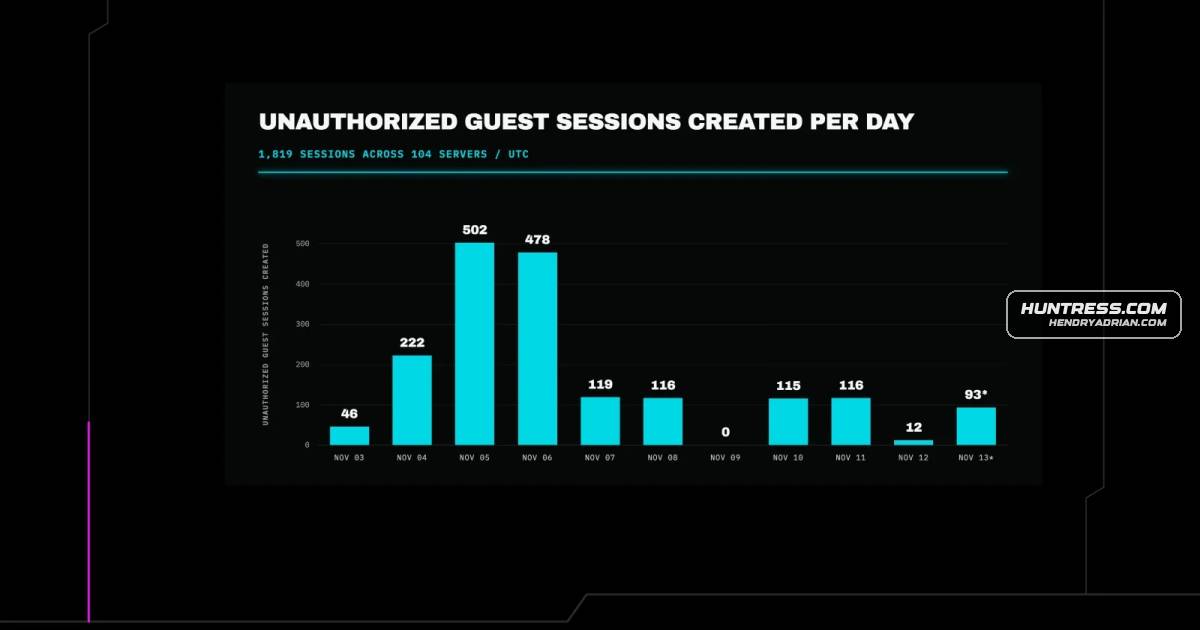
- Huntress reported thousands of unauthorized guest sessions across 118 self-hosted ScreenConnect servers at 109 organizations, with activity observed from November 3 to 13, 2026.
- The sessions used crypto-exchange-themed machine names and were attributed to a scripted emulator impersonating a Windows ScreenConnect client; nearly all observed connections came from 74.208.158[.]106.
- Huntress found no evidence that the guest sessions pushed files, ran commands, or otherwise performed malicious activity. In one case, a technician typed into a session, creating a possible credential-exposure concern.
- On 29 servers with complete histories, the operator revisited about every 151 seconds; individual connections typically lasted about 64 minutes and reconnected about every 55 minutes.
- Huntress’s leading hypothesis is that the sessions could bait technicians into connecting, potentially enabling exploitation of CVE-2026-84869. It has not observed the sessions being used to exploit the flaw.
- Huntress recommends updating ScreenConnect clients to 26.6.5 or later, checking for and removing fake sessions, and reviewing session history for technician access and guest-side activity.
Article Details
- Attack Vectors
- A scripted emulator impersonated Windows ScreenConnect guest clients and registered unauthorized sessions on self-hosted ScreenConnect servers. Most connections came from 74.208.158[.]106; another early source was 197.47.160[.]252.
- Huntress hypothesized that crypto-themed sessions could serve as bait for technicians, potentially enabling exploitation of CVE-2026-84869. The article reports no evidence that the sessions were used to push or run files.
- Defensive Notes
- Upgrade ScreenConnect host clients and affected Access agents to version 26.6.5 or later. If upgrades must wait, review ConnectWise's advisory about removing TransferFiles permission from roles and session groups.
- Check for unfamiliar crypto-themed sessions, empty company or site fields, guest version 25.3.4.9288, and crypto-site previews. Avoid joining sessions that cannot be tied to a customer.
- Before deleting fake sessions, preserve App_Data\Session.db and its WAL file. Review session history to determine whether a technician joined and whether files, commands, or text moved, distinguishing technician-side from guest-side activity.
- If an unpatched client joined a suspicious session, inspect its ScreenConnect Temp and Startup folders and process history.
- Where supported, restrict installer and web access, keep Access installer links private, rebuild leaked installers, and place unfamiliar sessions in a group technicians do not routinely browse.
Indicators of compromise
| Type | Indicator | Context |
|---|---|---|
| IPV4 | 197[.]47[.]160[.]252 | Created the first three unauthorized sessions on November 3, 2026; the article identifies it as an Egyptian residential IP. |
| IPV4 | 74[.]208[.]158[.]106 | Source of 97.8% of the crypto-named guest connections; the article identifies it as an IONOS-hosted IP. |
| IPV4 | 87[.]106[.]111[.]220 | Related IONOS host sharing JARM and TLS certificates with 74.208.158[.]106; no guest sessions were observed from it. |
| SHA256 | 008839ef2a2d54e9efa47013bb23c773d3a152f351e9dfd3b2f4dd27086121df | Hash of the most-used Binance-style bait-image WebP preview thumbnail associated with the unauthorized sessions. |
| SHA256 | 45136a9ab47015c4334b881df9daf824a72347daae0b5730ce3bd7d42b204bf2 | Hash of a WebP preview thumbnail from a bait-image family used in the unauthorized sessions. |
| SHA256 | b55ce5130cd2623017cca29318341f6b4656e3a1dc5ab82ce704e912d0d17535 | Hash of a WebP preview thumbnail from a bait-image family used in the unauthorized sessions. |
| SHA256 | bea82efc82672225cf29eb869972670754f15941bc61b9e5801ffd41c5c39e5f | Hash of a WebP preview thumbnail from a bait-image family used in the unauthorized sessions. |
| SHA256 | c15b008b0296b1bc9e0f979e6f25b780e3e89edabb344c7ee8c284a1a140f0d7 | Hash of a WebP preview thumbnail from a bait-image family used in the unauthorized sessions. |
| SHA256 | e73020645e7a11a90865d93bd7f3d797585f49ef72b1ac7354392a2da7fbd91f | Hash of a WebP preview thumbnail from a bait-image family used in the unauthorized sessions. |
| SHA256 | f6d37291c4948b974caf2e9e7e8ca9c2173d2779d1ec0a391488706bbd1a995c | Hash of a WebP preview thumbnail from a bait-image family used in the unauthorized sessions. |