
Huntress Details CVE-2026-84869 Exploitation of MSP ScreenConnect Technicians
Summary
Huntress reports CVE-2026-84869 exploitation against MSP technicians, including a rogue ScreenConnect client deployed in one observed case. It found 688,000 guest file-run requests across 42 servers and advises patching technician clients and hunting for exposure.
Key points
- Huntress observed a guest-pushed batch file execute on a technician's ScreenConnect host client without a prompt; the chain downloaded an MSI and launched a rogue ScreenConnect client.
- The observed compromise unfolded in about nine seconds and connected the rogue client to masterdarky[.]com.
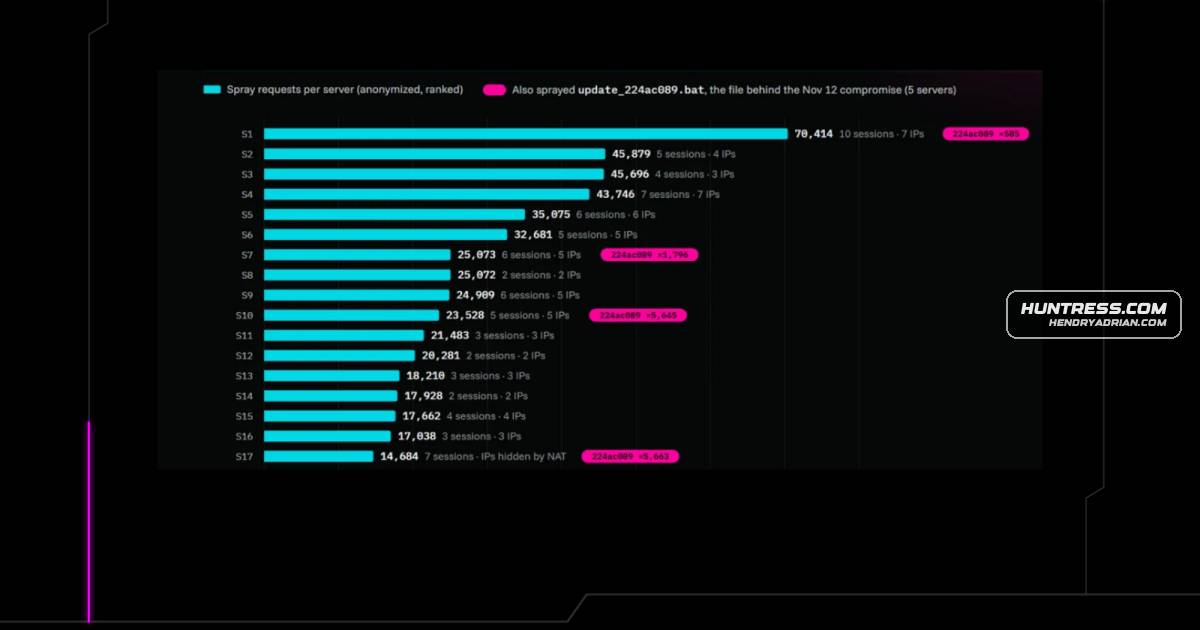
- From October 20 to November 16, Huntress counted 688,000 guest “run file” requests across 42 MSP ScreenConnect servers, from 29 IP addresses.
- Huntress linked the sprayed update_224ac089.bat file to the observed compromise and assessed with high confidence that the spray operator and masterdarky[.]com operator were the same.
- Other observed activity included a marker-file canary test and attempts to use path traversal to place Sync.bat in a technician's Startup folder.
- ConnectWise identified ScreenConnect host client and Access agent version 26.6.5 as fixed; Huntress recommends updating clients, removing the TransferFiles permission if patching is delayed, and hunting for suspicious guest file requests and workstation processes.
- If exposure is found, Huntress advises isolating the workstation, removing the rogue client, and rotating credentials accessible from that technician's machine.
Article Details
- Attack Vectors
- Attackers exploited CVE-2026-84869 by joining ScreenConnect sessions as guests and causing a technician's host client to run guest-pushed files without a prompt.
- Guests repeatedly sprayed MSP ScreenConnect servers with requests to run update.bat or update_<8 hex>.bat files, waiting for a technician to join.
- In observed activity, a batch file relaunched through PowerShell, reported the victim through a Telegram bot, downloaded an MSI, and launched a rogue ScreenConnect client connected to the attacker's relay.
- An attacker sent a path-traversal filename intended to place Sync.bat in a technician's Windows Startup folder.
- A guest pushed marker.txt as a canary to test whether the technician's client would run a guest-supplied file.
- Defensive Notes
- Update every technician's ScreenConnect host client and applicable Access agents to version 26.6.5 or later; updating the server alone does not fix the vulnerable technician-side code.
- If patching is delayed, remove the TransferFiles permission from roles and session groups.
- Review ScreenConnect session records for guest-originated RanFiles or SentFiles events, repeated update*.bat requests, marker.txt, Run-Lateral.bat, svc_payload.cmd, and paths containing ../; check whether a technician Host connection overlapped.
- On technician workstations, investigate ScreenConnect clients spawning scripts from Temp folders, unexpected Startup-folder files, wclient_<8hex> folders, wupdate_<8hex>.msi files, and clients connecting to unrecognized relays.
- If a workstation is exposed, isolate it, remove the rogue client and installer, restore the seclogon service's normal startup type, and rotate credentials accessible from the workstation.
- Restrict guest session access and permissions, limit access to the ScreenConnect web interface and installer downloads where possible, and avoid joining unattended sessions that cannot be tied to a customer.
Indicators of compromise
| Type | Indicator | Context |
|---|---|---|
| DOMAIN | masterdarky[.]com | Attacker-controlled domain used to host the payload and the rogue ScreenConnect relay. |
| IPV4 | 103[.]195[.]100[.]70 | Sprayer IP used by attacker guests to send repeated file-run requests to MSP ScreenConnect servers. |
| IPV4 | 103[.]195[.]102[.]66 | Sprayer IP used by attacker guests to send repeated file-run requests to MSP ScreenConnect servers. |
| IPV4 | 107[.]148[.]223[.]103 | Sprayer IP used by attacker guests to send repeated file-run requests to MSP ScreenConnect servers. |
| IPV4 | 107[.]148[.]223[.]37 | Guest IP that pushed svc_payload.cmd repeatedly at a technician. |
| IPV4 | 107[.]173[.]186[.]58 | Sprayer IP used by attacker guests to send repeated file-run requests to MSP ScreenConnect servers. |
| IPV4 | 154[.]30[.]4[.]248 | Sprayer IP used by attacker guests to send repeated file-run requests to MSP ScreenConnect servers. |
| IPV4 | 162[.]35[.]167[.]105 | Sprayer IP used by attacker guests to send repeated file-run requests to MSP ScreenConnect servers. |
| IPV4 | 162[.]35[.]40[.]249 | Sprayer IP used by attacker guests to send repeated file-run requests to MSP ScreenConnect servers. |
| IPV4 | 178[.]173[.]246[.]85 | Sprayer IP used by attacker guests to send repeated file-run requests to MSP ScreenConnect servers. |
| IPV4 | 181[.]215[.]242[.]106 | Sprayer IP used by attacker guests to send repeated file-run requests to MSP ScreenConnect servers. |
| IPV4 | 193[.]26[.]115[.]63 | Source IP for guest-pushed path-traversal attempts targeting a technician's Startup folder. |
| IPV4 | 198[.]23[.]165[.]181 | Sprayer IP used by attacker guests to send repeated file-run requests to MSP ScreenConnect servers. |
| IPV4 | 199[.]127[.]60[.]149 | Sprayer IP used by attacker guests to send repeated file-run requests to MSP ScreenConnect servers. |
| IPV4 | 199[.]127[.]60[.]150 | Sprayer IP used by attacker guests to send repeated file-run requests to MSP ScreenConnect servers. |
| IPV4 | 23[.]92[.]65[.]131 | Sprayer IP used by attacker guests to send repeated file-run requests to MSP ScreenConnect servers. |
| IPV4 | 38[.]18[.]228[.]165 | Sprayer IP used by attacker guests to send repeated file-run requests to MSP ScreenConnect servers. |
| IPV4 | 38[.]18[.]228[.]173 | Sprayer IP used by attacker guests to send repeated file-run requests to MSP ScreenConnect servers. |
| IPV4 | 38[.]18[.]229[.]249 | Sprayer IP used by attacker guests to send repeated file-run requests to MSP ScreenConnect servers. |
| IPV4 | 45[.]13[.]233[.]32 | Sprayer IP used by attacker guests to send repeated file-run requests to MSP ScreenConnect servers. |
| IPV4 | 57[.]128[.]131[.]66 | Source IP for guest-pushed path-traversal attempts targeting a technician's Startup folder. |
| IPV4 | 64[.]20[.]44[.]120 | Sprayer IP used by attacker guests to send repeated file-run requests to MSP ScreenConnect servers. |
| IPV4 | 66[.]118[.]239[.]23 | Sprayer IP used by attacker guests to send repeated file-run requests to MSP ScreenConnect servers. |
| IPV4 | 74[.]235[.]98[.]176 | Sprayer IP used by attacker guests to send repeated file-run requests to MSP ScreenConnect servers. |
| IPV4 | 91[.]224[.]92[.]167 | Guest IP that pushed marker.txt as a canary to test file execution on technician workstations. |
| IPV4 | 91[.]224[.]92[.]83 | Guest IP that repeatedly pushed Run-Lateral.bat at a technician's ScreenConnect client. |
| IPV4 | 98[.]142[.]247[.]243 | Sprayer IP used by attacker guests to send repeated file-run requests to MSP ScreenConnect servers. |
| SHA256 | f8871b1561d5c77c297378a7f49c84de52a01ff297395544f0e95d13ef972841 | SHA-256 hash identified for WindowsUpdate.WindowsClient.exe, the rogue ScreenConnect client. |
| URL | hxxps[:]//masterdarky[.]com/WindowsUpdate.msi | Specific attacker-hosted URL for the MSI containing the rebranded ScreenConnect client. |
MITRE ATT&CK
T1012 · Query RegistryThe batch file used reg query to retrieve the Windows product name and build.T1036.005 · Match Legitimate Resource Name or LocationThe rogue ScreenConnect client was named WindowsUpdate.WindowsClient.exe and the installer was named wupdate_<id>.msi.T1059.001 · PowerShellThe batch script relaunched itself through PowerShell, which also launched the payload.T1059.003 · Windows Command ShellGuest-pushed batch and command files included update_<8 hex>.bat, Sync.bat, Run-Lateral.bat, and svc_payload.cmd.T1082 · System Information DiscoveryThe observed script collected the Windows product name and build.T1102.003 · One-Way CommunicationThe script decoded a Telegram bot token and chat ID and used the bot to report a new victim to the operator.T1105 · Ingress Tool Transfercurl downloaded the stage-two MSI to the technician's Temp directory; attacker guests also pushed files through ScreenConnect sessions.T1134.002 · Create Process with TokenThe observed chain used runas /trustlevel:0x20000 to launch the payload under a different trust level.T1203 · Exploitation for Client ExecutionThe article reports that CVE-2026-84869 let a guest cause the technician's ScreenConnect host client to run pushed files such as update_224ac089.bat and marker.txt without a prompt.T1218.007 · Msiexecmsiexec /a unpacked the downloaded MSI into a local wclient_<id> directory as an administrative image.T1219.002 · Remote Desktop SoftwareA rebranded ScreenConnect client was launched on the technician's workstation and connected to the attacker's relay.T1543.003 · Windows ServiceThe observed commands changed the seclogon service to start automatically and then started it.T1547.001 · Registry Run Keys / Startup FolderA path-traversal filename was pushed to place Sync.bat in a technician's Windows Startup folder for execution at the next logon.T1564.003 · Hidden WindowThe batch script relaunched itself hidden using PowerShell and WScript.Shell.T1571 · Non-Standard PortThe rogue ScreenConnect client connected to the attacker's relay on port 8041.
CVE
Malware
Vendors
ConnectWiseConnectWise disclosed CVE-2026-84869 on September 8, 2026, with a CVSS score of 9.9, and CISA added the CVE to its Known Exploited Vulnerabilities catalog on September 11. ConnectWise's advisory stated that in bothHuntressHuntress has confirmed in-the-wild exploitation of CVE-2026-84869, a ScreenConnect client flaw that allows a guest to run a malicious file on a connecting technician's host.