
Analysis Links Sinobi Ransomware to Lynx and INC Codebases
Summary
SOCRadar reports code similarities linking Sinobi ransomware to Lynx and INC, while describing its access methods, defense evasion, Rclone exfiltration, encryption, and extortion tactics. The lineage suggests shared code, not necessarily the same operators.
Key points
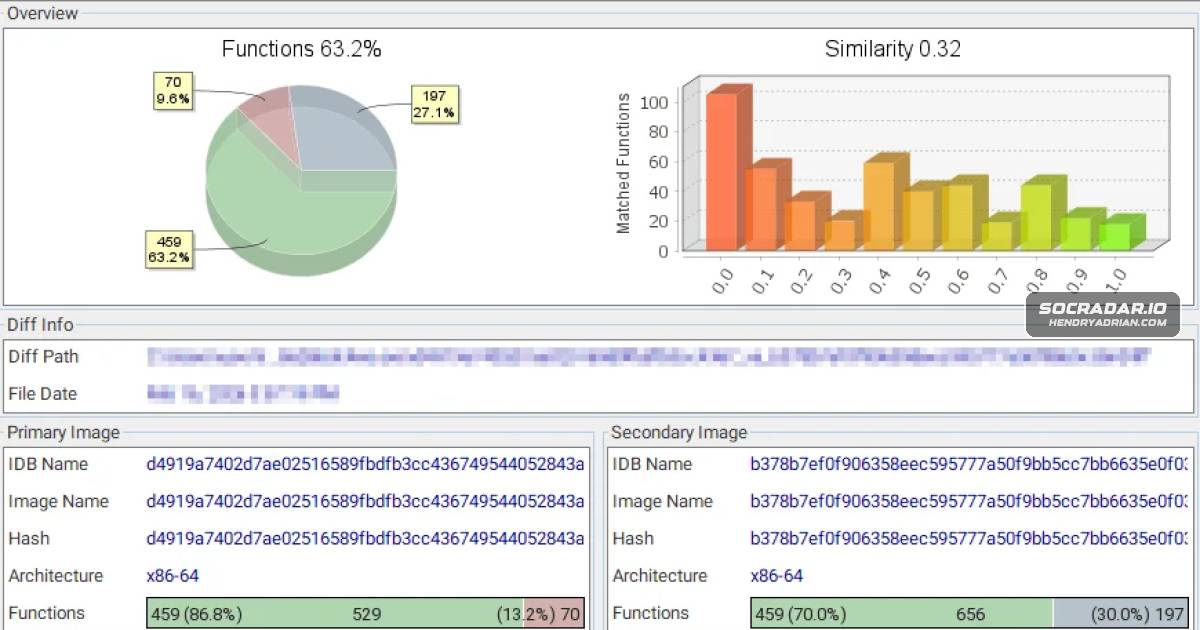
- BinDiff analysis found 63.2% function similarity between Sinobi and Lynx samples, and 55.9% between Sinobi and INC Ransom samples; the article says this supports shared code or tooling but does not prove the same operators.
- The article describes Sinobi as a closed Ransomware-as-a-Service operation using trusted affiliates and in-house operators.
- Reported access methods include compromised VPN and RDP credentials, phishing, and exploitation of CVE-2024-53704 and CVE-2024-40766.
- In a described intrusion, operators used uninstall credentials found on a network share to remove Carbon Black EDR, then used administrative tools for lateral movement.
- The operators reportedly used Rclone to exfiltrate data before threatening publication and deploying ransomware.
- Sinobi uses Curve-25519 and AES-128-CTR for encryption, appends the .SINOBI extension, and targets recovery options including Volume Shadow Copies.
- The article recommends securing remote access, preventing EDR tampering, monitoring Rclone and administrator-account changes, and maintaining offline or immutable backups.
Article Details
- Attack Vectors
- Compromised credentials for VPN and RDP accounts
- Exploitation of public-facing systems, including SonicWall SSL VPN vulnerability CVE-2024-53704 and improper access control vulnerability CVE-2024-40766
- Phishing emails containing malicious attachments or links
- Defensive Notes
- Restrict VPN privileges and avoid assigning domain-admin rights to remote accounts.
- Patch VPN appliances and other internet-facing systems.
- Protect EDR and antivirus tools against tampering; do not store uninstall or deregistration credentials on file shares.
- Monitor for Rclone use, new local administrator accounts, and changes to the Domain Admins group.
- Maintain offline, immutable backups.
- Train employees to recognize phishing and social engineering.
MITRE ATT&CK
T1005 · Data from Local SystemBefore encryption, operators collected financial records, intellectual property, and customer data.T1059 · Command and Scripting InterpreterThe article reports that scripts and shell commands were used to enumerate domain structure, identify file shares, and locate privileged accounts.T1078 · Valid AccountsSinobi operators reportedly gained initial access using compromised VPN and RDP credentials.T1083 · File and Directory DiscoveryScripts were used to identify file shares and locate data for collection and exfiltration.T1087.002 · Domain AccountScripts were used to locate privileged accounts in the domain.T1098 · Account ManipulationIn the observed incident, operators added accounts to the Domain Admins group.T1106 · Native APIThe ransomware used the SHEmptyRecycleBinA API to clear the Recycle Bin.T1136.001 · Local AccountAfter gaining access, operators created new local administrator accounts.T1190 · Exploit Public-Facing ApplicationOperators reportedly exploited public-facing vulnerabilities, including CVE-2024-53704 in SonicWall SSL VPN and CVE-2024-40766.T1486 · Data Encrypted for ImpactSinobi encrypted accessible files, renamed them with the .SINOBI extension, and left README.txt ransom notes.T1489 · Service StopProcesses associated with SQL servers, backup services, and Exchange were terminated before encryption.T1490 · Inhibit System RecoveryThe ransomware deleted Volume Shadow Copies by resizing shadow storage to zero, hindering recovery.T1562.001 · Disable or Modify ToolsOperators reportedly used uninstall credentials found on a network share to remove Carbon Black EDR.T1566 · PhishingPhishing emails with malicious attachments or embedded links were reported as a supporting access vector.
CVE
CVE-2024-40766SonicWall · SonicOSInitial access vectors include compromised VPN/RDP credentials, phishing, and exploitation of public-facing vulnerabilities (e.g., CVE-2024-53704, CVE-2024-40766).CVE-2024-53704SonicWall · SonicOSInitial access vectors include compromised VPN/RDP credentials, phishing, and exploitation of public-facing vulnerabilities (e.g., CVE-2024-53704, CVE-2024-40766).
Threat Actors
INC RansomINC Ransom is described as a ransomware family whose code shares similarities with Sinobi; the article says Sinobi may derive from code associated with INC Ransom through Lynx, but does not establish that the operators are the same.LynxLynx is described as a ransomware group and as a likely predecessor or related operation to Sinobi based on code similarity. The article cautions that code overlap does not prove shared operators.sinobiThe article describes Sinobi as a ransomware operation using compromised credentials, vulnerability exploitation, data theft, and encryption. Its relationship to Lynx is presented as likely rather than proven; code similarity alone does not establish that the operators are the same.
Malware
INC RansomSinobi is a Ransomware-as-a-Service operation that emerged in mid-2025 and appears to be a rebrand or successor to the Lynx and INC Ransom families based on significant code overlap.LynxSinobi is a Ransomware-as-a-Service operation that emerged in mid-2025 and appears to be a rebrand or successor to the Lynx and INC Ransom families based on significant code overlap.SinobiSinobi is a Ransomware-as-a-Service operation that emerged in mid-2025 and appears to be a rebrand or successor to the Lynx and INC Ransom families based on significant code overlap.
Vendors
Products
Tools
Countries
AustraliaThe majority of Sinobi’s victims are located in the United States, followed by activity in Canada, Australia, and the United Kingdom.CanadaThe majority of Sinobi’s victims are located in the United States, followed by activity in Canada, Australia, and the United Kingdom.United KingdomThe majority of Sinobi’s victims are located in the United States, followed by activity in Canada, Australia, and the United Kingdom.United StatesPrimary targets are medium-to-large organizations in manufacturing, healthcare, financial services, and education, with most victims in the United States.
Industries
EducationPrimary targets are medium-to-large organizations in manufacturing, healthcare, financial services, and education, with most victims in the United States.Financial ServicesPrimary targets are medium-to-large organizations in manufacturing, healthcare, financial services, and education, with most victims in the United States.HealthcarePrimary targets are medium-to-large organizations in manufacturing, healthcare, financial services, and education, with most victims in the United States.ManufacturingPrimary targets are medium-to-large organizations in manufacturing, healthcare, financial services, and education, with most victims in the United States.