
Three Ways CISOs Can Scale Phishing Detection in the SOC
Summary
The sponsored article recommends interactive sandboxing, analyst-like automation and SSL decryption to expose phishing flows, citing ANY.RUN demonstrations of Tycoon2FA and Salty2FA and vendor-reported SOC improvements.
Key points
- The article says static checks can miss phishing behavior revealed only after redirects, clicks or credential entry.
- It recommends interacting with suspicious links in a controlled sandbox to observe behavior and collect indicators.
- It describes automating sandbox interactions, including navigating CAPTCHAs, QR codes and multi-step redirects.
- The article says ANY.RUN extracts encryption keys from process memory to inspect HTTPS activity, including redirects and credential capture.
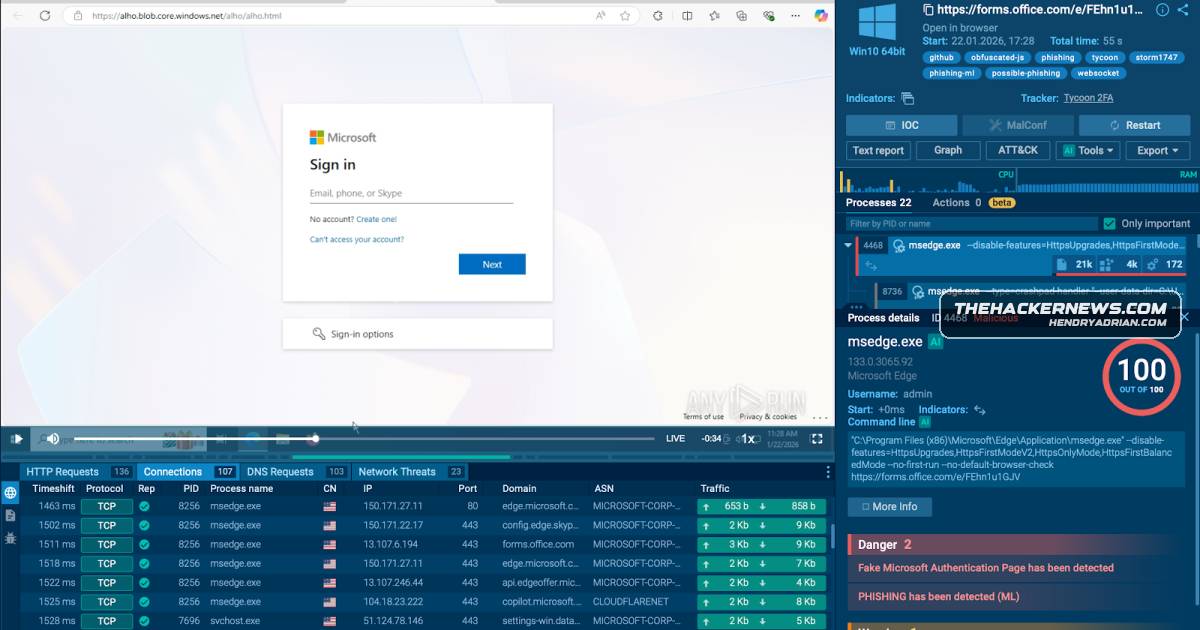
- A Tycoon2FA example uses a Microsoft Azure Blob Storage-hosted login form; a Salty2FA demonstration reportedly triggers a Suricata rule.
Article Details
- Defense Focus
- Scale phishing detection by safely exposing phishing behavior, automating investigations, and decrypting HTTPS traffic during sandbox analysis.
- Detection Methods
- Run suspicious links and files in an interactive sandbox; follow redirects and observe the phishing flow.
- Use automated sandbox interaction to navigate multi-step pages and challenges, including CAPTCHA and QR-code flows.
- Decrypt HTTPS traffic inside the sandbox to inspect redirects, credential capture, and other activity hidden in encrypted sessions.
- Correlate observed behavior with indicators and detection rules to produce an evidence-based verdict.
- Data Sources
- Suspicious links, attachments, QR codes, and user-reported messages submitted for analysis
- Sandbox-observed page behavior, redirect chains, network activity, and dropped files
- Decrypted HTTPS traffic and encryption keys extracted from process memory during execution
- Suricata rule alerts
- Rule Types
- Suricata rules
- Defensive Actions
- Analyze suspicious artifacts in a controlled sandbox rather than opening them in the business environment.
- Automate sandbox interaction and indicator collection to reduce manual investigation bottlenecks.
- Enable sandbox-based SSL decryption to reveal malicious behavior inside HTTPS sessions.
- Use behavioral evidence and extracted indicators to support downstream detection and faster triage.
MITRE ATT&CK
T1056.003 · Web Portal CaptureThe Tycoon2FA example uses a login form to capture credentials; the article says the form is hosted on Microsoft Azure Blob Storage.T1566.002 · Spearphishing LinkThe article describes phishing campaigns delivered through suspicious links that redirect users to phishing pages.