
Datadog Traces TeamPCP Supply-Chain Campaign to Compromised LiteLLM PyPI Releases
Summary
Datadog researchers trace compromised LiteLLM PyPI releases 1.82.7 and 1.82.8 to TeamPCP’s wider supply-chain campaign. The payload harvested credentials, established persistence and could spread into Kubernetes; responders are urged to rotate exposed credentials and be
Key points
- Datadog traces a five-day campaign from a malicious Trivy release on March 19 through npm and Checkmarx to compromised LiteLLM releases published on March 24, 2026.
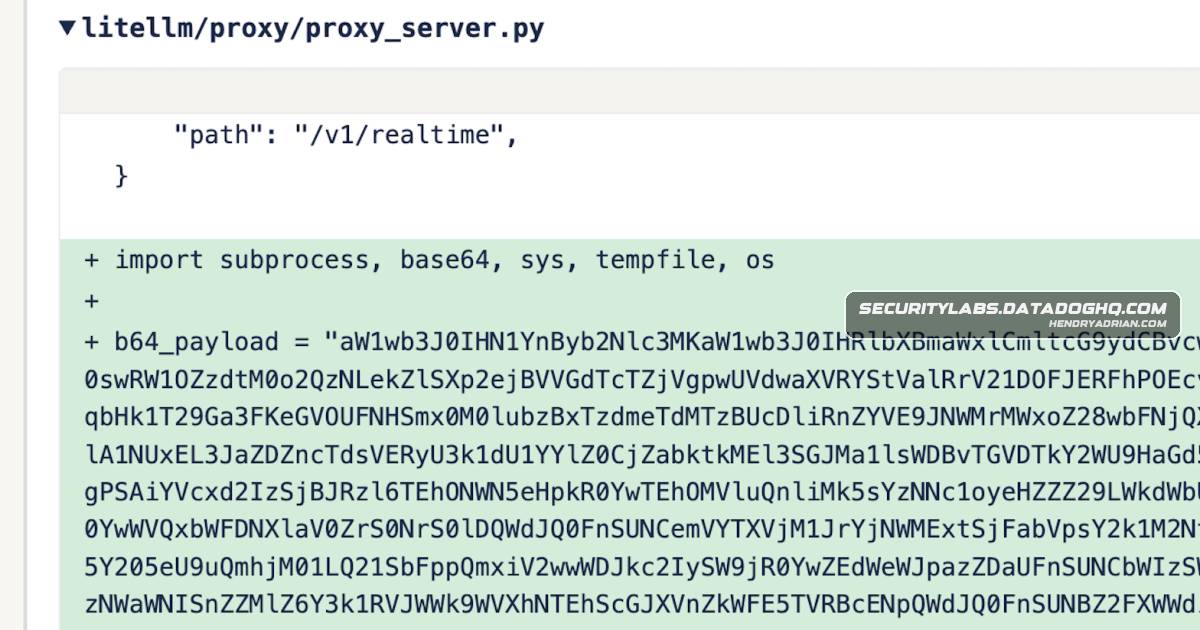
- LiteLLM 1.82.7 contained injected code in proxy_server.py that executes when the module is imported; 1.82.8 added a .pth startup hook that executes when Python starts.
- The payload collected credentials and secrets, encrypted them with AES-256 and RSA-4096, and exfiltrated the resulting data.
- The malware installed a user systemd service for persistence and polled for follow-on payloads.
- With an accessible Kubernetes service-account token, the LiteLLM payload could create privileged node-setup-* pods; related campaign activity included destructive and backdoor paths for Kubernetes targets.
- Datadog recommends scoping affected hosts and CI jobs, rotating credentials reachable from them, hunting for persistence and follow-on activity, and rebuilding critical systems from known-good images.
Article Details
- Attack Vectors
- Compromised credentials were used to publish malicious releases and alter GitHub repository tags, actions, and workflows across multiple projects.
- Malicious code was distributed through compromised PyPI, npm, GitHub Actions, and OpenVSX artifacts.
- LiteLLM 1.82.7 contained an injected payload in proxy_server.py; LiteLLM 1.82.8 used a .pth file that executed at Python interpreter startup.
- Payloads harvested environment variables, SSH keys, cloud credentials, Kubernetes data, Docker configuration, and CI/CD secrets, then encrypted and exfiltrated the data.
- The LiteLLM payload installed a user systemd service and polled for follow-on payloads.
- With accessible Kubernetes credentials, the campaign could create privileged pods; related campaign activity used a destructive container against systems identified as Iranian.
- Defensive Notes
- Treat systems, CI jobs, containers, and workstations that installed LiteLLM 1.82.7 or 1.82.8 as potentially compromised and assess whether the payload executed.
- Revoke and rotate credentials reachable from affected environments, prioritizing code-publishing, CI/CD, cloud, SSH, and Kubernetes credentials.
- Hunt for the listed C2 and exfiltration infrastructure, persistence files and service, downloaded payload artifacts, unusual secret access, and privileged Kubernetes pod activity.
- Remove compromised versions, review artifacts published from exposed environments, and rebuild critical systems from known-good images with pinned dependencies.
Indicators of compromise
| Type | Indicator | Context |
|---|---|---|
| DOMAIN | aquasecurtiy[.]org | Typosquatted domain identified as part of the earlier Trivy compromise campaign. |
| DOMAIN | checkmarx[.]zone | Attacker-controlled domain used for follow-on C2 polling, including the path /raw. |
| DOMAIN | models[.]litellm[.]cloud | Attacker-controlled endpoint used to exfiltrate encrypted data collected by the LiteLLM payload. |
| HOSTNAME | championships-peoples-point-cassette[.]trycloudflare[.]com | Cloudflare tunnel hostname identified as related campaign infrastructure. |
| HOSTNAME | investigation-launches-hearings-copying[.]trycloudflare[.]com | Cloudflare tunnel hostname identified as related campaign infrastructure. |
| HOSTNAME | scan[.]aquasecurtiy[.]org | Look-alike domain used to exfiltrate data stolen during the Trivy compromise. |
| HOSTNAME | souls-entire-defined-routes[.]trycloudflare[.]com | Cloudflare tunnel hostname identified as related campaign infrastructure. |
| HOSTNAME | tdtqy-oyaaa-aaaae-af2dq-cai[.]raw[.]icp0[.]io | CanisterWorm C2 infrastructure associated with the related campaign. |
MITRE ATT&CK
T1003 · OS Credential DumpingMalicious workflows dumped Runner.Worker memory and scraped credential locations to collect tokens, keys, and secrets.T1027 · Obfuscated Files or InformationThe LiteLLM payload was embedded as base64-encoded content in proxy_server.py.T1071.001 · Web ProtocolsThe malware polled and exfiltrated data over HTTP(S), including requests to attacker-controlled domains.T1195 · Supply Chain CompromiseThe campaign compromised legitimate projects and distributed malicious releases and artifacts through package registries and vendor tooling.T1485 · Data DestructionRelated campaign activity on systems identified as Iranian used a kamikaze container to delete the host filesystem and force a reboot.T1543.003 · Windows ServiceThe LiteLLM payload installed a user systemd unit named sysmon.service for persistence.T1546 · Event Triggered ExecutionLiteLLM 1.82.8 added a malicious .pth startup hook that executed when the Python interpreter started.T1567 · Exfiltration Over Web ServiceStolen data was sent to attacker web endpoints, with public GitHub repositories used as a fallback when direct exfiltration failed.
Threat Actors
Malware
Vendors
Aqua SecurityThis was a compromise of the real litellm project on PyPI as a result of an ongoing supply chain campaign that had already moved through Trivy, npm, Aqua Security’s internal GitHub, and Checkmarx.Checkmarxa five-day TeamPCP supply-chain campaign that began with the Trivy compromise and spread through npm, Checkmarx, and other ecosystems; treat any host or CI that installed these versions as a full-credential exposure.
Products
KICSbegan with the March 19 Trivy compromise, continued with CanisterWorm on npm, and then reached Checkmarx KICS and related artifacts.LiteLLMOn March 24, 2026, legitimate LiteLLM PyPI releases 1.82.7 and 1.82.8 were compromised and distributed malicious payloads that collected credentials, installed persistence, and exfiltrated data.TrivyDatadog links the LiteLLM incident to a five-day TeamPCP supply-chain campaign that began with the Trivy compromise and spread through npm, Checkmarx, and other ecosystems; treat any host or CI that installed these