
Trojanized LiteLLM and OpenVSX Packages Steal Secrets and Target Kubernetes
Summary
Kaspersky analyzed malicious LiteLLM releases and OpenVSX extensions designed to harvest files and cloud credentials, target Kubernetes, and establish persistence. The packages were removed; users are advised to rotate secrets and inspect systems.
Key points
- Malicious LiteLLM versions 1.82.7 and 1.82.8 were uploaded to PyPI on March 24, 2026; version 1.82.8 added a .pth file that ran code when the Python interpreter started.
- The payload scanned files and configurations for SSH keys, cloud and database credentials, development secrets, TLS materials, and crypto wallet data; it also targeted AWS and ECS runtime credentials through metadata endpoints.
- Collected data was encrypted, packaged, and sent to a remote server. The malware also contacted checkmarx[.]zone for additional payloads.
- With sufficient access, the Python malware attempted to establish Kubernetes node persistence using a privileged pod and hostPath mount, then installed a systemd service. It also supported local persistence outside Kubernetes.
- Trojanized OpenVSX extensions ast-results 2.53.0 and cx-dev-assist 1.7.0 delivered a NodeJS variant with a narrower collection scope and local persistence.
- Kaspersky reported infection attempts worldwide. The compromised versions had been removed from PyPI and OpenVSX at the time of writing.
- Recommended response includes rotating potentially exposed credentials, checking hosts and clusters for suspicious files and pods, and auditing and replacing affected packages.
Article Details
- Attack Vectors
- Attackers uploaded trojanized LiteLLM versions 1.82.7 and 1.82.8 to PyPI; version 1.82.7 embedded malicious code in proxy_server.py, while version 1.82.8 added litellm_init.pth for execution when the Python interpreter starts.
- Trojanized OpenVSX extensions ast-results 2.53.0 and cx-dev-assist 1.7.0 delivered a NodeJS malware variant.
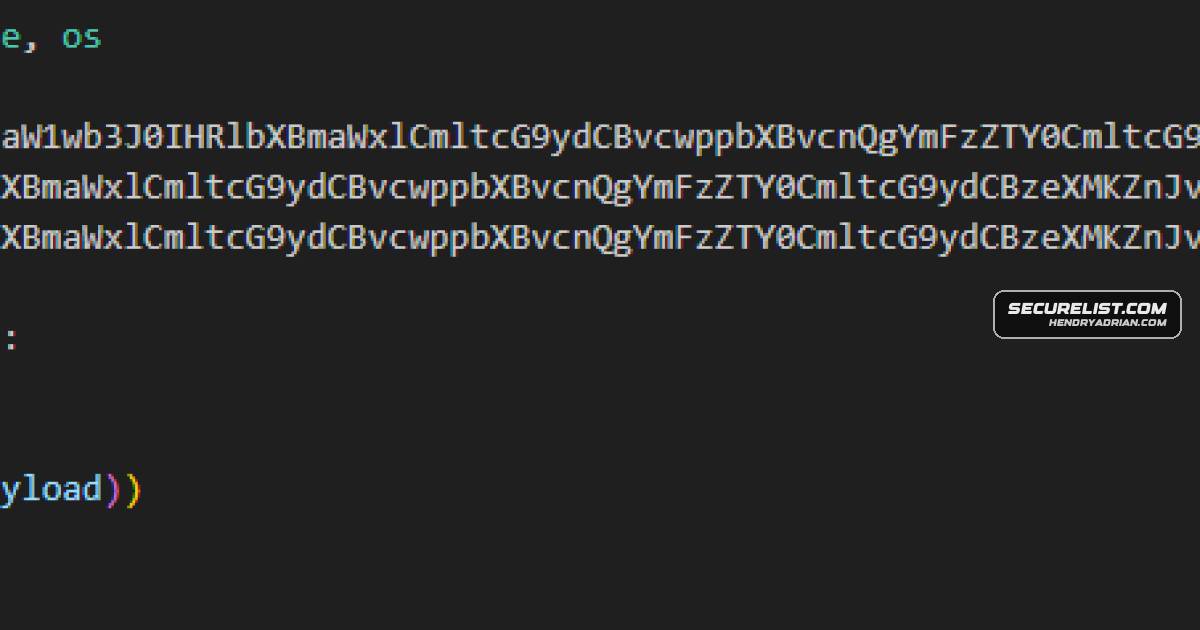
- Base64-encoded Python payloads collected local files, configurations, credentials, and crypto wallet data; the malware also attempted to retrieve temporary credentials from AWS IMDS and ECS metadata endpoints.
- The Python payload attempted Kubernetes persistence by creating a privileged pod with a hostPath mount, then registering sysmon.py as a systemd service. It also established local systemd persistence when Kubernetes was absent.
- The malware encrypted collected output and a key, packaged them in tpcp.tar.gz, and sent the archive to a remote server. A later-stage script contacted a C2 endpoint for payload updates.
- Defensive Notes
- The article reports that the compromised LiteLLM versions had been removed from PyPI and OpenVSX at the time of writing.
- Recommended response includes scanning systems, rotating potentially compromised credentials and secrets, checking hosts and Kubernetes clusters for sysmon.py and suspicious pods, clearing caches, auditing PyPI modules, and rolling back to clean versions.
- Check systems and networks for the indicators of compromise listed in the article.
Indicators of compromise
| Type | Indicator | Context |
|---|---|---|
| DOMAIN | checkmarx[.]zone | Attacker C2 domain used to retrieve links to additional payloads and host a NodeJS payload. |
| DOMAIN | models[.]litellm[.]cloud | Listed by the article as C2 and malicious hosting infrastructure. |
| MD5 | 05bacbe163ef0393c2416cbd05e45e74 | Hash listed for a malicious script. |
| MD5 | 0fccc8e3a03896f45726203074ae225d | Hash listed for an infected package. |
| MD5 | 2e3a4412a7a487b32c5715167c755d08 | Hash listed for an infected package. |
| MD5 | 85ed77a21b88cae721f369fa6b7bbba3 | Hash listed for an infected package. |
| MD5 | cde4951bee7e28ac8a29d33d34a41ae5 | Hash listed for a malicious script. |
| MD5 | f5560871f6002982a6a2cc0b3ee739f7 | Hash listed for a malicious script. |
MITRE ATT&CK
T1005 · Data from Local SystemThe payload recursively scanned working directories and read files to collect configurations, keys, and other sensitive data.T1036.005 · Match Legitimate Resource Name or LocationThe malware saved a payload as sysmon.py under a path presented as a legitimate system component.T1041 · Exfiltration Over C2 ChannelEncrypted archives were sent to a remote server, and the persistence script contacted the C2 endpoint for further payloads.T1059.006 · PythonBase64-encoded Python scripts, including p.py, were executed to launch the payload.T1082 · System Information DiscoveryThe payload collected system information and saved it with the other output for exfiltration.T1195 · Supply Chain CompromiseAttackers uploaded trojanized LiteLLM packages to PyPI and malicious extensions to OpenVSX to deliver malware.T1543.003 · Windows ServiceThe malware registered sysmon.py as a systemd service for persistence on Kubernetes nodes or locally.T1547 · Boot or Logon Autostart ExecutionA .pth file in LiteLLM version 1.82.8 caused malicious code to execute when the Python interpreter started.T1560 · Archive Collected DataThe malware encrypted collected output and a key, then combined them into a tpcp.tar.gz archive.T1611 · Escape to HostThe malware attempted to create a privileged Kubernetes pod with a hostPath mount of the node root filesystem.
Malware
Vendors
Products
ast-results[Package names ] TrojANized PyPI/OpenVSX packages and extensions – litellm==1.82.7, litellm==1.82.8 (also ast-results 2.53.0 and cx-dev-assist 1.7.0 as trojanized OpenVSX extensions)cx-dev-assist[Package names ] TrojANized PyPI/OpenVSX packages and extensions – litellm==1.82.7, litellm==1.82.8 (also ast-results 2.53.0 and cx-dev-assist 1.7.0 as trojanized OpenVSX extensions)LiteLLMIn March 2026 attackers trojanized the popular Python library LiteLLM by uploading malicious versions to PyPI and OpenVSX that executed Base64-encoded payloads to collect secrets and deploy further stages.
Countries
BrazilMost infection attempts occurred in Russia, China, Brazil, the Netherlands, and UAE.ChinaMost infection attempts occurred in Russia, China, Brazil, the Netherlands, and UAE.NetherlandsMost infection attempts occurred in Russia, China, Brazil, the Netherlands, and UAE.RussiaMost infection attempts occurred in Russia, China, Brazil, the Netherlands, and UAE.UAEMost infection attempts occurred in Russia, China, Brazil, the Netherlands, and UAE.