
Guide Outlines Defenses Against BRICKSTORM Activity Targeting VMware vSphere
Summary
The guide presents four phases for hardening vCenter and ESXi against BRICKSTORM activity: baseline controls, privileged identity protections, network segmentation, and forensic visibility using Photon OS firewalls, auditd, AIDE, and remote logging.
Key points
- The guide describes BRICKSTORM operations as targeting the VCSA and ESXi control plane, where attackers can persist below guest operating systems and access virtual disks.
- Its four-phase program covers baseline controls, privileged identity management, vSphere network hardening, and logging and forensic visibility.
- It recommends limiting administrative access to privileged access workstations, using privileged access management, enforcing least privilege, and restricting ESXi shell access for vpxuser on ESXi 8.0 and later.
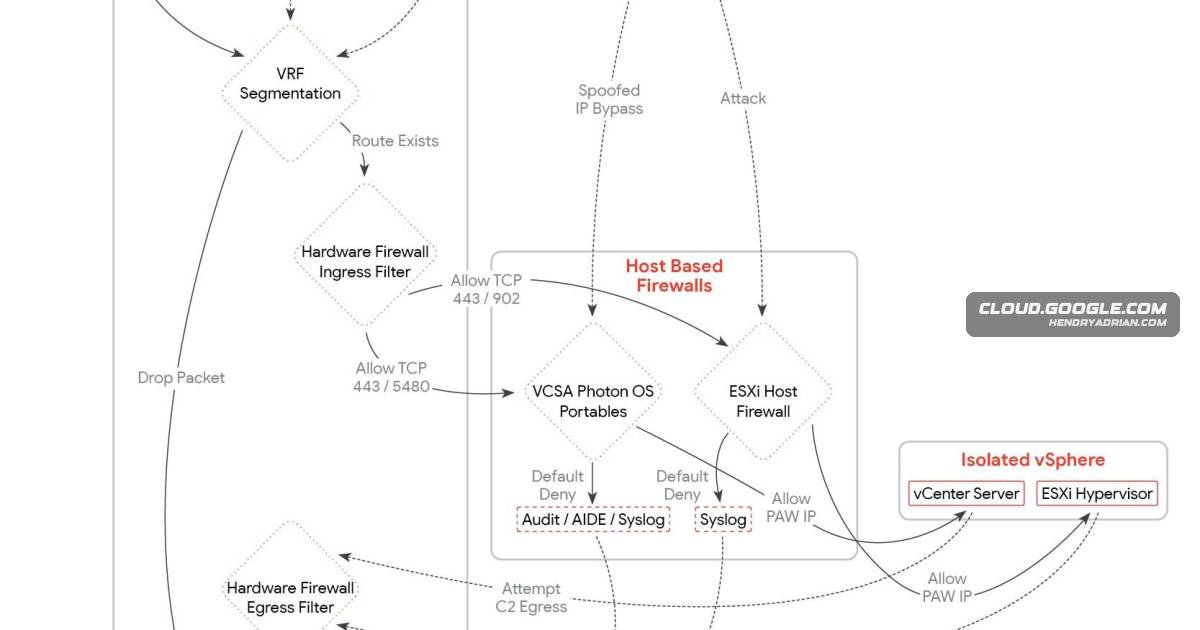
- Recommended network controls include isolating management networks and applying restrictive ingress and egress rules, alongside Photon OS host-firewall rules that log denied connections.
- The guide recommends VM encryption, encrypted vMotion, vTPM and Secure Boot, separate key management for Tier-0 workloads, and restricting clone and export privileges.
- It advises forwarding auditd events and system logs off-appliance over TLS, and using AIDE file-integrity monitoring to identify unauthorized changes.
- It recommends correlating vCenter events, identity activity, auditd records, AIDE alerts, and firewall logs in a SIEM to detect suspicious account changes, persistence modifications, cloning, and probing.
Article Details
- Defense Focus
- Harden and monitor the vSphere control plane and underlying Photon OS against persistent BRICKSTORM operations and unauthorized access to virtual machine data.
- Detection Methods
- Correlate host firewall drops with failed SSO logins from the same source IP.
- Alert on rapid SSO account creation and deletion, SSH enablement, and changes to BashShellAdministrators membership.
- Monitor auditd execution and privilege events for unauthorized binaries, sudo use, startup-script modification, RPM execution, and SSH key changes.
- Compare critical files against an AIDE integrity baseline and alert on AIDE_TRAP events.
- Investigate VM cloning, disk hot-plugging, unauthorized network adapter additions, and unregistered VM execution.
- Inspect Tomcat audit logs for requests to the manager deployment endpoint associated with malicious WAR deployment.
- Data Sources
- vCenter application and SSO audit events
- Photon OS auditd syscall logs
- AIDE integrity alerts
- Host firewall and network device logs
- VAMI access logs
- ESXi hostd and shell logs
- Tomcat audit logs
- Windows network logon events
- Rule Types
- auditd syscall and file-watch rules
- AIDE file integrity rules
- iptables firewall logging rules
- SIEM correlation rules
- Platforms
- Linux
- Virtualization control plane
- Defensive Actions
- Enforce MFA, privileged access workstations, credential rotation, and restricted break-glass accounts.
- Disable unnecessary SSH access and restrict management interfaces to authorized sources.
- Segment management, guest, storage, and vMotion networks; enforce restrictive ingress and egress filtering.
- Enable VM and vMotion encryption, isolate Tier-0 encryption keys, and remove clone and export privileges from standard administrator roles.
- Forward auditd, firewall, identity, and management events to a protected remote SIEM using TLS and validated certificates.
- Maintain an off-host AIDE baseline, schedule integrity checks, and test rules before production deployment.
- Synchronize timestamps and retain remote logs for at least 400 days, as recommended by the source.
MITRE ATT&CK
T1003 · OS Credential DumpingBRICKSTEAL reportedly uses sudo to scrape memory and configuration files for credentials.T1005 · Data from Local SystemThe detection guidance describes cloning domain controller VMs and mounting their disks offline to extract ntds.dit.T1059.004 · Unix ShellActors use the Photon OS shell and commands such as sed and chmod to modify and enable startup scripts.T1070.002 · Clear Linux or Mac System LogsThe article describes deleting local audit logs to remove evidence of activity on the VCSA.T1078 · Valid AccountsThe article describes actors using compromised administrative credentials to access the vSphere management plane.T1136 · Create AccountActors reportedly create transient local SSO accounts to deploy backdoors and then delete them.T1547.004 · Winlogon Helper DLLThe article describes startup-script modifications intended to keep backdoors running across reboots.
CVE
Malware
BRICKSTEALand sudo-assisted extraction of credentials/config to enable lateral movement and credential abuse (BRICKSTEAL); quote: ‘BRICKSTEAL requires sudo to scrape memory and config files.’BRICKSTORMThis article details Mandiant and GTIG findings on persistent BRICKSTORM operations that target the VMware vSphere control plane (VCSA and ESXi) and the Photon OS, and it prescribes a four-phase, infrastructure-centricSLAYSTYLEmalicious WARs via Tomcat manager (CVE-2026-22769) to gain initial access or deploy tools like SLAYSTYLE; quote: ‘Detects requests to /manager/text/deploy (CVE-2026-22769) to deploy malicious WAR files like
Vendors
Products
ESXiGTIG findings on persistent BRICKSTORM operations that target the VMware vSphere control plane (VCSA and ESXi) and the Photon OS, and it prescribes a four-phase, infrastructure-centric hardening strategy to preventNSXHost-based and network-level segmentation (immutable VLANs, VRF, physical ingress/egress filtering, NSX DFW for East-West) and PAW-only management access dramatically reduce lateral movement and exposure of thePhoton OSpersistent BRICKSTORM operations that target the VMware vSphere control plane (VCSA and ESXi) and the Photon OS, and it prescribes a four-phase, infrastructure-centric hardening strategy to prevent and detect thosevCenter Server ApplianceThese operations directly target the VMware vSphere ecosystem, specifically the vCenter Server Appliance (VCSA) and ESXi hypervisors.vSpherearticle details Mandiant and GTIG findings on persistent BRICKSTORM operations that target the VMware vSphere control plane (VCSA and ESXi) and the Photon OS, and it prescribes a four-phase, infrastructure-centric
Tools
AIDEIt emphasizes Photon OS–level firewalling and logging (auditd, AIDE), strict identity/network segmentation (PAWs, PAM, Zero Trust), VM encryption, and forensic remote logging to expose actions such as startup scriptauditdIt emphasizes Photon OS–level firewalling and logging (auditd, AIDE), strict identity/network segmentation (PAWs, PAM, Zero Trust), VM encryption, and forensic remote logging to expose actions such as startup scriptvCenter Hardening Scriptthis guidance and secure the control plane against threats like BRICKSTORM, Mandiant released a vCenter Hardening Script that enforces these security configurations directly at the Photon Linux layer.