
AttackIQ Releases NightSpire Ransomware Emulation for Defense Testing
Summary
AttackIQ released an emulation based on internal analysis of NightSpire samples, covering host discovery and file encryption to help organizations test security controls. The article also describes the group’s reported tactics and ransomware behavior.
Key points
- The emulation models NightSpire behaviors, including system profiling, reconnaissance, and file encryption, to help teams test detection and prevention controls.
- It covers discovery using Windows APIs and registry queries, including retrieval of the system’s MachineGUID.
- The article describes NightSpire’s Go payload as using AES-256 CBC and RSA-2048, with partial encryption of some large files and full encryption of smaller files; encrypted files receive the .nspire extension.
- The article reports phishing and exploitation of exposed services, including observed abuse of CVE-2024-55591 in FortiOS appliances, as initial access methods.
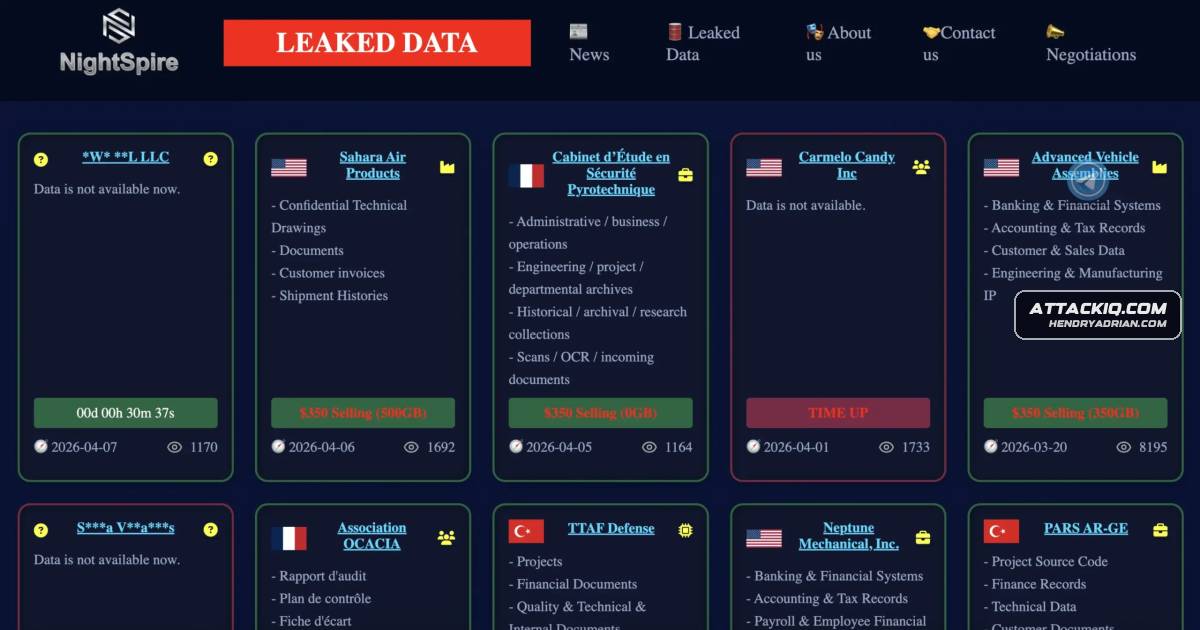
- NightSpire is described as a financially motivated extortion group that has announced a shift from an operator-run model to a ransomware-as-a-service program.
- AttackIQ recommends supplementing the emulation with scenarios for obfuscated Mimikatz credential dumping and lateral movement using PAExec or WMI.
Article Details
- Defense Focus
- Validate detection and prevention controls and incident-response readiness against NightSpire ransomware behaviors.
- Detection Methods
- Use the AttackIQ emulation to test detection and prevention of NightSpire sample delivery and execution.
- Monitor for the described host, user, registry, network, process, service, drive, volume, and file-system discovery behaviors.
- Test detection of file encryption and the addition of the .nspire extension.
- Use the recommended Mimikatz, PAExec, and WMI scenarios to assess coverage for credential dumping and lateral movement.
- Data Sources
- Endpoint telemetry for the described Windows API calls, including system and user discovery, process and service enumeration, drive and volume discovery, and file-system traversal.
- Registry activity involving the MachineGUID entry under HKLM\SOFTWARE\Microsoft\Cryptography.
- Telemetry for sample downloads and writes to disk.
- File activity showing encryption and the .nspire extension.
- Platforms
- AttackIQ Adversarial Exposure Validation (AEV) Platform
- Defensive Actions
- Run the NightSpire emulation to evaluate security controls against the described behaviors.
- Test both network and endpoint controls against delivery of the identified samples.
- Use the recommended Mimikatz, PAExec, and WMI emulation scenarios to assess additional detection and prevention coverage.
- Use results from continuous testing to adjust controls and improve incident-response readiness.
Indicators of compromise
| Type | Indicator | Context |
|---|---|---|
| SHA256 | 8f58870a3e5df1d904940c7ef2ad160b90ba739c7e5e21e4c908945e0a6f3f60 | SHA-256 listed in the article among NightSpire ransomware sample hashes. |
| SHA256 | c5f526cc62688cf34c49d098dab81e24e4294f832ada57433ef505d5ac6da8f3 | SHA-256 identified in the article for a NightSpire ransomware sample used in the emulation. |
MITRE ATT&CK
T1003 · OS Credential DumpingThe article recommends an obfuscated Mimikatz emulation to test dumping Windows account passwords and hashes; it presents this as a scenario to expand testing.T1007 · System Service DiscoveryThe emulation queries service information using QueryServiceStatusEx and EnumDependentServices.T1012 · Query RegistryThe emulation uses reg query to retrieve MachineGUID from the Cryptography registry key.T1016 · System Network Configuration DiscoveryThe emulation calls GetAdaptersInfo to retrieve local network-adapter information.T1021.002 · SMB/Windows Admin SharesThe article recommends a PAExec scenario to emulate lateral movement across network hosts; it does not establish that NightSpire used PAExec in an intrusion.T1033 · System Owner/User DiscoveryThe emulation retrieves the logged-in account name using GetUserNameW or GetUserNameExW.T1047 · Windows Management InstrumentationThe article recommends emulating lateral movement through WMI to execute a configurable command on a remote asset.T1057 · Process DiscoveryThe emulation enumerates running processes using CreateToolhelp32Snapshot, Process32FirstW, and Process32NextW.T1082 · System Information DiscoveryNightSpire profiling includes system, environment, drive, and volume information gathering using APIs including GetSystemInfo, GetEnvironmentStrings, GetLogicalDrives, and volume-enumeration functions.T1083 · File and Directory DiscoveryNightSpire uses FindFirstFileW and FindNextFileW to enumerate files for encryption.T1105 · Ingress Tool TransferThe AttackIQ scenario downloads a NightSpire sample and saves it to disk to test network and endpoint controls.T1120 · Peripheral Device DiscoveryThe emulation uses GetDriveTypeW to determine information about available storage.T1124 · System Time DiscoveryThe emulation checks UTC system time using GetSystemTimeAsFileTime.T1486 · Data Encrypted for ImpactNightSpire encrypts files in place using AES-256 CBC and RSA-2048 and appends the .nspire extension.
CVE
Threat Actors
Malware
Vendors
Products
AttackIQ Adversarial Exposure Validation (AEV) PlatformBy using this new emulation in the AttackIQ Adversarial Exposure Validation (AEV) Platform, security teams will be able to:FortiOSInitial access vectors include phishing and exploitation of exposed services, notably observed abuse of CVE-2024-55591 in FortiOS appliances.
Tools
Mimikatzencryption, leverages living-off-the-land tools (PowerShell, WMI, PsExec) and credential dumping (Mimikatz), and AttackIQ released an emulation to validate defenses against these behaviors.PAExec[T1021.002 ] Lateral Movement: Remote Services (PAExec) – Emulation includes lateral movement using PAExec (PSExec-like) to move across hosts (“This scenario simulates lateral movement within a network using PAExec, anPowerShellthe .nspire extension, uses hybrid partial/full encryption, leverages living-off-the-land tools (PowerShell, WMI, PsExec) and credential dumping (Mimikatz), and AttackIQ released an emulation to validatePsExecextension, uses hybrid partial/full encryption, leverages living-off-the-land tools (PowerShell, WMI, PsExec) and credential dumping (Mimikatz), and AttackIQ released an emulation to validate defenses against these
Industries
Financial ServicesThe group targets small- and medium-sized organizations across sectors (manufacturing, technology, healthcare, financial services, government) in over 30 countries.GovernmentThe group targets small- and medium-sized organizations across sectors (manufacturing, technology, healthcare, financial services, government) in over 30 countries.HealthcareThe group targets small- and medium-sized organizations across sectors (manufacturing, technology, healthcare, financial services, government) in over 30 countries.ManufacturingThe group targets small- and medium-sized organizations across sectors (manufacturing, technology, healthcare, financial services, government) in over 30 countries.TechnologyThe group targets small- and medium-sized organizations across sectors (manufacturing, technology, healthcare, financial services, government) in over 30 countries.