
Ollama Flaws Enable Remote Memory Disclosure and Persistent Windows Code Execution
Summary
Researchers disclosed CVE-2026-7482, an Ollama GGUF-loader flaw that may expose process memory to remote attackers; two unpatched Windows updater flaws, CVE-2026-42248 and CVE-2026-42249, can enable persistent user-level code execution.
Key points
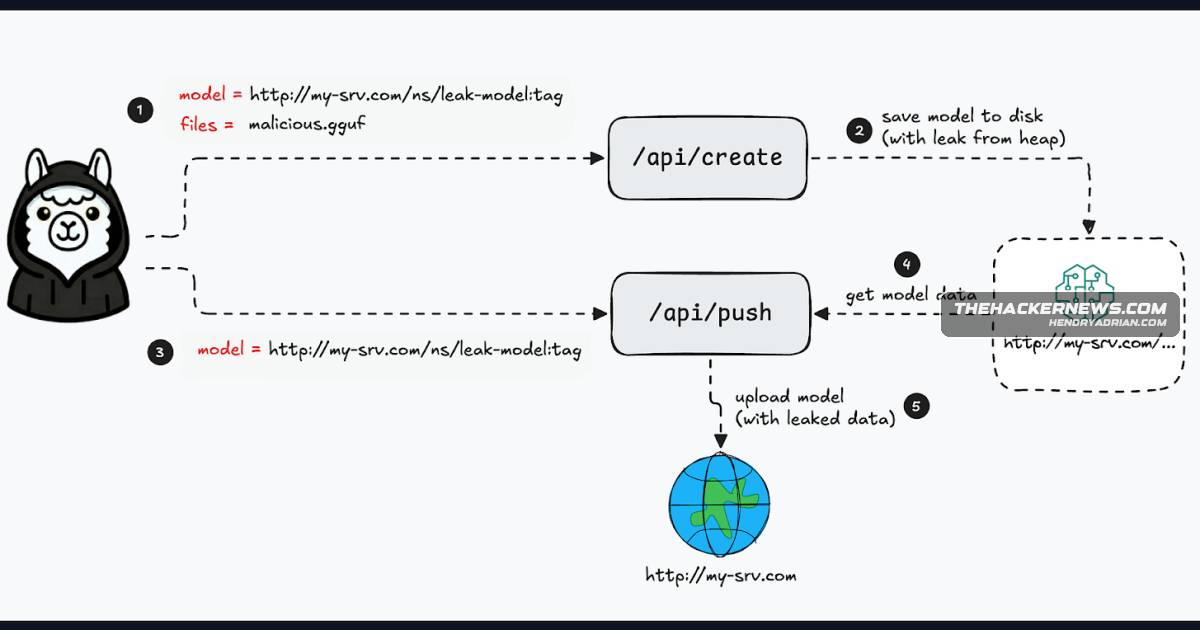
- CVE-2026-7482 is a heap out-of-bounds read in Ollama’s GGUF loader before version 0.17.1, triggered by a crafted file submitted through /api/create.
- Successful exploitation could expose Ollama process memory, including environment variables, API keys, system prompts, and conversation data; the article describes /api/push as a possible exfiltration path.
- Users are advised to update, limit network access, isolate exposed instances, and place an authentication proxy or API gateway in front of Ollama.
- The unpatched Windows flaws CVE-2026-42248 and CVE-2026-42249 involve missing update-signature verification and path traversal.
- The Windows flaws can be chained to place an executable in the Startup folder and run it at login. The described attack requires influence over the update response and enabled automatic updates, and runs with the user’s privileges.
- CERT Polska identifies Ollama for Windows versions 0.12.10–0.17.5 as affected, while researcher Bartłomiej Dmitruk separately cites versions 0.12.10–0.22.0.
- Interim advice for Windows users is to disable automatic updates and remove the Ollama Startup shortcut; the article says the underlying flaws remain.
Article Details
- Vulnerability Types
- Heap out-of-bounds read
- Path traversal
- Missing signature verification
- Severity
- CVE-2026-7482: CVSS 9.1 (critical); CVE-2026-42248 and CVE-2026-42249: CVSS 7.7 each.
- Affected Versions
- Ollama before 0.17.1 (CVE-2026-7482)
- Ollama for Windows 0.12.10 through 0.17.5 (CERT Polska's reported range for CVE-2026-42248 and CVE-2026-42249)
- Ollama for Windows 0.12.10 through 0.22.0 (range attributed to Bartłomiej “Bartek” Dmitruk for the Windows flaws)
- Exploitation Status
- unknown
- Exploit Availability
- unknown
- Patch Status
- partial
- Workarounds
- Limit Ollama network access and isolate instances behind a firewall; the article also recommends placing an authentication proxy or API gateway in front of instances.
- For Ollama for Windows, turn off automatic updates and remove the Ollama shortcut from the Windows Startup folder.
MITRE ATT&CK
T1210 · Exploitation of Remote ServicesThe article describes remotely triggering the out-of-bounds read by sending a crafted GGUF file to a network-accessible Ollama server through /api/create.T1547.001 · Registry Run Keys / Startup FolderThe Windows flaws can place an attacker-supplied executable in the Startup folder, where it runs at the next user login.
CVE
CVE-2026-42248Ollama · OllamaSeparate unpatched Windows update flaws, CVE-2026-42248 and CVE-2026-42249, can be chained for persistent code execution through Ollama’s updater and Startup folder behavior.CVE-2026-42249Ollama · OllamaSeparate unpatched Windows update flaws, CVE-2026-42248 and CVE-2026-42249, can be chained for persistent code execution through Ollama’s updater and Startup folder behavior.CVE-2026-7482ollama · ollamaResearchers disclosed CVE-2026-7482, a critical out-of-bounds read in Ollama’s GGUF model loader that could let a remote attacker leak process memory, including API keys, system prompts, and conversation data.