
Linux KVM Flaw Let AMD Guest VMs Read Host Memory; Fixes Available
Summary
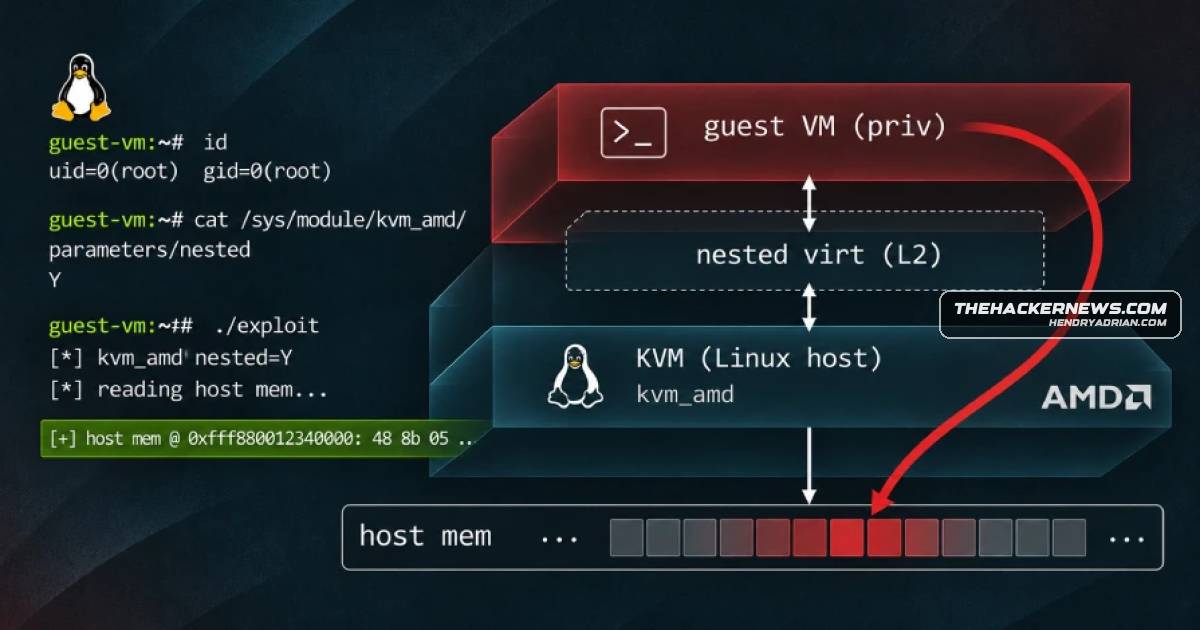
Researchers demonstrated that CVE-2026-99312 lets a root-controlled guest on AMD KVM hosts with nested virtualization read host memory and, in a separate test, write to it. Fixed kernels are available; disable nested virtualization until hosts are patched and rebooted.
Key points
- The flaw affects AMD KVM hosts with nested virtualization enabled; Intel-based KVM hosts are not affected.
- After an INIT reset, KVM could leave a pointer to freed memory. A guest could influence the reused page and forge nested page-table entries.
- A test on a DigitalOcean Droplet read about 127 GB of host RAM. In a separate test on researchers’ bare-metal AMD server, a guest wrote 32 chosen bytes to host-kernel memory.
- Both tests required root access inside a researcher-controlled VM; the write test did not involve other customers.
- Upstream fixes shipped in kernels 7.3.5, 6.18.64, and 6.12.118. The host must be updated and rebooted; updating guest operating systems does not fix the host.
- Until patched, disabling nested virtualization blocks this path but prevents VMs from running their own VMs.
- VirtFusion reported no known exploitation outside research and no published exploit code. Severity assessments differ, ranging from Moderate to critical.
Article Details
- Attack Vectors
- An attacker needs root access inside a guest VM on a vulnerable host; network access alone is insufficient.
- The host must use an AMD processor, have nested virtualization enabled, and run a vulnerable host kernel.
- Resetting a nested VM with INIT can leave a page-table pointer referencing freed memory. After the kernel reuses that page, the guest can supply entries that let the processor access host physical memory.
- Defensive Notes
- Install a fixed host kernel and reboot the host. Upstream fixes are in kernel versions 7.3.5, 6.18.64, and 6.12.118.
- Until a fixed kernel is installed and the host rebooted, disable nested virtualization. Warn tenants who rely on running VMs inside their VMs, since disabling it prevents that use.
- Updating operating systems inside guest VMs does not fix the host vulnerability.
- The article reports no known exploitation outside research, no published exploit code, and no guidance for detecting past attempts.
MITRE ATT&CK
CVE
CVE-2022-3344Vendor / Product unavailableThe flaw was created by a security fix. A 2022 patch for a different nested-virtualization bug, CVE-2022-3344, switched a reset path back to the outer VM's control block but missed the page-table pointer, theCVE-2026-99312Linux · LinuxOn a shared server, that memory can include other customers' virtual machines. The flaw, tracked as CVE-2026-99312, affects only hosts with AMD processors and nested virtualization enabled.
People
Vendors
AMDOn a shared server, that memory can include other customers' virtual machines. The flaw, tracked as CVE-2026-99312, affects only hosts with AMD processors and nested virtualization enabled.DebianDistribution kernels mostly do not have the fix yet. As of publication, Debian's security tracker lists the kernels in all of its releases as vulnerable, with a fix only in unstable, and Ubuntu's CVE tracker rates theDigitalOceanA flaw in KVM, the hypervisor built into the Linux kernel, let researchers read about 127 GB of a cloud server's memory from inside a virtual machine of their own on DigitalOcean.Red Hatscores the flaw 8.8 out of 10, with high impact on confidentiality, integrity, and availability, while Red Hat's preliminary security assessment rates it as Moderate at 5.6 and treats the impact as denial-of-serviceUbuntusecurity tracker lists the kernels in all of its releases as vulnerable, with a fix only in unstable, and Ubuntu's CVE tracker rates the flaw High and lists its kernels as vulnerable with no fixed package released. RedVirtFusionThere are no reports of the flaw being used outside research, according to VirtFusion, a virtualization platform vendor that is tracking the issue for its operators. No exploit code has been published either, and no
Products
Dropletthe day before the research went public. The provider patched its own fleet with a live patch, telling Droplet customers: "No action needed on your part." Operators who run their own KVM hosts on AMD hardware need toKVMA flaw in KVM, the hypervisor built into the Linux kernel, let researchers read about 127 GB of a cloud server's memory from inside a virtual machine of their own on DigitalOcean.Linux kernelA flaw in KVM, the hypervisor built into the Linux kernel, let researchers read about 127 GB of a cloud server's memory from inside a virtual machine of their own on DigitalOcean.VirtFusionThere are no reports of the flaw being used outside research, according to VirtFusion, a virtualization platform vendor that is tracking the issue for its operators. No exploit code has been published either, and no