
SOCRadar Profiles CoinbaseCartel’s Credential-Theft and Data-Extortion Operations
Summary
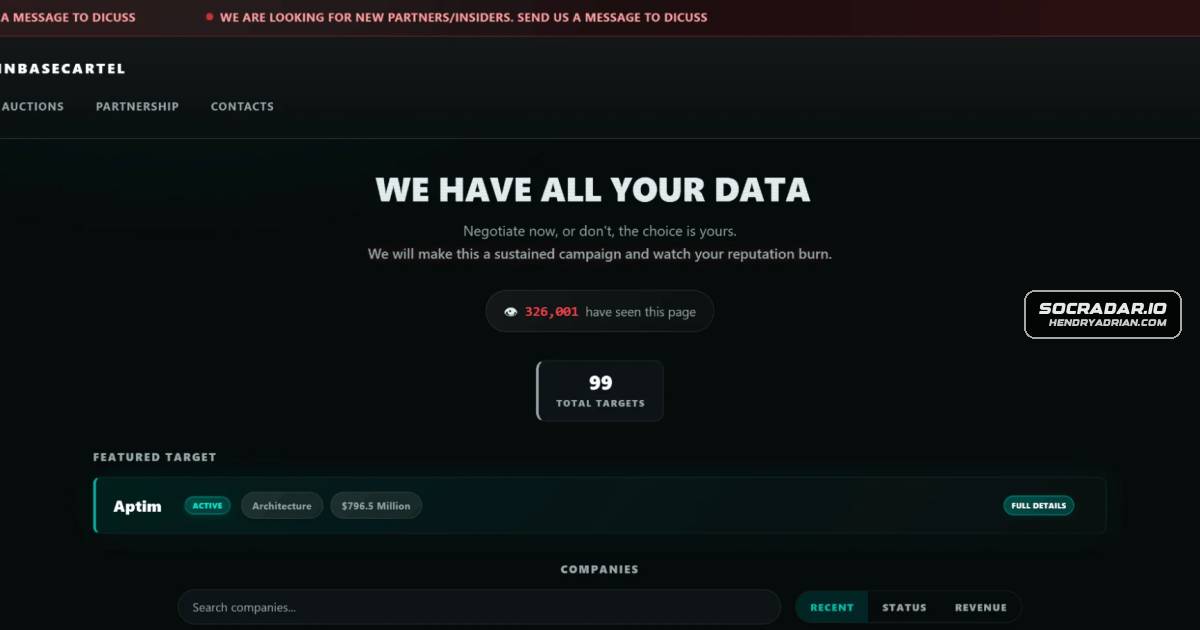
SOCRadar profiles CoinbaseCartel, an extortion actor reported to steal data using reused credentials and cloud access rather than encrypt systems. Researchers describe its tactics and defenses; proposed links to ShinyHunters, Scattered Spider and Lapsus$ remain ununfirm
Key points
- SOCRadar researchers say CoinbaseCartel appeared on September 15–16, 2025. The group has claimed more than 160 victims across 36 countries and 17 industries; these listings do not independently confirm every incident.
- The group reportedly uses single extortion: it threatens to publish stolen data without encrypting victims’ systems. Its leak site reportedly sets contact and payment deadlines and added a dataset auction section in early 2026.
- Researchers identify reused credentials from infostealer logs as a dominant access method, alongside compromised VPN/RDP credentials, exposed secrets, and OAuth abuse. Links to initial access brokers and insider recruitment are described as inconsistently corroborated.
- The article describes bulk data collection using custom Python tooling designed to resemble Salesforce Data Loader activity, followed by staging in compressed archives and exfiltration through cloud services.
- Researchers say the group truncates logs, disables syslog forwarding, and changes audit settings to hinder investigation. They also describe lateral movement using administrative tools and remote services.
- Recommended defenses include rotating exposed credentials, phishing-resistant MFA, restricting OAuth app permissions, monitoring bulk exports and unusual data transfers, and storing logs immutably.
- Researchers have hypothesized links to shinysp1d3r, ShinyHunters, Scattered Spider, and Lapsus$, but the article says attribution beyond superficial overlaps has not been validated.
Article Details
- Attack Vectors
- CoinbaseCartel reuses credentials from infostealer logs, including credentials harvested by RedLine, Lumma, and Vidar, to access corporate cloud environments, FTP/SFTP endpoints, and managed file transfer services.
- The group also uses compromised VPN and RDP credentials and exposed or hard-coded credentials found in code repositories such as GitHub and Bitbucket.
- OAuth abuse includes tricking users into authorizing malicious applications, including a modified Salesforce Data Loader, to obtain persistent access to cloud environments.
- Researchers link the group to Initial Access Brokers; reported insider recruitment and contractor bribery are not consistently corroborated.
- The group collects and exfiltrates data without encrypting victim systems. Reported exfiltration uses AWS, Google Cloud, or Cloudflare, with Tor used in some observed cases.
- Defensive Notes
- Monitor for exposed employee credentials and rotate credentials associated with infostealer infections; enforce phishing-resistant MFA across cloud, VPN, remote access, and SaaS accounts.
- Audit code repositories for hard-coded credentials, API keys, and tokens; use short-lived, automatically rotated secrets.
- Restrict third-party OAuth authorization, review existing application grants, and revoke unnecessary permissions that permit broad data export.
- Monitor API activity, CRM exports, archive creation, and outbound transfers; use immutable, segregated log storage.
- Harden SFTP, FTP, VPN, and RDP access with MFA, IP restrictions where feasible, and authentication monitoring.
- Maintain an inventory of sensitive data, test immutable backups, and prepare incident-response plans for extortion without encryption.
MITRE ATT&CK
T1059 · Command and Scripting InterpreterThe group uses built-in operating-system administrative tools and living-off-the-land techniques during intrusions.T1059.006 · PythonCustom Python tooling mimics Salesforce Data Loader behavior to conduct bulk CRM exports.T1070 · Indicator RemovalThe group truncates log files in bulk to hinder forensic investigation.T1078 · Valid AccountsCoinbaseCartel reuses credentials from infostealer logs and compromised remote-access accounts to gain access.T1078.004 · Cloud AccountsStolen cloud credentials are used to authenticate to corporate cloud environments and management consoles.T1119 · Automated CollectionCustom tooling enables bulk CRM exports and other large-scale scripted data collection.T1199 · Trusted RelationshipResearchers link CoinbaseCartel to the use of Initial Access Brokers.T1550.001 · Application Access TokenUsers are tricked into authorizing malicious OAuth applications, including a modified Salesforce Data Loader, to grant persistent cloud access.T1552.001 · Credentials In FilesThe group uses exposed or hard-coded credentials found in code repositories such as GitHub and Bitbucket.T1560 · Archive Collected DataCollected data is staged in large compressed archives before exfiltration.T1567 · Exfiltration Over Web ServiceData is exfiltrated through trusted cloud platforms, including AWS, Google Cloud, and Cloudflare.
Threat Actors
Coinbase CartelThe article describes CoinbaseCartel as a financially motivated extortion group that steals data and threatens to publish it without encrypting victim systems.LAPSUS$Researchers have hypothesized a connection between Lapsus$ and CoinbaseCartel, but the article says attribution beyond superficial operational overlaps has not been validated.Scattered LAPSUS$ Hunters (SLSH)The article describes SLSH as an alliance that publicly emerged via Telegram in August 2025 and reports that an encryptor project associated with SLSH-affiliated actors was under development; the connection to CoinbaseCartel is unvalidated.Scattered SpiderResearchers have hypothesized a connection between Scattered Spider and CoinbaseCartel, but the article says attribution beyond superficial operational overlaps has not been validated.ShinyHuntersResearchers have hypothesized a connection between ShinyHunters and CoinbaseCartel, but the article says attribution beyond superficial operational overlaps has not been validated.Shinysp1d3rSome researchers track CoinbaseCartel under the alias shinysp1d3r. The article also says the alias is associated with an encryptor project reportedly under development by SLSH-affiliated actors; attribution remains contested.
Malware
Lummacorporate cloud environments and services (‘Credentials harvested by malware families such as RedLine, Lumma, and Vidar are reused’).RedLineto access corporate cloud environments and services (‘Credentials harvested by malware families such as RedLine, Lumma, and Vidar are reused’).Vidarcloud environments and services (‘Credentials harvested by malware families such as RedLine, Lumma, and Vidar are reused’).
Vendors
Amazon Web Services[Cloud / Platform Services ] Infrastructure used for exfiltration or access – AWS, Google Cloud, Cloudflare, Salesforce, Microsoft 365, and Google WorkspaceCloudflare[Cloud / Platform Services ] Infrastructure used for exfiltration or access – AWS, Google Cloud, Cloudflare, Salesforce, Microsoft 365, and Google WorkspaceGoogle Cloud[Cloud / Platform Services ] Infrastructure used for exfiltration or access – AWS, Google Cloud, Cloudflare, Salesforce, Microsoft 365, and Google WorkspaceSalesforce[T1059.006 ] Command and Scripting Interpreter: Python – Custom Python tooling is used to mimic legitimate data export behavior (‘custom Python tooling designed to mimic the legitimate Salesforce Data Loader’).
Products
AWS[Cloud / Platform Services ] Infrastructure used for exfiltration or access – AWS, Google Cloud, Cloudflare, Salesforce, Microsoft 365, and Google WorkspaceCloudflare[Cloud / Platform Services ] Infrastructure used for exfiltration or access – AWS, Google Cloud, Cloudflare, Salesforce, Microsoft 365, and Google WorkspaceGoogle Cloud[Cloud / Platform Services ] Infrastructure used for exfiltration or access – AWS, Google Cloud, Cloudflare, Salesforce, Microsoft 365, and Google WorkspaceGoogle Workspace[Cloud / Platform Services ] Infrastructure used for exfiltration or access – AWS, Google Cloud, Cloudflare, Salesforce, Microsoft 365, and Google WorkspaceMicrosoft 365 Apps for Enterprise[Cloud / Platform Services ] Infrastructure used for exfiltration or access – AWS, Google Cloud, Cloudflare, Salesforce, Microsoft 365, and Google WorkspaceSalesforce[T1059.006 ] Command and Scripting Interpreter: Python – Custom Python tooling is used to mimic legitimate data export behavior (‘custom Python tooling designed to mimic the legitimate Salesforce Data Loader’).Salesforce Data Loader[T1059.006 ] Command and Scripting Interpreter: Python – Custom Python tooling is used to mimic legitimate data export behavior (‘custom Python tooling designed to mimic the legitimate Salesforce Data Loader’).
Countries
BrazilThe UAE, Germany, France, Brazil, Canada, and the UK follow, reflecting a multi-regional, opportunistic posture.CanadaThe UAE, Germany, France, Brazil, Canada, and the UK follow, reflecting a multi-regional, opportunistic posture.FranceThe UAE, Germany, France, Brazil, Canada, and the UK follow, reflecting a multi-regional, opportunistic posture.GermanyThe UAE, Germany, France, Brazil, Canada, and the UK follow, reflecting a multi-regional, opportunistic posture.UAEThe UAE, Germany, France, Brazil, Canada, and the UK follow, reflecting a multi-regional, opportunistic posture.United KingdomThe UAE, Germany, France, Brazil, Canada, and the UK follow, reflecting a multi-regional, opportunistic posture.United StatesGeographically, the United States dominates at 37.3% of all victims, consistent with the high volume of U.S.
Industries
business servicesTechnology leads all targeted industries at 30.4%, followed by Manufacturing (~13%), Business Services, and Consumer Services (~10% each).Consumer ServicesTechnology leads all targeted industries at 30.4%, followed by Manufacturing (~13%), Business Services, and Consumer Services (~10% each).EnergyThe group has shown no intent to avoid sensitive sectors; healthcare, energy, and critical infrastructure all appear in its victim listings.financeManufacturing, retail, finance, energy and oil and gas, construction, aerospace, education, food and beverage, media, and packaging have also appeared consistently across the group’s victim listings.HealthcareResearchers say CoinbaseCartel has claimed more than 160 victims across 36 countries and 17 industry verticals, with technology, healthcare, and logistics among the top targets.logisticsResearchers say CoinbaseCartel has claimed more than 160 victims across 36 countries and 17 industry verticals, with technology, healthcare, and logistics among the top targets.ManufacturingTechnology leads all targeted industries at 30.4%, followed by Manufacturing (~13%), Business Services, and Consumer Services (~10% each).Oil and gasManufacturing, retail, finance, energy and oil and gas, construction, aerospace, education, food and beverage, media, and packaging have also appeared consistently across the group’s victim listings.TechnologyResearchers say CoinbaseCartel has claimed more than 160 victims across 36 countries and 17 industry verticals, with technology, healthcare, and logistics among the top targets.TransportationSince posting its first victim listings in September 2025, CoinbaseCartel has claimed over 160 victims across sectors, including healthcare, technology, transportation, and logistics.