
Contain Prompt-Injection Damage With Defense in Depth
Summary
The article recommends treating prompt injection as a likely compromise and limiting its impact with least privilege, credential isolation, sandboxing, output checks, human approval, monitoring and session isolation, citing OWASP guidance and incident examples.
Key points
- The article cites OWASP’s 2025 LLM guidance that foolproof prompt-injection prevention may not be possible, and recommends designing for containment.
- It distinguishes probabilistic controls, such as filters and classifiers, from deterministic boundaries that limit what a compromised model can do.
- Keep credentials outside the model’s context and give integrations only the permissions they need.
- Sandbox tool execution, isolate sessions and agents, and use output validation and human approval for consequential actions.
- Monitor model tool calls and output patterns; the article argues monitoring should focus on application-layer behavior.
- The article describes Vanna.AI CVE-2024-5565 as an example where model-generated code reached Python exec() without an adequate boundary.
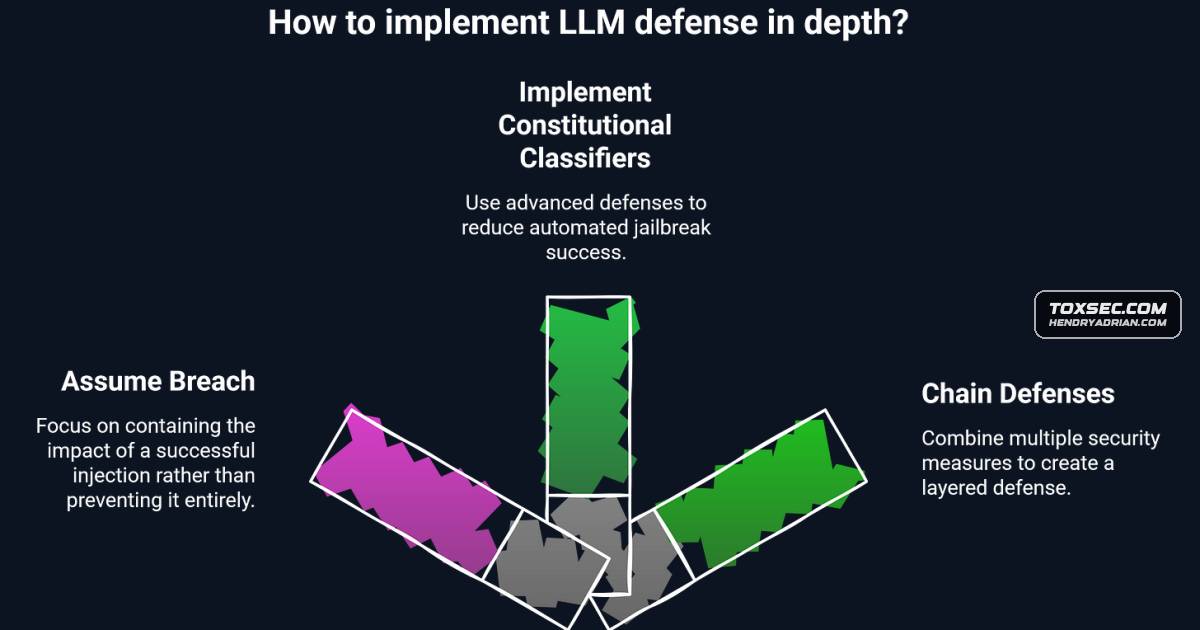
- It reports that Anthropic’s Constitutional Classifiers reduced automated jailbreak success from 86% to 4.4%, but a later public bounty found a universal bypass.
Article Details
- Defense Focus
- Contain prompt-injection blast radius by treating the model as untrusted and enforcing deterministic controls outside it.
- Detection Methods
- Baseline normal model behavior and alert on deviations.
- Monitor tool calls and output patterns at the application layer.
- Test what an injected prompt can reach after it succeeds, rather than testing only whether injection is possible.
- Data Sources
- Model behavior baselines
- Tool-call activity
- Model output and output-rendering activity
- Platforms
- LLM applications
- MCP servers
- Isolated container environments for tool execution
- Defensive Actions
- Label system prompts as trusted and user input, retrieved content, and tool output as untrusted; use those labels to gate tool calls.
- Apply least privilege to API tokens, database connections, and integrations.
- Keep credentials outside the model context and authenticate at the tool-execution boundary.
- Validate output before execution or rendering; block markdown image rendering and strip embedded URLs with query parameters where appropriate.
- Require human confirmation for actions that spend money, modify data, or send communications; treat the confirmation prompt as untrusted output.
- Sandbox tools with filesystem restrictions, no network access, and no process creation.
- Partition agents with separate credentials, tool scopes, and monitoring profiles; isolate user sessions and sanitize persistent memory before storage and retrieval.
MITRE ATT&CK
T1059.006 · PythonIn the described Vanna.AI exploit, prompt injection rewrote generated Plotly code that the ask() function passed to Python exec(), enabling arbitrary commands.T1195.001 · Compromise Software Dependencies and Development ToolsThe article reports that TeamPCP shipped backdoored LiteLLM versions to PyPI, containing a credential stealer.
CVE
Threat Actors
Vendors
Products
Constitutional ClassifiersAnthropic threw Constitutional Classifiers at the problem, one of the hardest defenses shipped to date, and reduced automated jailbreak success from 86% to 4.4%.Grok-4NeuralTrust chained Echo Chamber with Crescendo and broke Grok-4 within 48 hours of release, no explicit malicious prompt anywhere in the chain.LiteLLM#OWASPMicrosoft CopilotMicrosoft Copilot’s defense kills markdown image exfil at this layer.Vanna.AIWorst case in the catalog right now: Vanna.AI, CVE-2024-5565, CVSS 8.1.