CloudSEK Finds AI-Agent-Driven Campaign Behind 12,000 WordPress Backdoors and Crypto Theft
Summary
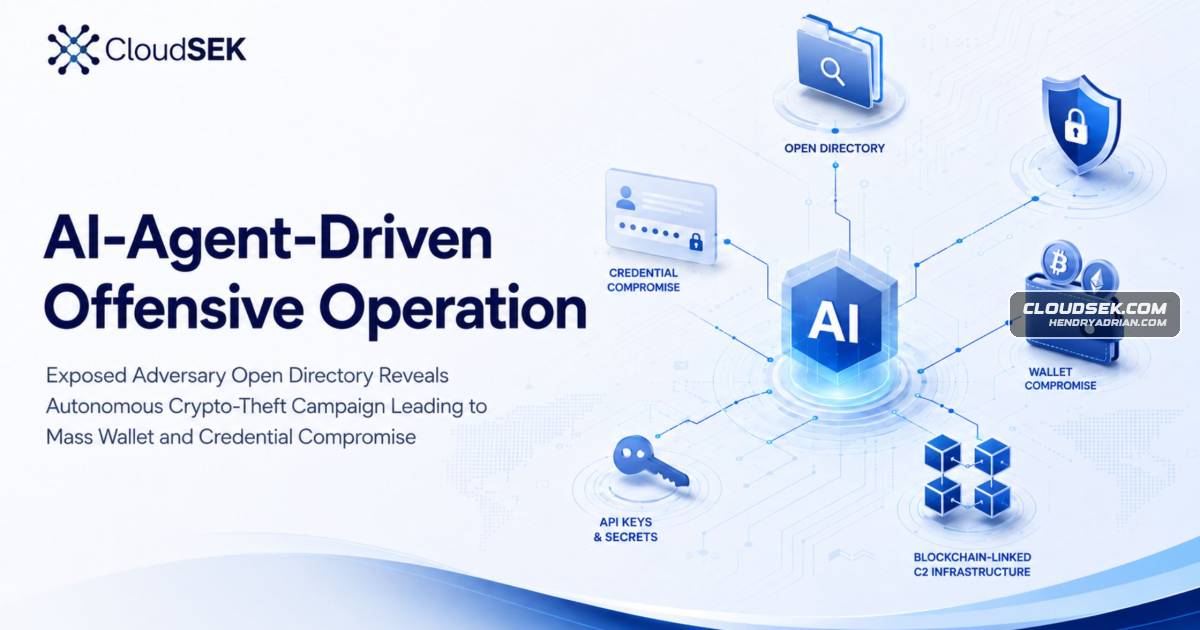
CloudSEK traced mass WordPress compromises, crypto theft, and cryptojacking to an operator using AI coding agents. An exposed directory revealed the operation; its blockchain C2 project was tested locally but never deployed.
Key points
- An unauthenticated directory listing exposed the operator’s working files, including agent transcripts, reconnaissance data, tools, and stolen material.
- The operator used AI coding agents in full-auto mode, disabling approval safeguards and tasking them through Telegram with reused fake-authorization prompts.
- A WordPress-to-webshell pipeline produced 12,048 backdoor records across 8,996 sites; separate files contained 66 sets of harvested database admin credentials.
- The operator held wallet keys and recovery phrases scraped without authentication from a third-party phishing network’s misconfigured database. The report says these wallets should be treated as compromised.
- Evidence also included validated API keys and admin tokens, exposed customer and financial data, and a Monero miner deployed on compromised hosts.
- The operator developed a blockchain-based command-and-control prototype, but CloudSEK found evidence it was only tested locally and never deployed on a live chain.
- CloudSEK recommends rotating exposed credentials, moving API keys out of client-side code, securing public data stores, sweeping affected wallets to new keys, and retaining human approval controls for AI agents.
Article Details
- Attack Vectors
- Automated exploitation of WordPress sites through a WordPress-to-webshell pipeline, creating attacker-controlled administrator accounts.
- Credential access through harvested WordPress database credentials, secrets scraped from client-side bundles, and unauthenticated reads of exposed cloud databases.
- Targeted compromise of crypto and DeFi organisations, including an authentication bypass against a trading-bot backend that exposed encrypted wallet keys.
- Scraping seed phrases and wallet keys from a third-party phishing network's publicly readable Firestore database; the article says these were phishing victims' wallets, not a breach of the legitimate upstream product.
- Cryptojacking through a disguised Monero miner deployed to compromised hosts and run in the background.
- Remote-code-execution reconnaissance using a fastjson2 deserialization kit; the article reports no successful code execution from this activity.
- Use of Telegram to task and monitor AI coding agents configured for unattended offensive activity.
- Defensive Notes
- Rotate potentially exposed credentials, API keys, SSH keys, and tokens; invalidate captured admin and session tokens, and scope API keys.
- Treat affected wallets as compromised and move funds to freshly generated keys.
- Disable internet-facing directory listings and require authentication for cloud databases and object storage; audit Firestore, S3, and equivalent stores for public access.
- Keep human approvals enabled for AI agents, avoid blanket permission-bypass flags, constrain sub-agent auto-approval, and monitor for fake authorized-target prompts and full-auto configurations.
- Move RPC and analytics API keys embedded in client-side bundles to server-side storage.
- If the DeadDropC2 design or a derivative is deployed, monitor for interactions with its identified wallet addresses, matching contract bytecode and event signatures, and periodic getStatus() calls to the listed BSC testnet RPC endpoints.
Indicators of compromise
| Type | Indicator | Context |
|---|---|---|
| IPV4 | 103[.]236[.]54[.]207 | Sister host attributed to the operator, with an identical open-directory setup previously exposed on port 18080 and an LLM proxy on port 7070. |
| IPV4 | 165[.]154[.]152[.]47 | Cloud VPS referenced in shell history and cryptojacking deployment procedures as temporary pivot or worker infrastructure. |
| IPV4 | 165[.]154[.]157[.]40 | Cloud VPS referenced in shell history and cryptojacking deployment procedures as temporary pivot or worker infrastructure. |
| IPV4 | 80[.]96[.]109[.]64 | Operator-controlled primary staging host that exposed the operator's home directory through an unauthenticated open directory listing on port 18080. |
MITRE ATT&CK
T1021.004 · SSHA recovered SSH private key was reused to obtain root access on multiple cloud hosts.T1036.005 · Match Legitimate Resource Name or LocationThe operator renamed the Monero miner to an innocuous filename and ran it from a hidden path.T1102.002 · Bidirectional CommunicationThe operator used Telegram bridges to send tasks to AI agents and collect their results.T1190 · Exploit Public-Facing ApplicationThe operator's WordPress-to-webshell pipeline exploited internet-facing WordPress sites and produced confirmed compromises; a fastjson2 deserialization RCE kit was also used for reconnaissance, without confirmed code execution.T1496.001 · Compute HijackingThe operator deployed a disguised Monero miner on compromised hosts for illicit mining revenue.T1505.003 · Web ShellThe mass WordPress exploitation pipeline is described as producing confirmed webshell compromises.T1530 · Data from Cloud StorageThe operator read wallet and seed-phrase records from a third-party phishing network's publicly accessible Firestore database.T1552.001 · Credentials In FilesThe operator scraped secrets, including API keys, from client-side bundles.T1595.002 · Vulnerability ScanningThe operator used scanning and reconnaissance tooling, including nuclei and other ProjectDiscovery-style tools, against targets; the article describes a 6,326-target fastjson2 sweep.
Vendors
HeliusMultiple providers' live paid RPC and analytics API keys (Helius, QuickNode, and similar) were extracted from client-side bundles and confirmed working against production.QuickNodeMultiple providers' live paid RPC and analytics API keys (Helius, QuickNode, and similar) were extracted from client-side bundles and confirmed working against production.
Products
Claude CodeAutonomous AI attack fleet: The operator drives multiple AI coding agents (Claude Code, Codex, and the open-source Hermes and pi agents) in full-auto mode with every safety approval disabled, tasking and monitoring themCodexAutonomous AI attack fleet: The operator drives multiple AI coding agents (Claude Code, Codex, and the open-source Hermes and pi agents) in full-auto mode with every safety approval disabled, tasking and monitoring themfastjson2The host also carried a fastjson2 deserialization RCE kit and a full ProjectDiscovery-style reconnaissance suite driven from a multi-million-host FOFA corpus. The fastjson2 activity was reconnaissance only: across aFirebasedata exposed. This operator independently found and exploited that exposure himself: he pulled the Firebase config out of the clone sites' frontend JavaScript, confirmed their Firestore databases had no securityFirestorehimself: he pulled the Firebase config out of the clone sites' frontend JavaScript, confirmed their Firestore databases had no security rules, and read every record straight from the public Firestore REST API withHermesAI attack fleet: The operator drives multiple AI coding agents (Claude Code, Codex, and the open-source Hermes and pi agents) in full-auto mode with every safety approval disabled, tasking and monitoring themPifleet: The operator drives multiple AI coding agents (Claude Code, Codex, and the open-source Hermes and pi agents) in full-auto mode with every safety approval disabled, tasking and monitoring them entirely overSolanaThe bulk of the wallet key material in the dump, hundreds of Solana wallets with addresses, private keys, and mnemonics plus their live balances, and hundreds of captured recovery passphrases and keyphrases, allTelegramagents) in full-auto mode with every safety approval disabled, tasking and monitoring them entirely over Telegram. Human-typed prompts recovered from the agents' own session transcripts show a reusable ChineseWordPressConfirmed mass compromise: Working files contain over 12,000 real WordPress backdoor records (each a unique attacker-created admin account), a separate set of 66 genuinely harvested (non-backdoor) database adminZhipu GLMApproximately 800 lines of gateway logs demonstrating the host brokering LLM API requests during at least one live intrusion session, operating a self-hosted Zhipu GLM (zai-glm5.2) proxy via LiteLLM/llmio on port 7070.
Tools
DeadDropC2directoryThe operator was developing an EtherHiding-style command-and-control system, internally named DeadDropC2, whose commands are hidden on a public blockchain, so that even if defenders seize his servers,ffuf(subfinder, httpx, katana, naabu, nuclei, ffuf)FOFAPhase 1: Asset mapping via FOFAhttpx(subfinder, httpx, katana, naabu, nuclei, ffuf)katana(subfinder, httpx, katana, naabu, nuclei, ffuf)LiteLLMApproximately 800 lines of gateway logs demonstrating the host brokering LLM API requests during at least one live intrusion session, operating a self-hosted Zhipu GLM (zai-glm5.2) proxy via LiteLLM/llmio on port 7070.llmioApproximately 800 lines of gateway logs demonstrating the host brokering LLM API requests during at least one live intrusion session, operating a self-hosted Zhipu GLM (zai-glm5.2) proxy via LiteLLM/llmio on port 7070.naabu(subfinder, httpx, katana, naabu, nuclei, ffuf)NiktoA self-initiated Nikto scan targeting the host, recovered from the operator's files.Nuclei(subfinder, httpx, katana, naabu, nuclei, ffuf)subfinder(subfinder, httpx, katana, naabu, nuclei, ffuf)wp2shellWordPress-to-webshell mass exploitation (wp2shell);
Countries
CanadaCanadaFinlandFinlandFrancethe United States alone accounts for over a quarter, and the top three countries (United States, Germany, France) make up just over half of all compromised hosts.Germanythe United States alone accounts for over a quarter, and the top three countries (United States, Germany, France) make up just over half of all compromised hosts.IndiaIndiaNetherlandsNetherlandsPolandPolandRussiaRussiaUnited KingdomUnited KingdomUnited Stateshost, yields a full geographic picture of the victims. The campaign is overwhelmingly Western: the United States alone accounts for over a quarter, and the top three countries (United States, Germany, France) make
Industries
Blockchainholds numerous validated live API keys and admin tokens for crypto exchanges, DeFi protocols, and blockchain infrastructure providers.Cryptocurrencyholding: The operator holds private keys, seed phrases, and live balances for hundreds of end-user cryptocurrency wallets. The bulk of this material was scraped with zero authentication from one phishing cloneDecentralized finance (DeFi)Gaming and paymentsA real-money gaming and payments platform's admin bearer token was captured and used to read a live withdrawal ledger containing victim names, bank details, and payout amounts.