
CYFIRMA Details Tax-Themed Phishing Campaign Delivering In-Memory Malware
Summary
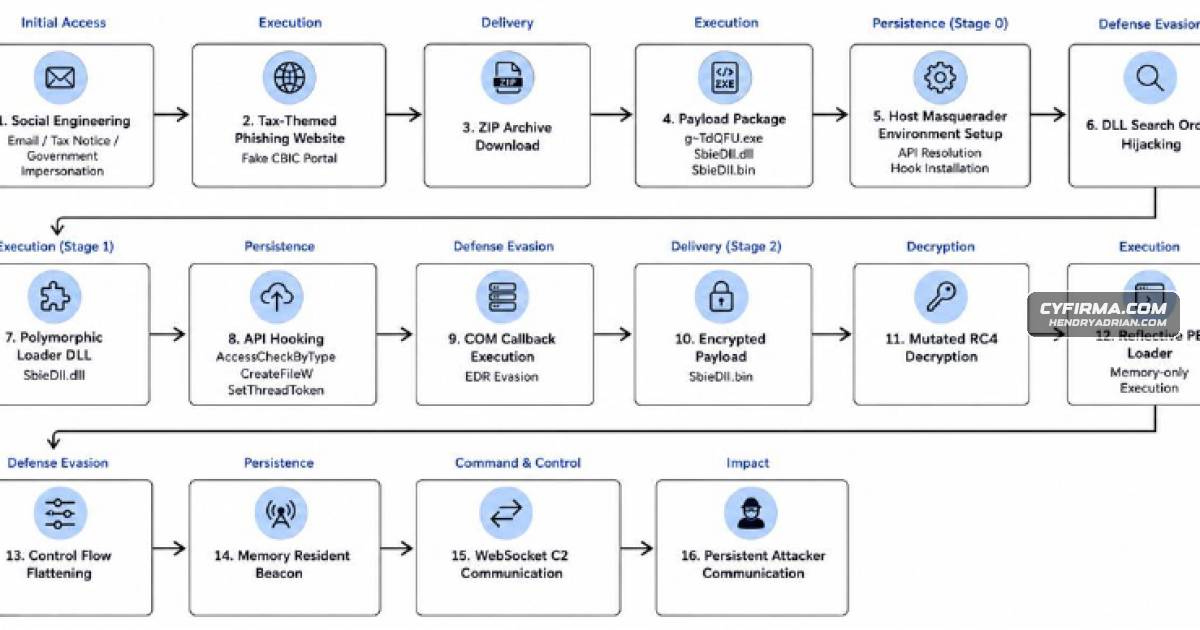
CYFIRMA analyzes Operation TaxShadow, a tax-themed phishing campaign delivering staged Windows malware via a fake portal and ZIP archive. It details DLL hijacking, token manipulation, in-memory loading and WebSocket C2; attribution remains moderate-confidence.
Key points
- The report describes fraudulent tax-notification emails redirecting targets to fake Indian and Japanese tax portals, which offered a malicious ZIP archive.
- The archive contained a loader executable, SbieDll.dll and SbieDll.bin; the report says the DLL used search-order hijacking to load the malicious component.
- Analysis describes API hooks and token manipulation, COM callback execution, and a Mersenne Twister-based dispatcher as part of the malware’s evasion behavior.
- The encrypted payload was decrypted and loaded in memory using reflective PE loading; the report also details mutated RC4 and LLVM-based control-flow flattening.
- The malware established persistent WebSocket C2 and supported HTTP CONNECT proxy communication; dynamic analysis observed communication with 43.128.54.184 over port 1234.
- The report found shared infrastructure hosting Indian- and Japanese-themed phishing pages and Chinese-language artifacts, but says attribution remains at moderate confidence.
Article Details
- Attack Vectors
- A fraudulent tax-notification email impersonated an Indian government tax authority and included a link to phishing infrastructure.
- The phishing site imitated tax portals and prompted victims to download a malicious ZIP archive containing à¤à¤° विवरण.exe, SbieDll.dll, and SbieDll.bin; execution depended on extracting and launching the executable.
- The malware used DLL Search Order Hijacking to load the malicious SbieDll.dll, then decrypted the SbieDll.bin payload and reflectively loaded it in memory.
- During observed execution, the malware injected into svchost.exe and mitmweb.exe and established WebSocket communication with 43.128.54.184 over port 1234. HTTP CONNECT support indicated proxy awareness.
- Defensive Notes
- Train users to recognize government-impersonation emails, urgent tax-related lures, malicious links, and unexpected ZIP attachments.
- Use email security controls and domain-reputation monitoring to identify spoofed sender identities and phishing infrastructure.
- Monitor for DLL Search Order Hijacking, API hooking, token manipulation, reflective PE loading, and unusual process injection.
- Use network IDS and proxy monitoring to investigate suspicious HTTP-to-WebSocket upgrades, HTTP CONNECT activity, and unusual outbound connections.
- Enable endpoint and memory monitoring, and include phishing-based intrusions, malicious DLL execution, and multi-stage payload behavior in threat hunts.
Indicators of compromise
| Type | Indicator | Context |
|---|---|---|
| DOMAIN | appradarr[.]cc | Listed as a campaign infrastructure domain and marked for blocking. |
| DOMAIN | asdqxcdsa[.]icu | Listed as a campaign infrastructure domain and marked for blocking. |
| DOMAIN | guhxmg[.]com | Listed as a campaign phishing or infrastructure domain and marked for blocking. |
| DOMAIN | mnb-ny[.]com | Identified in the phishing email analysis as the attacker-controlled domain underlying the spoofed sender identity. |
| DOMAIN | naiqja[.]icu | Listed as a campaign phishing or infrastructure domain and marked for blocking. |
| DOMAIN | ws4962[.]com | Listed as a campaign infrastructure domain and marked for blocking. |
| DOMAIN | zh-welcome-1xbet[.]com | Listed as a campaign infrastructure domain and marked for blocking. |
| DOMAIN | zhengfu666[.]com | Listed as a campaign infrastructure domain and marked for blocking. |
| HOSTNAME | d[.]pc-weide[.]com | Listed as a hostname hosting tax-themed impersonation content or related campaign infrastructure; marked for blocking. |
| HOSTNAME | taxations[.]cn-web-okooo[.]com | Listed as a hostname hosting tax-themed impersonation content or related campaign infrastructure; marked for blocking. |
| HOSTNAME | taxations[.]indiagov[.]it[.]com | Listed as a campaign phishing or infrastructure hostname and marked for blocking. |
| IPV4 | 43[.]128[.]54[.]184 | External endpoint contacted by the malware; the report identifies it as command-and-control or remote communication infrastructure. |
| MD5 | 3a8f6454927b8993aded75de0de2bd00 | Identified as the MD5 hash of the initial executable sample à¤à¤° विवरण.exe. |
| MD5 | b498256cb086a6962077cdd6d2f65327 | Identified as the MD5 hash of the encrypted shellcode component SbieDll.bin. |
| MD5 | e83ff54e58f0b295a392c7fc39a7d0de | Identified as the MD5 hash of the malicious loader DLL SbieDll.dll. |
| SHA256 | 185b7a487316454da04e9cc0fe6eb370bb2955cf6096fe3e8c02c46f8989ba37 | Listed as a malware or related sample hash for detection and blocking. |
| SHA256 | 4c9061a07d667bf7dd6f597a43a8552af2f4277b7be06d6ea138abdb668d6a49 | Listed as a malware or related sample hash for detection and blocking. |
| SHA256 | 7d87a86dbd2379ef2516c99258137cd9c25ca19c48aeb096c5332c02fcbf16d0 | Listed as a malware or related sample hash for detection and blocking. |
| SHA256 | 949acbe543fc244ffbc981ea169067da7c5792af3c3d19b2c31b3d7e19106880 | Listed as a malware or related sample hash for detection and blocking. |
| SHA256 | be31a63cad112723178289968ad6f93a576c5a7984099c42eec3521cdf6e5fc0 | Listed as a malware or related sample hash for detection and blocking. |
MITRE ATT&CK
T1027 · Obfuscated Files or InformationThe malware used mutated RC4, Control Flow Flattening, and dynamic execution logic to obfuscate its payload and behavior.T1036 · MasqueradingThe initial executable used deceptive localized naming to appear legitimate.T1055 · Process InjectionObserved execution included process injection into svchost.exe and mitmweb.exe.T1071.001 · Web ProtocolsThe malware used HTTP-based WebSocket communication for command and control.T1082 · System Information DiscoveryThe loader checked the Windows version and environment before proceeding.T1090 · ProxyHTTP CONNECT functionality indicated that the malware could communicate through enterprise proxies.T1134 · Access Token ManipulationHooks on SetThreadToken() and GetTokenInformation() manipulated tokens and impersonation contexts.T1140 · Deobfuscate/Decode Files or InformationThe malware decrypted the encrypted payload in SbieDll.bin at runtime before execution.T1204.002 · Malicious FileExecution required victims to extract the ZIP archive and launch à¤à¤° विवरण.exe.T1566.002 · Spearphishing LinkThe campaign used a tax-themed phishing email containing a malicious link to phishing infrastructure.T1573 · Encrypted ChannelThe report describes the malware's WebSocket-based communication sessions as encrypted.T1574.001 · DLLThe malware used DLL Search Order Hijacking to load the malicious SbieDll.dll in place of a legitimate library.T1620 · Reflective Code LoadingThe loader manually reconstructed and executed the decrypted PE payload in memory without using LoadLibrary().
Vendors
Products
Tools
Astral-PEThe extracted strings confirmed that the malware sample was obfuscated using the Astral-PE obfuscation tool.Detect It EasyFigure 6: Static analysis results of à¤à¤° विवरण.exe using Detect It Easy (DiE) showing PE64 architecture, Visual Studio compilation artifacts, debug information, and overlay structures, indicating its roleIDA ProSuch techniques disrupt IDA Pro graph reconstruction, reduce the effectiveness of signature-based detection, and complicate behavioural analysis, as analysts cannot easily identify the original execution sequence.SigmaDeploy Enhanced Detection Rules: Implement YARA, Sigma, and EDR detection rules to monitor indicators associated with DLL Search Order Hijacking, API Hooking, Reflective PE Loading, token manipulation, andYARADeploy Enhanced Detection Rules: Implement YARA, Sigma, and EDR detection rules to monitor indicators associated with DLL Search Order Hijacking, API Hooking, Reflective PE Loading, token manipulation, and