
Researchers Find Wallet-Draining Code in Polymarket-Associated Third-Party Script
Summary
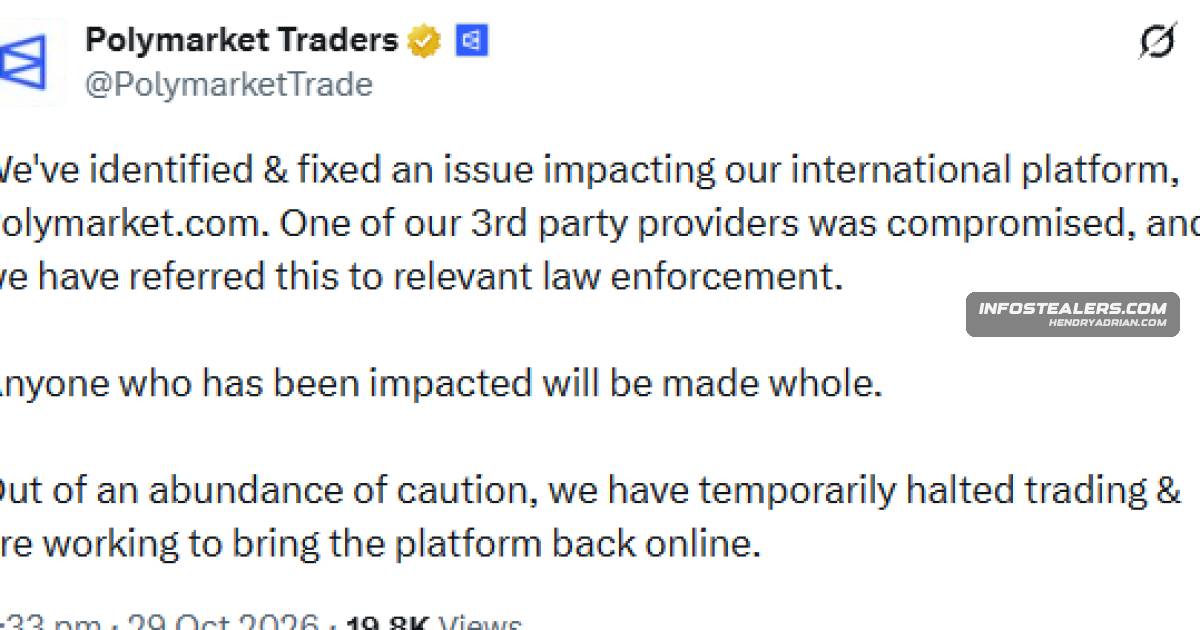
Hudson Rock reports that a retrieved DebugBear-associated script contained code targeting Polymarket trading sessions to sell or transfer assets. Polymarket build metadata records removal of the integration; affected users and losses remain unverified.
Key points
- Hudson Rock retrieved the same 15,187-byte script twice and found logic that reads account context, searches for a live trading client and signer, and inspects positions.
- The code attempts to transfer position tokens for some account types and to sell positions before transferring proceeds for others; the researchers did not execute it or sign transactions.
- The sample contains a fallback recipient address also shown in a supplied balance screenshot. The displayed holdings total about $2.19 million, but are not verified incident proceeds.
- Polymarket production build metadata records removal of the DebugBear RUM integration at 17:59:20 UTC on October 29, 2026. A homepage snapshot lacked the script reference, but this does not establish the exposure window or complete containment.
- The script contains reporting logic for wallet and device information to data[.]debugbear[.]com; the researchers did not execute the sample or verify that those requests were sent.
- The number of affected users, attributable losses, initial compromise mechanism, and attacker remain unresolved. The investigation did not establish transaction flows from victims to the recipient.
Article Details
- Attack Vectors
- Malicious JavaScript was retrieved from the specific script URL associated with Polymarket’s DebugBear RUM integration.
- The payload searched browser storage for Polymarket authentication context and traversed React component state to find the live trading client and signer.
- Depending on account type and portfolio conditions, the code attempted to sell positions or transfer tokens and proceeds to a configured recipient using signed Polygon deposit-wallet batches.
- The payload constructed reporting requests containing wallet, account, device, portfolio, and transfer-result information; the investigators did not execute those requests.
- Defensive Notes
- For potentially exposed users, reject unexpected signing or approval requests, close potentially exposed tabs, and review orders, position movements, and wallet transactions through a trusted route.
- Review sessions, API credentials, and permissions using platform support guidance; do not assume disconnecting a wallet reverses transfers or revokes on-chain approvals.
- Preserve exact response bytes, hashes, HTTP metadata, loader references, and browser request history during incident response.
- Remove unnecessary third-party integrations from authenticated trading and signing flows; investigate exact payloads and request paths rather than relying on a trusted hostname.
- Where applicable, use Subresource Integrity with a restrictive Content Security Policy and controlled update processes, and review which actions untrusted page code can request through the signer.
Indicators of compromise
| Type | Indicator | Context |
|---|---|---|
| SHA256 | 0755e767504d8103f6c27b9e765a1026507a17c04513242adb503df7777879e5 | SHA-256 of the captured malicious JavaScript payload. |
MITRE ATT&CK
T1059.007 · JavaScriptThe retrieved malicious JavaScript ran as a third-party page script and searched Polymarket’s browser-side application state for trading and signing functionality.T1657 · Financial TheftThe payload contained logic to sell eligible positions or transfer tokens and proceeds to a configured recipient; successful theft was not established.