
Seqrite Details Phishing Campaign Using AnyDesk for Persistent Access to Russian Aerospace Targets
Summary
Seqrite traced a phishing campaign targeting Russian aerospace organizations from a password-protected archive to unattended AnyDesk access, scheduled-task persistence, and SMTP exfiltration of configuration data. Rare Werewolf links are suspected, not confirmed.
Key points
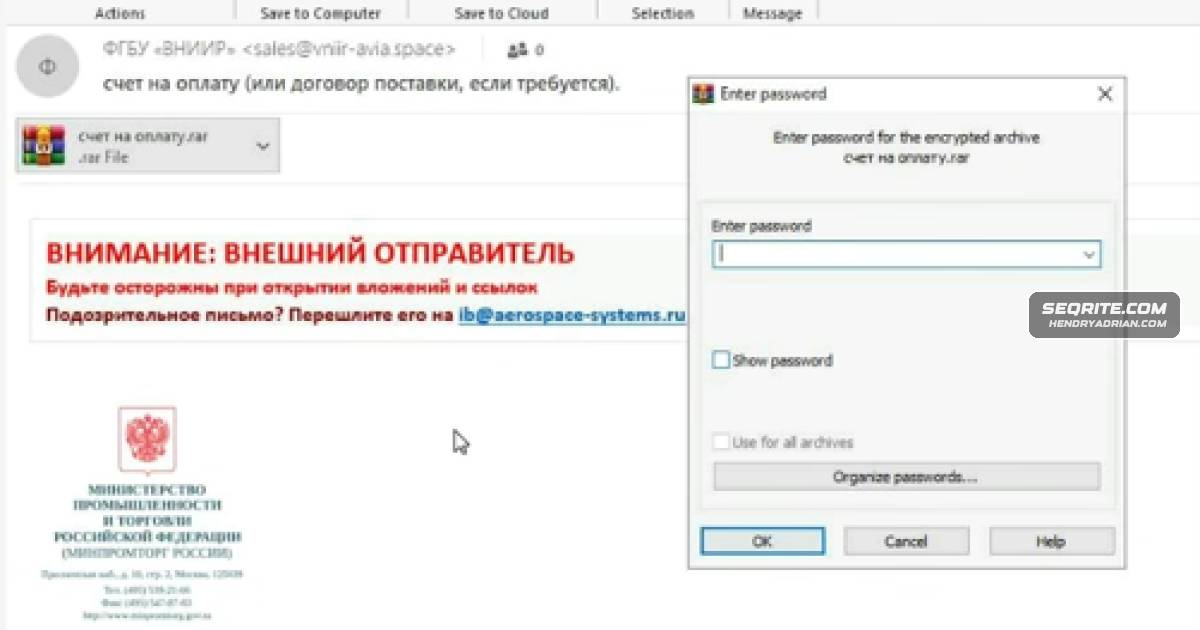
- A spear-phishing email impersonated Russian institute VNIIR and delivered a password-protected invoice-themed RAR archive.
- The dropper opened a decoy PDF, staged files, and used command scripts to retrieve and extract additional payloads.
- The payload deployed portable AnyDesk, Blat, and Tray Minimizer; a script configured unattended access with a preset password.
- A scheduled task launched Tray Minimizer at user logon, while the script deleted temporary files to reduce forensic artifacts.
- The campaign archived AnyDesk configuration data and sent it over SMTP using Blat through mail[.]versio[.]nl.
- Seqrite says the tradecraft aligns with Rare Werewolf, also known as Librarian Ghouls, but notes attribution is not definitive; its sample showed no cryptojacking.
Article Details
- Attack Vectors
- Spear-phishing email impersonating the Russian research institute Federal Budgetary Institution “VNIIR” and carrying a password-protected RAR archive.
- The extracted dropper opens a decoy PDF, writes temporary files, and uses command scripts to retrieve and extract additional payloads.
- A batch script configures unattended AnyDesk access, creates a scheduled task to launch Tray Minimizer at user logon, and deletes temporary artifacts.
- AnyDesk configuration data is archived and exfiltrated over SMTP using Blat.
- Defensive Notes
- The article lists Seqrite XDR coverage for multi-stage payload download and execution via Curl and Command Shell.
- The article lists Seqrite XDR coverage for remote access tool staging and SMTP data exfiltration.
Indicators of compromise
| Type | Indicator | Context |
|---|---|---|
| DOMAIN | aviatronika[.]online | Domain listed as campaign spoofing, staging, or exfiltration infrastructure. |
| DOMAIN | fgub-vniir[.]space | Domain listed as campaign spoofing, staging, or exfiltration infrastructure. |
| DOMAIN | nova-stream[.]site | Related campaign infrastructure domain listed in the indicators. |
| DOMAIN | vniir-avia[.]space | Lookalike domain used to send the phishing email impersonating VNIIR. |
| DOMAIN | vniir-info[.]space | Related campaign infrastructure domain listed in the indicators. |
in@okbm-bus[.]nl | Recipient account used in the campaign's SMTP exfiltration of the AnyDesk archive. | |
out@okbm-bus[.]nl | Sender account used in the campaign's SMTP exfiltration of the AnyDesk archive. | |
sales@vniir-avia[.]space | Phishing sender address used with the lookalike domain to impersonate VNIIR. | |
| IPV4 | 109[.]106[.]178[.]14 | Campaign infrastructure IP listed among the indicators. |
| IPV4 | 194[.]87[.]57[.]81 | Campaign infrastructure IP listed among the indicators. |
| IPV4 | 198[.]54[.]120[.]13 | Campaign infrastructure IP listed among the indicators. |
| IPV4 | 2[.]23[.]88[.]201 | Campaign infrastructure IP listed among the indicators. |
| SHA256 | 0dc0fa727f900ed5033f46f8ba6cf2d97d20ab95fd334cabc0f216da6e0622b0 | SHA-256 of a malicious or related campaign file, listed in the article's indicators. |
| SHA256 | 12648cd9d425f78db2dbc6e03c14f11e6ac6aadf8b3975c23cce9519e2b58d33 | SHA-256 of a malicious or related campaign file, listed in the article's indicators. |
| SHA256 | 47854deb456cb08c651b7f9ae2f9d87c72d0719de6af233340632efb3c1980f4 | SHA-256 of a malicious or related campaign file, listed in the article's indicators. |
| SHA256 | f57e010541fb4ccbf23aefc4a827f753a6ff3f8792d9c04c3eea83f6963c6bae | SHA-256 of a malicious or related campaign file, listed in the article's indicators. |
MITRE ATT&CK
T1005 · Data from Local SystemThe campaign collected AnyDesk service.conf and system.conf files from the compromised host.T1027 · Obfuscated Files or InformationThe attachment and subsequent payload archives were password-protected, with passwords supplied separately in the email or script.T1036 · MasqueradingThe phishing email impersonated VNIIR and used the lookalike domain vniir-avia.space.T1048.003 · Exfiltration Over Unencrypted Non-C2 ProtocolThe AnyDesk.rar archive was exfiltrated through SMTP using Blat.T1053.005 · Scheduled TaskThe batch script created the “Auto apdate” scheduled task to run Trays.exe at user logon.T1059.003 · Windows Command ShellBatch and .cmd scripts performed payload retrieval, extraction, persistence, and cleanup actions.T1070.004 · File DeletionThe batch script deleted temporary command, text, archive, executable, and PDF files.T1071.001 · Web ProtocolsA command script connected to C2 to download a malicious RAR file; the article's mapping identifies Curl-based web retrieval.T1204.002 · Malicious FileThe infection chain relied on the recipient opening and executing the attached archive and extracted files.T1219 · Remote Access ToolsThe campaign deployed portable AnyDesk and configured it for unattended remote access.T1560 · Archive Collected DataThe script packaged AnyDesk configuration and related files into the password-protected AnyDesk.rar archive.T1564.003 · Hidden WindowTray Minimizer was used to conceal the AnyDesk interface and reduce its visibility to the user.T1566.001 · Spearphishing AttachmentA targeted phishing email delivered a password-protected archive attachment.
Threat Actors
Products
4t Tray MinimizerWhile exploring the Trays folder, we observe it contains multiple executables, DLLs, documentation, and supporting files associated with the legitimate 4t Tray Minimizer application.AnyDeskthe Russian research institute ФÐУ “ÐÐÐÐÐ ” to deliver a password-protected archive that stages AnyDesk, Blat, and Tray Minimizer for persistent remote access and data exfiltration.Smart Install Maker Delphi and programming language used is Pascal. One of the most interesting findings is Installer: Smart Install Maker (5.04), this tells us the executable is not just an application; it is an installer package builtWinRARSubsequent stages leverage trusted utilities such as AnyDesk, Blat and WinRAR, while additional utilities such as Tray Minimizer are used to reduce user visibility.
Tools
Countries
Industries
AerospaceThe phishing email impersonates a legitimate Russian research institute associated with aerospace and aviation systems and is delivered using a spoofed domain designed to mimic the organization.ElectronicsDuring analysis, we observed that the initial access starts with a spear-phishing email targeting Russian aerospace and electronics sectors.