
Report Examines AI-Accelerated Industrial Espionage
Summary
CYFIRMA examines six ways AI can enable industrial espionage, from agentic intrusions and synthetic identities to model theft and voice cloning, while distinguishing reported cases from speculative risks.
Key points
- The report reviews public activity from roughly June 2025 through July 2026 and identifies six AI-related espionage vectors.
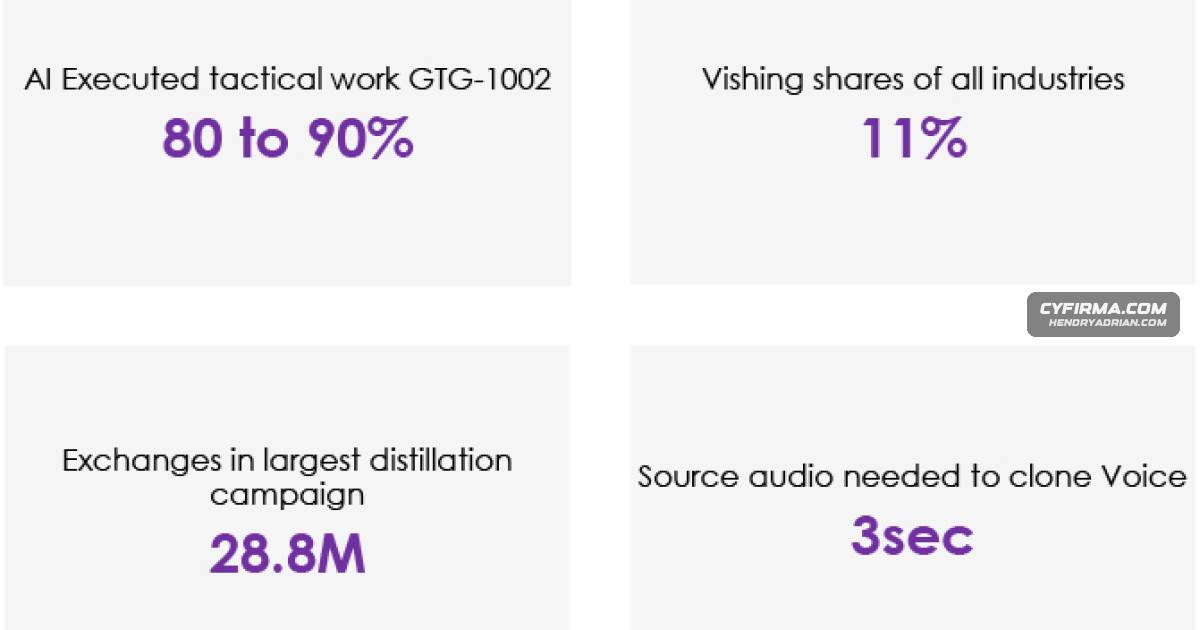
- Anthropic attributed an estimated 80–90% of tactical work in the GTG-1002 campaign to AI; the report notes that independent researchers questioned aspects of the disclosure.
- Mandiant described PROMPTFLUX as a self-rewriting dropper, PROMPTSTEAL as generating document-theft commands with an LLM, and QUIETVAULT as targeting AI tool credentials.
- Anthropic reported suspected model-distillation campaigns involving millions of queries and tens of thousands of fake accounts.
- The report distinguishes documented AI supply-chain risks from their proposed use in espionage, for which it identifies no named case.
- CYFIRMA recommends independent verification of sensitive requests, phishing-resistant MFA, monitoring AI tool egress and reviewing synthetic-identity risks.
Article Details
- Publisher
- CYFIRMA
- Report Period
- Approximately June 2025 through July 2026
- Scope
- Publicly reported AI-accelerated industrial espionage and related security risks, with separate forward assessments.
- Key Statistics
- Anthropic estimated that AI performed 80–90% of tactical operations in the GTG-1002 campaign, which targeted roughly 30 organizations; independent researchers questioned aspects of the disclosure.
- Mandiant reported that UNC3944 progressed from help-desk vishing to domain administrator privileges in roughly 40 minutes.
- Mandiant reported that highly interactive vishing accounted for 11% of observed intrusions.
- The reported ShinyHunters breach of Charter Communications obtained 4.9 million records.
- Anthropic reported approximately 16 million queries from 24,000 fake accounts in one suspected distillation campaign and 28.8 million queries from 25,000 accounts in a second campaign tied to Qwen models.
- Recommendations
- Eliminate voice-only verification for help-desk and other high-risk requests, and deploy phishing-resistant multi-factor authentication.
- Assign AI systems a named risk owner and govern them as critical assets.
- Extend insider-threat and vendor-access programs to address synthetic identity fraud.
- Extend data loss prevention monitoring to AI tool egress and review AI vendor data retention terms.
- Rate-limit and monitor customer-facing AI products for high-volume model or logic extraction.
MITRE ATT&CK
T1078 · Valid AccountsReported North Korean IT worker operations used fabricated identities to obtain legitimate employment and associated access.T1566.004 · Spearphishing VoiceThe report describes vishing used to obtain access, including help-desk attacks and the reported Charter Communications breach.T1588.007 · Artificial IntelligenceAnthropic reported that GTG-1002 used AI capabilities to perform much of its tactical intrusion work; aspects of that disclosure were questioned by independent researchers.
Threat Actors
APT28Mandiant attributed PROMPTSTEAL, which queries an LLM to generate document-theft commands, to this group.GTG-1002Anthropic attributed an AI-assisted intrusion campaign targeting roughly 30 organizations to this Chinese state-linked group; independent researchers questioned aspects of the claims.Scattered SpiderThe report associates the group with reconnaissance and live vishing against help desks.ShinyHuntersThe report states that the group used vishing to breach Charter Communications and obtain records in April 2026.UNC3944Mandiant reported that the group moved from help-desk vishing to domain administrator privileges in approximately 40 minutes.
Malware
PROMPTFLUXThe report ties these changes to named cases including GTG-1002, PROMPTFLUX, PROMPTSTEAL, Scattered Spider, ShinyHunters, and the North Korean IT worker campaigns, while warning that AI-driven espionage willPROMPTSTEALThe report ties these changes to named cases including GTG-1002, PROMPTFLUX, PROMPTSTEAL, Scattered Spider, ShinyHunters, and the North Korean IT worker campaigns, while warning that AI-driven espionage willQUIETVAULTMandiant reported AI-native malware such as PROMPTFLUX, PROMPTSTEAL, and QUIETVAULT, showing malware that can query AI models during execution.
Industries
ChemicalsChemicals and manufacturing companies might seem like an unlikely target for an AI-driven threat, but they were named specifically in the GTG-1002 disclosure, a useful reminder that this is not a software-industryfinanceAI Voice Cloning and Synthetic Pretext: Real-time, conversational cloned voices used to defeat the human trust that help desks, finance teams, and executives rely on.GovernmentEverything in it is drawn from public sources: vendor threat intelligence disclosures, court filings, government advisories, and breach reporting.Technologyto reduce the cost, time, and skill required at any stage of stealing proprietary information, technology, or competitive advantage.