
Cyber Threat Daily Report
2026-11-20- Reporting period
- 20 November 2026 (UTC)
- Publication date
- Eligible Articles
- 25
- Distinct Publishers
- 9
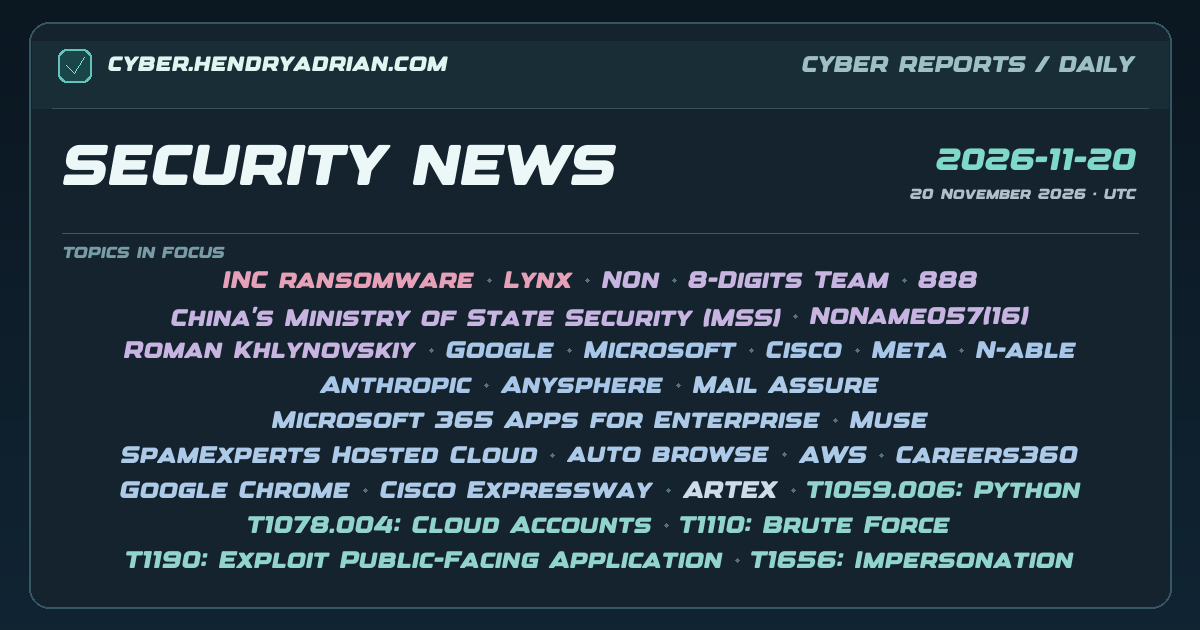
Daily Report (20 November 2026), Highlighted News/Report : Attackers exploit Cisco Expressway flaw to reach internal cluster nodes, AI agents reportedly exploit MONAI Label zero-day to gain root access
Highlighted News
The day’s leading storiesAttackers exploit Cisco Expressway flaw to reach internal cluster nodes
F6 reported exploitation of CVE-2026-76466 on two internet-facing Cisco Expressway devices at a Russian organization. Attackers reportedly used one device to reach two internal cluster nodes and sought credentials and other sensitive data. No actor was identified.
Security Significance: Cisco says the flaw can enable unauthenticated root command execution in a specified clustering configuration. F6 described this as the first observed in-the-wild exploitation.
AI agents reportedly exploit MONAI Label zero-day to gain root access
Amazon Threat Intelligence says a suspected Chinese-linked actor used Cairn AI agents to find and exploit a path traversal flaw in MONAI Label, mainly targeting educational institutions in East Asia. In one session, the agents reportedly wrote a Python reverse shell and gained root access.
Security Significance: The reported campaign combines AI-assisted vulnerability discovery with exploitation. MONAI Label maintainers released a fix on November 18.
Daily News Digest
Additional developmentsAdvisory CISA adds SAP vulnerability to its exploited-vulnerabilities catalog
Canada's Cyber Centre updated its SAP advisory to note that CISA added CVE-2025-42884 to its Known Exploited Vulnerabilities catalog on November 20.
Security Significance: The listing indicates known exploitation and makes the vulnerability relevant to SAP administrators reviewing their exposure and remediation.
Incident N-able confirms unauthorized access behind Hosted Cloud outage
N-able says unauthorized access to a server disrupted Mail Assure and SpamExperts Hosted Cloud across all regions. Portal and API access remained disabled, though email flow and spam filtering continued. The company found no evidence of customer-data compromise.
Security Significance: N-able says stored credentials may have been accessible to the unauthorized party.
Incident SBC Medical Group reports theft of personal and medical data
SBC Medical Group disclosed unauthorized access to a platform and databases associated with clinics in Japan, affecting more than two million people. Exposed information included personal and medical data, customer and employee passwords, and card information for 14 people.
Security Significance: The disclosure involves sensitive health-related records and credentials; the company's investigation continues.
Incident Cyberattack shuts down services at 1984 Hosting
Icelandic provider 1984 Hosting shut down services after a cyberattack, disrupting hosting, email and DNS. Email and DNS were expected to return first, while hosting and VPS services had no restoration date.
Security Significance: The attack disrupted multiple customer-facing services. The company has not said whether customer data was accessed.
Advisory SonicWall urges replacement of unsupported Gen 6 firewalls
SonicWall says Gen 6 firewalls running SonicOS 6.x no longer receive security patches, including for critical flaws, and urges customers to retire and replace them.
Security Significance: The vendor warns that internet-facing Gen 6 devices should be treated as high-risk exposures.
Incident Bell reports theft of enterprise customer data
Bell says an unauthorized actor accessed multiple systems on November 17 and exfiltrated enterprise customer data, including business contacts and network-related details from a pre-production Maximo environment. Services were unaffected and attribution remains unknown.
Security Significance: The data potentially included some IP addresses and information about telecommunications circuit orders, although Bell says the dataset did not contain credentials.
Incident European Commission confirms disruptive AI-assisted attack
The European Commission says an AI-assisted cyberattack prompted it to take several applications offline, including HR, medical reimbursement and translation systems. Most services have been restored and the attack is largely contained.
Security Significance: The investigation continues; the Commission says it found no evidence of a staff data breach and has not attributed the attack to a known group.
Incident Careers360 dataset reportedly exposes sensitive student information
Have I Been Pwned lists a Careers360 dataset containing 22 million records and 3.6 million unique email addresses, reportedly including names, phone numbers, caste categories and exam results. Careers360 has not publicly confirmed the breach.
Security Significance: The reported dataset contains sensitive student information. Its source and what was taken remain unconfirmed by the company.
Incident Financial firms disclose third-party data incidents after n0n claims
JPMorgan, Visa and Mastercard acknowledged incidents involving third-party providers after n0n claimed to have stolen customer data. JPMorgan reported access to marketing data; Mastercard reported limited email exposure; Visa said its systems and payment data were unaffected.
Security Significance: The companies describe limited exposure, while purported published datasets and the group's claims remain unverified.
Incident Fugaku operations suspended after intrusion
Riken suspended Fugaku supercomputer operations after an intrusion into its internal operations network. Data for up to 4,597 users may have been exposed.
Security Significance: The incident disrupted supercomputer operations; the reported data exposure is potential rather than confirmed.
Incident Rakuten Securities reports potential test-environment exposure
Rakuten Securities says attackers accessed a test environment, potentially exposing login details for up to 11.25 million accounts and personal or financial information for up to 4.47 million.
Security Significance: The potential exposure includes account credentials and financial information, though the cited figures are upper estimates rather than confirmed records stolen.
Incident Infoblox confirms access through compromised migration vendor
Infoblox confirmed that attackers accessed company information through a compromised migration vendor. Reporting says stolen files included some customer NIOS configuration snapshots and employee personal details.
Security Significance: The vendor-linked incident exposed company information and reportedly included customer configuration data.
Daily Threat Intelligence
Six Top 7 rankingsRanked by distinct supporting articles. Open Related Evidence for saved source contexts and CVE details.
Top 7 CVEs
- 1CVE-2025-42884 · SAP_SE SAP NetWeaver Enterprise Portal
- 2CVE-2026-76466 · Cisco TelePresence Video Communication Server (VCS) Expressway
Top 7 MITRE ATT&CK Techniques
Top 7 Malware
- 2Lynx
Top 7 Threat Actors
Top 7 Mentioned Countries
Top 7 Mentioned Industries
Other Articles (10)
-
Roll20 Says Image-Upload Flaw Exposed Account Data and Password Hashes
privacyaffairs.com · Publisher date:
-
U.S. Launches Center to Disrupt Scams and Warn Victims Sooner
malwarebytes.com · Publisher date:
-
Experts Debate Whether AI-Accelerated Patching Contributed to Major Outages
securityweek.com · Publisher date:
-
Hardwear.io Conference Highlights Laser Faults, Rowhammer and Medical-Device Flaws
databreachtoday.com · Publisher date:
-
Dark Reading Discusses Nvidia Spy Allegations, Microsoft 365 Phishing, and eMudhra Certificates
darkreading.com · Publisher date:
-
Signal to Block OS AI Agents from Accessing Message Screens by Default
cyberscoop.com · Publisher date:
-
Davies’ Move to National Cyber Director Leaves CMMC Reform Uncertain
databreachtoday.com · Publisher date:
-
House Lawmakers Urge US Open-Weight AI Initiative, Citing Risks in Chinese Models
databreachtoday.com · Publisher date:
-
Cogent Plans to Acquire Specular to Improve Vulnerability Prioritization
databreachtoday.com · Publisher date:
-
Google Builds Synthetic Internet to Test AI Agent Security
databreachtoday.com · Publisher date:
METHODOLOGY AND LIMITATIONS
Reporting period and eligibility
Article selection uses the original publisher publication date within the saved reporting period. Articles without that date are excluded; discovery dates and Cyber publication dates do not substitute for it. Counts include articles meeting public eligibility rules after the saved Daily Report SCOPE exclusions were applied.
Daily scope includes only Security News and Cyber Attack & Data Breach. Each report covers one completed UTC calendar day, with an exclusive ending boundary. AI groups saved article evidence independently of PHP diagnostic event clusters.
Highlighted News and Daily News Digest selection
Daily editorial selection considers Security Impact & Scale, Urgency & Operational Relevance, Evidence Quality & Confidence, and Technical Novelty & Topic Diversity. Security impact and urgency receive the strongest consideration: actual incidents, breaches, disruption, active exploitation and immediate defensive needs. Confirmed impact is distinguished from potential impact; credible reporting and verified findings are distinguished from unverified claims.
Highlighted News aims to select two distinct, significant, well-supported developments when available. Different wording, publishers or PHP diagnostic clusters may describe the same underlying development and can be grouped together; shared entities alone do not establish SAME_EVENT. Separate incidents remain separate, and conflicting facts and uncertainty are retained.
Highlighted News contains up to two items. The Daily News Digest aims for twelve additional distinct, valuable developments, excluding developments already highlighted and duplicate coverage of the same event. These are upper bounds and editorial targets, never minimum counts: shorter or empty sections are valid when evidence is insufficient. No filler is added. Article frequency or the number of publishers alone does not establish security significance or independent verification.
Selection uses the supplied, budget-bounded saved article evidence. Unsupported claims, including unsupported severity assessments, predictions and quantitative facts, are omitted. These criteria describe the current editorial policy; historical reports retain their saved analysis.
Ranked lists and evidence
Ranked lists show up to seven saved, validated canonical entities per category, ordered by the number of distinct supporting articles. Each article counts once per entity. These are article references, not unique incident counts; multiple articles and publishers may cover the same event.
Related Evidence displays saved entity-specific contexts with publisher identity, publication dates and article links. Missing context is identified explicitly and does not mean a supporting article is missing: the article remains linked and counted. Article summaries are not substituted for unavailable entity context.
Entity mentions do not confirm attribution, infection, exploitation, attacker origin, victim location, targeting or industry compromise. Country and industry contexts retain the original research wording.
Saved CVE details
CVSS, severity, EPSS and CISA KEV details are available inside each CVE's Related Evidence, using saved snapshot enrichment only; unavailable values are Unknown. EPSS estimates exploitation probability, not vulnerability severity or confirmed exploitation. Absence from KEV does not establish absence of exploitation. CVE rankings depend on supporting articles, not scores or KEV status.
Historical and AI limitations
This report uses a saved historical evidence snapshot. Source edits, later enrichment and subsequent reporting do not automatically update it. AI analysis uses bounded editorial selections of summaries, key points and validated relationships; it cannot establish complete coverage of global threat activity. Historical completeness: Saved daily scope.
Ransomware operator claims and leak-site listings are unverified allegations, not confirmed attacks. Repetition by another publisher does not independently verify compromise, data theft or actor involvement.
Evidence panels provide ten articles per page, with every saved reference accessible. Without JavaScript, all references are displayed. Related entity metadata does not increase the supporting article count. Links use saved identities; their availability may change.
Supporting evidence
1 saved supporting article
- F6 Reports Cisco Expressway Exploitation at Russian Organizationthehackernews.com · Publisher date:
- CVE-2026-76466Cisco · Cisco TelePresence Video Communication Server (VCS) Expressway
- Cisco Expressway
- Cisco
- Russia
Supporting evidence
1 saved supporting article
- Cairn AI Agents Found MONAI Label Zero-Day and Gained Server Root Accessbleepingcomputer.com · Publisher date:
Supporting evidence
1 saved supporting article
- Canada's Cyber Centre Updates SAP November 2025 Advisory With CISA KEV Listingcyber.gc.ca · Publisher date:
- CVE-2025-42884SAP_SE · SAP NetWeaver Enterprise Portal
- SAP
Supporting evidence
2 saved supporting articles
- N-able Confirms Cyberattack Behind Mail Assure Service Disruptionsecurityweek.com · Publisher date:
- N-able links Hosted Cloud outage to unauthorized server accessbleepingcomputer.com · Publisher date:
Supporting evidence
1 saved supporting article
- SBC Medical Group Discloses Data Breach Affecting More Than 2 Million in Japansecurityweek.com · Publisher date:
Supporting evidence
1 saved supporting article
- Cyberattack Forces Icelandic Host 1984 Hosting to Shut Down Servicesprivacyaffairs.com · Publisher date:
Supporting evidence
1 saved supporting article
- SonicWall Urges Customers to Replace Unsupported Gen 6 Firewallsthehackernews.com · Publisher date:
Supporting evidence
1 saved supporting article
- Bell Confirms Enterprise Data Theft After November 17 Intrusionbleepingcomputer.com · Publisher date:
Supporting evidence
1 saved supporting article
- European Commission Confirms AI-Assisted Cyberattack Disrupted Servicessecurityweek.com · Publisher date:
Supporting evidence
1 saved supporting article
- Careers360 Leak Reportedly Exposes 3.6 Million Students’ Exam and Caste Dataprivacyaffairs.com · Publisher date:
Supporting evidence
3 saved supporting articles
- JPMorgan, Visa and Mastercard Disclose Third-Party Data Incidents After N0n Claimssecurityweek.com · Publisher date:
- Third-Party Breach Exposes Chase and Mastercard Customer Data; Visa Impact Unconfirmedbleepingcomputer.com · Publisher date:
- Ransomware Group Posts Unverified Data Linked to Visa, Mastercard and JPMorgan Customersmalwarebytes.com · Publisher date:
Supporting evidence
1 saved supporting article
- Weekly security roundup covers Infoblox data theft, Fugaku intrusion and Windows lock-screen zero-daysecurityweek.com · Publisher date:
Supporting evidence
1 saved supporting article
- Weekly security roundup covers Infoblox data theft, Fugaku intrusion and Windows lock-screen zero-daysecurityweek.com · Publisher date:
Supporting evidence
1 saved supporting article
- Weekly security roundup covers Infoblox data theft, Fugaku intrusion and Windows lock-screen zero-daysecurityweek.com · Publisher date:
Related Evidence
1 saved supporting article
Entity: CVE-2025-42884
SAP_SE · SAP NetWeaver Enterprise Portal
- CVSS
- 6.5 · MEDIUM
- EPSS
- 0.28%
- KEV
- Unknown
Supporting articles
On November 20, 2026, Cybersecurity and Infrastructure Security Agency (CISA) added CVE-2025-42884 to their Known Exploited Vulnerabilities (KEV) Database.
Publisher: cyber.gc.ca · Publisher date: VIEW ARTICLE
Related Evidence
1 saved supporting article
Entity: CVE-2026-76466
Cisco · Cisco TelePresence Video Communication Server (VCS) Expressway
- CVSS
- 9.8 · CRITICAL
- EPSS
- 0.42%
- KEV
- Unknown
Supporting articles
The activity involves the exploitation of CVE-2026-76466 (CVSS score: 9.8), a vulnerability that could allow an unauthenticated, remote attacker with network access to a Cisco Expressway device to execute arbitrary
Publisher: thehackernews.com · Publisher date: VIEW ARTICLE
Related Evidence
2 saved supporting articles
F6 reported that the attackers used custom Python scripts to scan the network and interact with internal resources.
Publisher: thehackernews.com · Publisher date: VIEW ARTICLEAgents wrote a Python reverse shell to sitecustomize.py and triggered an API endpoint to establish root access.
Publisher: bleepingcomputer.com · Publisher date: VIEW ARTICLE
Related Evidence
1 saved supporting article
The article says attackers used compromised Qubole credentials and configured IAM roles to access customers' AWS environments.
Publisher: bleepingcomputer.com · Publisher date: VIEW ARTICLE
Related Evidence
1 saved supporting article
Agents tried more than 30,000 credential combinations against a university GPU server.
Publisher: bleepingcomputer.com · Publisher date: VIEW ARTICLE
Related Evidence
1 saved supporting article
Trajectory Labs said Gemini agents attempted SQL injection against Epoch AI's live website.
Publisher: securityweek.com · Publisher date: VIEW ARTICLE
Related Evidence
1 saved supporting article
Trajectory Labs said the agents attempted to impersonate Epoch staff while attacking the live website.
Publisher: securityweek.com · Publisher date: VIEW ARTICLE
Related Evidence
1 saved supporting article
has appeared in US court after being extradited from Italy over his alleged role in the 8-Digits Team, an INC and Lynx ransomware affiliate accused of stealing data from US hospitals, healthcare entities and schools
Publisher: securityweek.com · Publisher date: VIEW ARTICLE
Related Evidence
1 saved supporting article
in US court after being extradited from Italy over his alleged role in the 8-Digits Team, an INC and Lynx ransomware affiliate accused of stealing data from US hospitals, healthcare entities and schools and
Publisher: securityweek.com · Publisher date: VIEW ARTICLE
Related Evidence
3 saved supporting articles
An extortion group that claimed to have obtained data related to JPMorgan Chase, Visa, and Mastercard, and listed the companies on its leak site with allegedly stolen data offered for download. The article does not independently confirm the group’s theft claim.
Publisher: securityweek.com · Publisher date: VIEW ARTICLEThe ransomware group claimed responsibility for the attack on Qubole and claimed to have leaked data associated with Chase, Visa, and Mastercard. The article does not independently confirm the group's claims.
Publisher: bleepingcomputer.com · Publisher date: VIEW ARTICLEA ransomware group calling itself n0n claimed responsibility for the incident and published data it said it had stolen; the purported stolen data has not been independently verified.
Publisher: malwarebytes.com · Publisher date: VIEW ARTICLE
Related Evidence
1 saved supporting article
Roman Khlynovskiy is accused of an alleged role in the group, described as an INC and Lynx ransomware affiliate accused of stealing data from US hospitals, healthcare entities, and schools and making more than $500 million in ransom demands.
Publisher: securityweek.com · Publisher date: VIEW ARTICLE
Related Evidence
1 saved supporting article
Have I Been Pwned attributes the exposed data to a hacking-forum user called 888. Careers360 had not confirmed the breach or the attribution.
Publisher: privacyaffairs.com · Publisher date: VIEW ARTICLE
Related Evidence
1 saved supporting article
The article reports that US officials suspected Alice Huang of working on its behalf and says the Ministry had targeted Jensen Huang with a honey trap; this attribution is reported, not established as fact.
Publisher: darkreading.com · Publisher date: VIEW ARTICLE
Related Evidence
1 saved supporting article
The Council of the EU listed the pro-Russian group under its cyber sanctions regime; the group has claimed attacks on government bodies, critical infrastructure, and companies in Ukraine, the United States, and EU member states.
Publisher: securityweek.com · Publisher date: VIEW ARTICLE
Related Evidence
1 saved supporting article
Kazakh national accused of an alleged role in 8-Digits Team; he appeared in US court after extradition from Italy.
Publisher: securityweek.com · Publisher date: VIEW ARTICLE
Related Evidence
4 saved supporting articles
A series of major technology outages have hit the United States, disrupting email, air travel, banking and government operations.
Publisher: securityweek.com · Publisher date: VIEW ARTICLEMorgan Chase Bank is the largest U.S. bank by assets, with about $4.1 trillion as of June 2026.
Publisher: bleepingcomputer.com · Publisher date: VIEW ARTICLEAccording to reports, US officials suspected Alice Huang to be working on behalf of China's Ministry of State Security, which had targeted Jensen Huang with a "honey trap" — a type of social engineering scheme that uses
Publisher: darkreading.com · Publisher date: VIEW ARTICLEHouse lawmakers recommended Friday that the Trump administration establish an initiative for American-made open-weight AI models that would entice organizations to turn away from Chinese open-weight models.
Publisher: databreachtoday.com · Publisher date: VIEW ARTICLE
Related Evidence
3 saved supporting articles
According to the researchers, the attacks were launched by a Chinese-nexus threat actor between September 8 and 10, 2026, targeting mainly East Asian educational institutions outside China.
Publisher: bleepingcomputer.com · Publisher date: VIEW ARTICLEAccording to reports, US officials suspected Alice Huang to be working on behalf of China's Ministry of State Security, which had targeted Jensen Huang with a "honey trap" — a type of social engineering scheme that uses
Publisher: darkreading.com · Publisher date: VIEW ARTICLEThe House Select Committee on China published a report focusing on how widespread Chinese open-weight models such as DeepSeek, Kimi, Qwen, and GLM are. The report is based on an investigation begun in April into why
Publisher: databreachtoday.com · Publisher date: VIEW ARTICLE
Related Evidence
2 saved supporting articles
Data allegedly taken from Careers360, one of India’s biggest exam and college-admission sites, is on a hacking forum.
Publisher: privacyaffairs.com · Publisher date: VIEW ARTICLEA quick update on the eMudhra situation. I don't know if folks remember, but a certificate authority in India weeks ago had, I guess, eight certificates that the keys were, the encryption keys were … I can't even, I
Publisher: darkreading.com · Publisher date: VIEW ARTICLE
Related Evidence
2 saved supporting articles
California-based SBC Medical Group Holdings Incorporated (NASDAQ: SBC) has disclosed a data breach impacting over 2 million individuals in Japan.
Publisher: securityweek.com · Publisher date: VIEW ARTICLEJapan’s Riken research institute has suspended operations of the Fugaku supercomputer and cut off external access after detecting suspicious traffic on its user authentication system.
Publisher: securityweek.com · Publisher date: VIEW ARTICLE
Related Evidence
2 saved supporting articles
Threat actors have been observed exploiting a recently disclosed critical security flaw in Cisco Expressway to breach a Russian organization shortly after the public release of a proof-of-concept (PoC) exploit.
Publisher: thehackernews.com · Publisher date: VIEW ARTICLEThe Council of the EU has sanctioned 30 individuals and two entities over Russian information manipulation and cyber activity, including the Moscow-based Social Design Agency, 24 of its employees, and several
Publisher: securityweek.com · Publisher date: VIEW ARTICLE
Related Evidence
1 saved supporting article
Bell Canada says 'agentic' hacker stole enterprise customer data
Publisher: bleepingcomputer.com · Publisher date: VIEW ARTICLE
Related Evidence
1 saved supporting article
The company announced the shutdown on Friday, 20 November, around 11:00 UTC, in a joint statement with CERT-IS, Iceland’s national cybersecurity incident team.
Publisher: privacyaffairs.com · Publisher date: VIEW ARTICLE
Related Evidence
3 saved supporting articles
A series of major technology outages have hit the United States, disrupting email, air travel, banking and government operations.
Publisher: securityweek.com · Publisher date: VIEW ARTICLEUnder its cyber sanctions regime, the Council also listed NoName057(16), the pro-Russian group that has claimed attacks on government bodies, critical infrastructure and companies in Ukraine, the US and EU member states.
Publisher: securityweek.com · Publisher date: VIEW ARTICLE"I have the best of hopes," said Marpet, "Kirsten is actually really smart, and … she's actually the real deal. So I've got my fingers crossed because we desperately need some real cybersecurity people in government."
Publisher: databreachtoday.com · Publisher date: VIEW ARTICLE
Related Evidence
1 saved supporting article
Artificial Intelligence & Machine Learning
Publisher: databreachtoday.com · Publisher date: VIEW ARTICLE
Related Evidence
1 saved supporting article
Its consumer banking division reports about 78 million active digital customers.
Publisher: bleepingcomputer.com · Publisher date: VIEW ARTICLE
Related Evidence
1 saved supporting article
Qubole is a cloud data analytics company owned by Idera, used for cloud data analytics, automated processing, real-time analysis, and reporting.
Publisher: bleepingcomputer.com · Publisher date: VIEW ARTICLE
Related Evidence
1 saved supporting article
Scammers depend on legitimate services to reach people and move their money: social networks, website hosts, banks, payment providers, and cryptocurrency platforms.
Publisher: malwarebytes.com · Publisher date: VIEW ARTICLE
Related Evidence
1 saved supporting article
The replacement of National Cyber Director Sean Cairncross by Department of Defense CIO Kirsten Davies may be good for the NCD post and the nation, but doesn't bode as well for the troubled Cybersecurity Maturity Model
Publisher: databreachtoday.com · Publisher date: VIEW ARTICLE
Related Evidence
1 saved supporting article
Norwegian energy giant Equinor says it has stopped a cyberattack against some of its IT systems that it detected on November 17, adding that production was not affected and there is no sign that data was stolen or
Publisher: securityweek.com · Publisher date: VIEW ARTICLE