
Cyber Threat Daily Report
2026-11-10- Reporting period
- 10 November 2026 (UTC)
- Publication date
- Eligible Articles
- 36
- Distinct Publishers
- 10
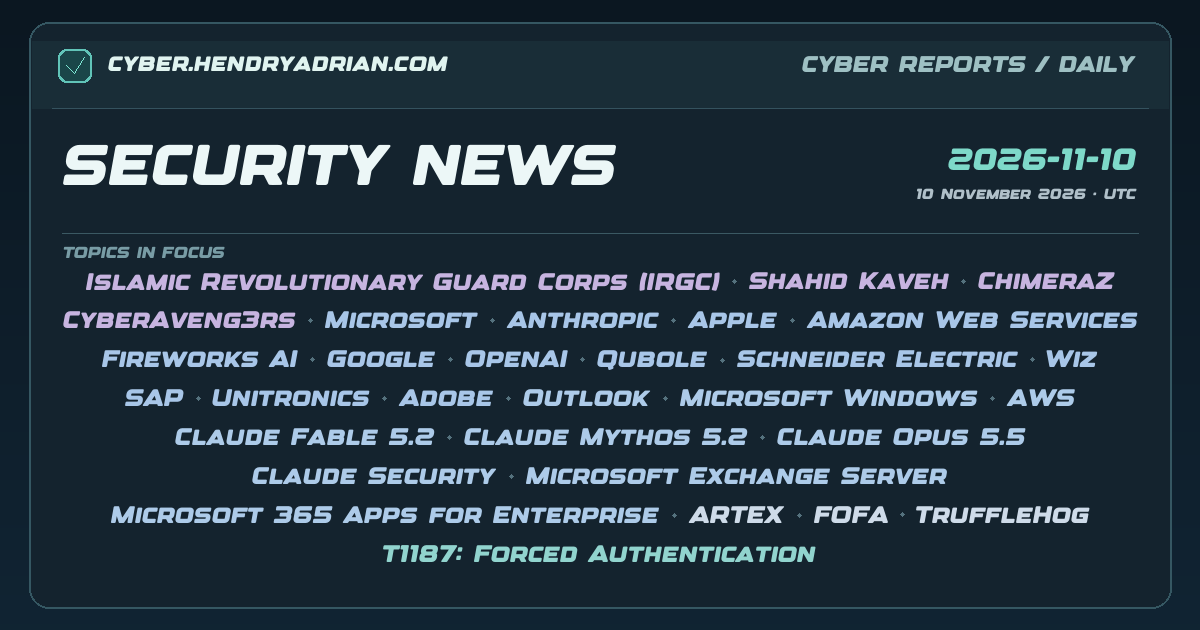
Daily Report (10 November 2026), Microsoft patches exploited Outlook zero-day, Stolen Qubole credentials used to access customer AWS environments
Highlighted News
The day’s leading storiesMicrosoft patches exploited Outlook zero-day
Microsoft’s November updates fix CVE-2026-124194, an Outlook spoofing flaw the company says has been exploited. Opening a specially crafted message file can cause Outlook to connect to an attacker-controlled location and disclose an NTLMv2 hash. Microsoft has not disclosed details of the observed attacks.
Security Significance: Administrators should prioritize the Outlook update. The Preview Pane cannot trigger the flaw, but opening a malicious file can expose authentication material.
Stolen Qubole credentials used to access customer AWS environments
Wiz and Sentra say an attacker used compromised Qubole AWS credentials to assume customer cross-account roles, including dormant roles, and steal data between October 14 and 26. Wiz reported access to dozens of customer environments; researchers reported data exfiltration from more than a dozen organizations.
Security Significance: The incident illustrates the risk of retained third-party cloud trust relationships. Affected organizations should review Qubole-linked IAM roles and investigate exposed credentials and data.
Daily News Digest
Additional developmentsIncident France attributes refrigeration sabotage to Iran-linked unit
France attributed an October attack on refrigeration controllers at about 700 retail sites to Shahid Kaveh, which it says is linked to Iran’s IRGC. Authorities described spoiled food and fires; reports differ on the attack date and put the fire count at at least 15 or about 20. France also linked the campaign to attacks on small hydroelectric installations with moderate effects.
Security Significance: The reported manipulation of controller settings and safety alerts shows the potential for cyberattacks to cause physical disruption. The attribution is France’s assessment, and an investigation is underway.
Vulnerability SAP fixes four maximum-severity vulnerabilities
SAP says the maximum-severity flaws can allow unauthenticated remote attackers to fully compromise affected systems.
Security Significance: Administrators should prioritize the relevant SAP patches, including those for NetWeaver ABAP and SAP Gateway.
Threat Research Threat actors repurpose Artex AI testing framework
Researchers report that multiple actors have used the open-source Artex penetration-testing framework in campaigns involving credential attacks and cloud compromises. Microsoft observed an AI agent move from scanning GitHub for secrets to exfiltrating data from an Azure Key Vault in five minutes.
Security Significance: The reported activity demonstrates operational use of AI-assisted tooling in attacks, including credential abuse and cloud data access.
Incident NEAR AI reports data theft after SGLang exploitation
NEAR AI says an attacker exploited an SGLang remote-code-execution flaw, accessed an inference server and internal systems, and downloaded account details for about 100 Private Chat users and data from 18 agents. The company revoked exposed API keys, deployed a fix and restored service.
Security Significance: Requests processed inside the affected trusted execution environment could have been visible to the attacker, including confidential-mode requests. NEAR AI has not said whether those requests were accessed.
Incident Fireworks AI discloses access to customer data and secrets
Fireworks AI says attackers reached its development environment through a third-party cloud provider incident and affected a limited set of customer accounts. Exposed information included account and billing data, secrets, datasets and incomplete models. Fireworks revoked credentials and hardened systems.
Security Significance: Exposed API keys and tokens can create downstream risk for affected customers. Fireworks says payment card numbers were not accessed because it does not store them.
Incident Nitori warns that customer records may have been exposed
Nitori says an attacker accessed a company-managed system from mid-October until November 6 and may have exposed up to 37.62 million customer records. Potentially affected data includes names, contact details, addresses and order information.
Security Significance: Unauthorized access is confirmed, but the number of records actually leaked is not. Nitori says passwords and credit card information were not exposed.
Threat Research ESET details Turla toolset found on government Exchange servers
ESET found the modular Turla’s Cereal toolset on a Kazakhstan government Exchange server and later at a Romanian government agency. The toolset chains legitimate Exchange, Windows and .NET functions and can use a compromised server for command handling and collection.
Security Significance: Using compromised Exchange infrastructure for command and control can reduce reliance on external infrastructure and complicate detection.
Threat Research Research links public GitHub secrets to saved Claude Code commands
Apiiro found 2,539 credentials across nearly 2,000 public GitHub repositories and linked some exposures to Claude Code saving approved commands containing secrets in a project settings file. It found real secrets in 1,122 of 104,185 public copies of that file examined.
Security Significance: The findings identify a route by which secrets in approved commands can be retained in project files and exposed publicly. Anthropic says it is exploring safeguards.
Vulnerability Adobe patches critical flaws across product portfolio
Adobe’s November updates address about 110 vulnerabilities across nine products, including critical flaws in Connect and Adobe Experience Manager. Adobe says it is unaware of exploitation.
Security Significance: The affected products include commonly deployed creative and enterprise applications; administrators should apply the relevant updates.
Threat Research Electron app scan finds lingering trust in recoverable certificate keys
A scan of 36 Electron apps found that some still trusted certificates made with recoverable eMudhra keys and also failed to verify update signatures. The researcher warned that the app list may contain misattributions; no attacks have been reported.
Security Significance: The combination of certificate trust and missing update-signature checks could expose affected apps to malicious updates, but the scan does not establish exploitation.
Daily Threat Intelligence
Six Top 7 rankingsRanked by distinct supporting articles. Open Related Evidence for saved source contexts and CVE details.
Top 7 CVEs
- 1CVE-2026-124194 · Microsoft 365 Apps for Enterprise
- 2CVE-2026-116928 · Microsoft Windows 10 Version 1607
- 3CVE-2026-76964 · SAP_SE SAP NetWeaver AS ABAP (Internet Communication Manager)
- 4CVE-2026-89126 · SAP_SE SAP Web Dispatcher
- 5CVE-2026-110043 · Microsoft 365 Apps for Enterprise
- 6CVE-2026-111560 · Barracuda Networks Barracuda Email Security Gateway (ESG)
- 7CVE-2026-116606 · Barracuda Networks Barracuda Email Security Gateway (ESG)
Top 7 MITRE ATT&CK Techniques
Top 7 Malware
Top 7 Threat Actors
- 5BYOD
Top 7 Mentioned Countries
- 2Iran
Top 7 Mentioned Industries
Other Articles (14)
-
ChimeraZ Claims Geofixe Customer and Billing Data Leak
darkwebinformer.com · Publisher date:
-
Actor Claims to Offer Lithos DEX Database with 173,146 Wallet Addresses
darkwebinformer.com · Publisher date:
-
Google Expands Gemini 4 Carbon Access After AI Agents Verify Signal Code
securityweek.com · Publisher date:
-
WhiteMatter Raises $20 Million to Expand AI-Agent Security Platform
securityweek.com · Publisher date:
-
Wiz Plans ISMAP External Assessment for Early 2027
wiz.io · Publisher date:
-
Anthropic Says Mythos 5.2 Improves Bug Finding and Reduces Sandbox Escapes
securityweek.com · Publisher date:
-
Claude Fable 5.2 Scores 76.3% on CyScenarioBench, Above GPT-6 Cyber's 61%
thehackernews.com · Publisher date:
-
AI Makes Reverse Engineering of Software and Malware Easier, Researchers Find
darkreading.com · Publisher date:
-
iVerify Report Finds Spyware Reaching Beyond Traditional High-Value Targets
cyberscoop.com · Publisher date:
-
Bay Security Raises $50 Million for AI Agent Security Platform
databreachtoday.com · Publisher date:
-
Vanderbilt Responds to Ransomware Attack Claimed by BYOD
cyberscoop.com · Publisher date:
-
F-Secure Maps 26 AI-Related Consumer Harms and Where to Defend Against Them
darkreading.com · Publisher date:
-
Checkmarx Names Kobi Sivilya CISO and CIO
darkreading.com · Publisher date:
-
Cloud Range Launches 28-Question OT Cyber Readiness Assessment
darkreading.com · Publisher date:
METHODOLOGY AND LIMITATIONS
Reporting period and eligibility
Article selection uses the original publisher publication date within the saved reporting period. Articles without that date are excluded; discovery dates and Cyber publication dates do not substitute for it. Counts include articles meeting public eligibility rules after the saved Daily Report SCOPE exclusions were applied.
Daily scope includes only Security News and Cyber Attack & Data Breach. Each report covers one completed UTC calendar day, with an exclusive ending boundary. AI groups saved article evidence independently of PHP diagnostic event clusters.
Highlighted News and Daily News Digest selection
Daily editorial selection considers Security Impact & Scale, Urgency & Operational Relevance, Evidence Quality & Confidence, and Technical Novelty & Topic Diversity. Security impact and urgency receive the strongest consideration: actual incidents, breaches, disruption, active exploitation and immediate defensive needs. Confirmed impact is distinguished from potential impact; credible reporting and verified findings are distinguished from unverified claims.
Highlighted News aims to select two distinct, significant, well-supported developments when available. Different wording, publishers or PHP diagnostic clusters may describe the same underlying development and can be grouped together; shared entities alone do not establish SAME_EVENT. Separate incidents remain separate, and conflicting facts and uncertainty are retained.
Highlighted News contains up to two items. The Daily News Digest aims for twelve additional distinct, valuable developments, excluding developments already highlighted and duplicate coverage of the same event. These are upper bounds and editorial targets, never minimum counts: shorter or empty sections are valid when evidence is insufficient. No filler is added. Article frequency or the number of publishers alone does not establish security significance or independent verification.
Selection uses the supplied, budget-bounded saved article evidence. Unsupported claims, including unsupported severity assessments, predictions and quantitative facts, are omitted. These criteria describe the current editorial policy; historical reports retain their saved analysis.
Ranked lists and evidence
Ranked lists show up to seven saved, validated canonical entities per category, ordered by the number of distinct supporting articles. Each article counts once per entity. These are article references, not unique incident counts; multiple articles and publishers may cover the same event.
Related Evidence displays saved entity-specific contexts with publisher identity, publication dates and article links. Missing context is identified explicitly and does not mean a supporting article is missing: the article remains linked and counted. Article summaries are not substituted for unavailable entity context.
Entity mentions do not confirm attribution, infection, exploitation, attacker origin, victim location, targeting or industry compromise. Country and industry contexts retain the original research wording.
Saved CVE details
CVSS, severity, EPSS and CISA KEV details are available inside each CVE's Related Evidence, using saved snapshot enrichment only; unavailable values are Unknown. EPSS estimates exploitation probability, not vulnerability severity or confirmed exploitation. Absence from KEV does not establish absence of exploitation. CVE rankings depend on supporting articles, not scores or KEV status.
Historical and AI limitations
This report uses a saved historical evidence snapshot. Source edits, later enrichment and subsequent reporting do not automatically update it. AI analysis uses bounded editorial selections of summaries, key points and validated relationships; it cannot establish complete coverage of global threat activity. Historical completeness: Saved daily scope.
Ransomware operator claims and leak-site listings are unverified allegations, not confirmed attacks. Repetition by another publisher does not independently verify compromise, data theft or actor involvement.
Evidence panels provide ten articles per page, with every saved reference accessible. Without JavaScript, all references are displayed. Related entity metadata does not increase the supporting article count. Links use saved identities; their availability may change.
Supporting evidence
6 saved supporting articles
- Microsoft Says Outlook Zero-Day Was Exploited as It Patches 1,094 Flawssecurityweek.com · Publisher date:
- Microsoft’s November 2026 Patch Tuesday Fixes 1,235 Flaws, Including Exploited Outlook Zero-Daybleepingcomputer.com · Publisher date:
- Microsoft patches 1,094 vulnerabilities in November 2026 updatecyberscoop.com · Publisher date:
- Microsoft’s November Patch Tuesday Addresses 1,093 Vulnerabilities, Including an Actively Exploited Zero-Daydarkreading.com · Publisher date:
- Microsoft Releases Windows 10 KB5131096 Extended Security Updatebleepingcomputer.com · Publisher date:
- Microsoft Releases November 2026 Windows 11 Patch Tuesday Updatesbleepingcomputer.com · Publisher date:
- CVE-2026-124194Microsoft · Microsoft 365 Apps for Enterprise; Microsoft · Microsoft Office LTSC 2021; +1 more
- Outlook
- Microsoft
Supporting evidence
2 saved supporting articles
- Qubole AWS Credentials Used to Steal Data From More Than a Dozen Organizationssecurityweek.com · Publisher date:
- Compromised Qubole AWS Credentials Used to Access Customer Environmentsbleepingcomputer.com · Publisher date:
Supporting evidence
3 saved supporting articles
- France Blames Iran’s IRGC Unit for Refrigeration Sabotage at 700 Retail Sitesthehackernews.com · Publisher date:
- France Attributes Supermarket Refrigeration Cyberattack to Iransecurityweek.com · Publisher date:
- France Attributes Supermarket Cyberattacks to Iran-Linked Unitdatabreachtoday.com · Publisher date:
Supporting evidence
1 saved supporting article
- SAP Fixes Four Maximum-Severity Flaws in November Security Updatebleepingcomputer.com · Publisher date:
- SAP
- NetWeaver Application Server ABAP
- SAP Gateway
- SAP Web Dispatcher
- CVE-2026-120017SAP_SE · SAP NetWeaver AS ABAP and ABAP Platform (SAML2 Service Provider)
- CVE-2026-76964SAP_SE · SAP NetWeaver AS ABAP (Internet Communication Manager)
- CVE-2026-89103SAP_SE · SAP Gateway
Supporting evidence
1 saved supporting article
- Threat Actors Repurpose AI Pen-Testing Tool Artex for Automated Attacksdarkreading.com · Publisher date:
Supporting evidence
1 saved supporting article
- SGLang RCE Exploit Led to NEAR AI Data Access, Company Saysthehackernews.com · Publisher date:
Supporting evidence
3 saved supporting articles
- Fireworks AI Says Breach Exposed Customer Billing Data, Secrets and Incomplete Modelsthehackernews.com · Publisher date:
- Fireworks AI Says Attackers Accessed Development Systems via Cloud Provider Breachbleepingcomputer.com · Publisher date:
- Cybersecurity Roundup: Fireworks Breach, OpenAI’s 948 Linux Exploits, Nvidia Probecybersecuritypulse.net · Publisher date:
Supporting evidence
1 saved supporting article
- Nitori Says Hackers May Have Exposed 37.62 Million Customer Recordsbleepingcomputer.com · Publisher date:
Supporting evidence
1 saved supporting article
- ESET Details Turla’s Modular Toolset for Compromising Government Exchange Serverscyberscoop.com · Publisher date:
Supporting evidence
1 saved supporting article
- Apiiro Finds Thousands of Secrets Exposed in Public GitHub Repositoriesdarkreading.com · Publisher date:
Supporting evidence
1 saved supporting article
- Adobe Patches About 110 Vulnerabilities Across Nine Productssecurityweek.com · Publisher date:
Supporting evidence
1 saved supporting article
- Many Electron Apps Still Trust Compromised eMudhra Certificate Keysprivacyaffairs.com · Publisher date:
Related Evidence
4 saved supporting articles
Entity: CVE-2026-124194
Microsoft · Microsoft 365 Apps for Enterprise; Microsoft · Microsoft Office LTSC 2021; +1 more
- CVSS
- 6.5 · MEDIUM
- EPSS
- Unknown
- KEV
- Unknown
Supporting articles
The zero-day, tracked as CVE-2026-124194, has been classified as a spoofing flaw and stems from Outlook not alerting users before a potentially dangerous action takes place.
Publisher: securityweek.com · Publisher date: VIEW ARTICLECVE-2026-124194 - Microsoft Outlook Spoofing Vulnerability
Publisher: bleepingcomputer.com · Publisher date: VIEW ARTICLEThe exploited zero-day flaw, CVE-2026-124194, is an Outlook spoofing vulnerability.
Publisher: cyberscoop.com · Publisher date: VIEW ARTICLEtoday addressed 1,093 security vulnerabilities, with 63 rated critical, and one zero-day in the mix (CVE-2026-124194, CVSS 6.5) that Microsoft confirmed is under active exploit.
Publisher: darkreading.com · Publisher date: VIEW ARTICLE
Related Evidence
2 saved supporting articles
Entity: CVE-2026-116928
Microsoft · Windows 10 Version 1607; Microsoft · Windows 10 Version 1809; +14 more
- CVSS
- 9.8 · CRITICAL
- EPSS
- Unknown
- KEV
- Unknown
Supporting articles
The most severe fixes include CVE-2026-116928, a Windows Search vulnerability reachable through Exchange Server.
Publisher: cyberscoop.com · Publisher date: VIEW ARTICLEDustin Childs, head of threat awareness at the Zero-Day Initiative (ZDI), also identified a Windows Search RCE (CVE-2026-116928, CVSS 9.8) as needing immediate attention.
Publisher: darkreading.com · Publisher date: VIEW ARTICLE
Related Evidence
2 saved supporting articles
Entity: CVE-2026-76964
SAP_SE · SAP NetWeaver AS ABAP (Internet Communication Manager)
- CVSS
- 10 · CRITICAL
- EPSS
- Unknown
- KEV
- Unknown
Supporting articles
The company addressed memory corruption (CVE-2026-76964) and missing authentication (CVE-2026-120017) flaws in the NetWeaver Application Server ABAP's Internet Communication Manager and SAML2 Service Provider components.
Publisher: bleepingcomputer.com · Publisher date: VIEW ARTICLEOnapsis Research Labs tracks ICM2SHELL as CVE-2026-76964 and CVE-2026-89126, both CVSS 10.0. Source: Onapsis.
Publisher: cybersecuritypulse.net · Publisher date: VIEW ARTICLE
Related Evidence
2 saved supporting articles
Entity: CVE-2026-89126
SAP_SE · SAP Web Dispatcher
- CVSS
- 10 · CRITICAL
- EPSS
- Unknown
- KEV
- Unknown
Supporting articles
The other two maximum severity vulnerabilities stem from a broken access control weakness (CVE-2026-89103) in SAP Gateway and a memory corruption issue (CVE-2026-89126) in SAP Web Dispatcher.
Publisher: bleepingcomputer.com · Publisher date: VIEW ARTICLEOnapsis Research Labs tracks ICM2SHELL as CVE-2026-76964 and CVE-2026-89126, both CVSS 10.0. Source: Onapsis.
Publisher: cybersecuritypulse.net · Publisher date: VIEW ARTICLE
Related Evidence
1 saved supporting article
Entity: CVE-2026-110043
Microsoft · Microsoft 365 Apps for Enterprise; Microsoft · Microsoft Office LTSC 2021; +1 more
- CVSS
- 8.8 · HIGH
- EPSS
- Unknown
- KEV
- Unknown
Supporting articles
Another critical RCE to watch out for, according to Automox, is CVE-2026-110043 (CVSS 8.8/10), a one-click heap-based buffer overflow in Outlook that uses the Preview Pane as an attack vector. A target must select a
Publisher: darkreading.com · Publisher date: VIEW ARTICLE
Related Evidence
1 saved supporting article
Entity: CVE-2026-111560
Barracuda Networks · Barracuda Email Security Gateway (ESG); Barracuda Networks · Barracuda Load Balancer Application Delivery Controller (ADC); +4 more
- CVSS
- 8.6 · HIGH
- EPSS
- 0.47%
- KEV
- Unknown
Supporting articles
Barracuda says attackers have exploited two flaws against a small number of organizations. On Email Security Gateway, chaining CVE-2026-116606 with CVE-2026-111560 can bypass authorization and execute commands as root.
Publisher: cybersecuritypulse.net · Publisher date: VIEW ARTICLE
Related Evidence
1 saved supporting article
Entity: CVE-2026-116606
Barracuda Networks · Barracuda Email Security Gateway (ESG)
- CVSS
- 9.3 · CRITICAL
- EPSS
- 0.73%
- KEV
- Unknown
Supporting articles
Barracuda says attackers have exploited two flaws against a small number of organizations. On Email Security Gateway, chaining CVE-2026-116606 with CVE-2026-111560 can bypass authorization and execute commands as root.
Publisher: cybersecuritypulse.net · Publisher date: VIEW ARTICLE
Related Evidence
2 saved supporting articles
Microsoft says opening a specially crafted message file can make Outlook connect to an attacker-controlled network location and disclose the user's NTLMv2 hash.
Publisher: securityweek.com · Publisher date: VIEW ARTICLEA crafted Outlook message file can cause Windows to authenticate to an attacker-controlled network share, exposing an NTLMv2 authentication hash.
Publisher: bleepingcomputer.com · Publisher date: VIEW ARTICLE
Related Evidence
1 saved supporting article
C4 reported mass reconnaissance of Schneider Electric industrial control systems, including reconnaissance of equipment at energy and water facilities.
Publisher: databreachtoday.com · Publisher date: VIEW ARTICLE
Related Evidence
1 saved supporting article
CerealNeuron passively listens for incoming web requests on paths resembling ordinary Exchange traffic, and the compromised server acts as command-and-control infrastructure.
Publisher: cyberscoop.com · Publisher date: VIEW ARTICLE
Related Evidence
1 saved supporting article
Unauthorized access involved use of internal Fireworks credentials.
Publisher: thehackernews.com · Publisher date: VIEW ARTICLE
Related Evidence
1 saved supporting article
The attacker used compromised Qubole IAM credentials to assume customer AWS roles.
Publisher: bleepingcomputer.com · Publisher date: VIEW ARTICLE
Related Evidence
1 saved supporting article
Storm-0940 reportedly used Artex in a password-spraying campaign against user accounts.
Publisher: darkreading.com · Publisher date: VIEW ARTICLE
Related Evidence
1 saved supporting article
The article reports credential-stuffing activity by Storm-0940 using Artex.
Publisher: darkreading.com · Publisher date: VIEW ARTICLE
Related Evidence
1 saved supporting article
One component, dubbed CerealNeuron, operates as the main backdoor but does not beacon back to its operator the way many pieces of malware do.
Publisher: cyberscoop.com · Publisher date: VIEW ARTICLE
Related Evidence
1 saved supporting article
be overly focused on nation-state threats and well-known commercial mercenary spyware like NSO Group’s Pegasus.
Publisher: cyberscoop.com · Publisher date: VIEW ARTICLE
Related Evidence
1 saved supporting article
some high-profile candidates: Slack, Apple's Finder app, and, importantly for security researchers, the Turla malware.
Publisher: darkreading.com · Publisher date: VIEW ARTICLE
Related Evidence
3 saved supporting articles
French prosecutors said Iran’s paramilitary Revolutionary Guard was behind the attack; ANSSI described Shahid Kaveh as an affiliated cyber unit.
Publisher: securityweek.com · Publisher date: VIEW ARTICLEThe French government said an IRGC cyber unit sponsored and carried out the sabotage through Shahid Kaveh.
Publisher: thehackernews.com · Publisher date: VIEW ARTICLEThe French government said Shahid Kaveh is affiliated with the IRGC’s electronic and cyber center; the reported attribution is to the unit, not directly to the IRGC as the operator.
Publisher: databreachtoday.com · Publisher date: VIEW ARTICLE
Related Evidence
3 saved supporting articles
ANSSI attributed the supermarket refrigeration attack to this group, described as a cyber unit affiliated with Iran’s Islamic Revolutionary Guard Corps.
Publisher: securityweek.com · Publisher date: VIEW ARTICLEFrance attributed the refrigeration-controller sabotage to this IRGC cyber unit. French authorities said indicators linked the unit to the attack; this is the French government's attribution.
Publisher: thehackernews.com · Publisher date: VIEW ARTICLEThe French government, citing the C4 investigation, attributed the supermarket and related attacks to this cyber-offensive unit, which it said is affiliated with the IRGC’s electronic and cyber center.
Publisher: databreachtoday.com · Publisher date: VIEW ARTICLE
Related Evidence
2 saved supporting articles
The listing attributes the claim of leaking a database associated with Geofixe to an actor using this handle. The claim and the dataset have not been independently verified.
Publisher: darkwebinformer.com · Publisher date: VIEW ARTICLEThe handle used by the claimant offering a database associated with Lithos for sale. The dataset's source, authenticity, and the claimant's role in obtaining it are unverified.
Publisher: darkwebinformer.com · Publisher date: VIEW ARTICLE
Related Evidence
2 saved supporting articles
Described as a hacktivist persona through which Shahid Kaveh publicly claims some attacks. It claimed a November 2023 campaign against Unitronics and a later campaign targeting Israeli and U.S. interests; the article does not attribute the October French attack directly to this persona.
Publisher: thehackernews.com · Publisher date: VIEW ARTICLEThe article identifies CyberAveng3rs as another name for Shahid Kaveh. C4 attributed the supermarket and related attacks to the unit.
Publisher: databreachtoday.com · Publisher date: VIEW ARTICLE
Related Evidence
1 saved supporting article
The ransomware group claimed responsibility for the attack in a post on its leak blog and claimed to have more than one million Social Security numbers from Vanderbilt.
Publisher: cyberscoop.com · Publisher date: VIEW ARTICLE
Related Evidence
1 saved supporting article
Described as a hacktivist persona through which Shahid Kaveh publicly claims some attacks; the article does not attribute the October French attack directly to this persona.
Publisher: thehackernews.com · Publisher date: VIEW ARTICLE
Related Evidence
1 saved supporting article
Anthropic reported significant activity by this Russian threat actor targeting Ukraine's government, military, and diplomatic staff. The report said the group stole a proprietary drone-vision SDK and used Claude to reverse-engineer it.
Publisher: darkreading.com · Publisher date: VIEW ARTICLE
Related Evidence
3 saved supporting articles
France on Monday blamed Iran for last month’s cyberattack on supermarket refrigerators, summoned the Iranian ambassador and said it would seek European sanctions against those responsible for the attack.
Publisher: securityweek.com · Publisher date: VIEW ARTICLEThe unit is called Shahid Kaveh. It is known mainly through hacktivist personas, such as CyberAveng3rs and Cyber Isnaad Front, that publicly claim some of its attacks, France says.
Publisher: thehackernews.com · Publisher date: VIEW ARTICLEFrance has formally blamed Iran for cyberattacks on refrigeration units in French supermarkets last month and for the simultaneous targeting of hydroelectric plants. The government called it "an unprecedented attack
Publisher: databreachtoday.com · Publisher date: VIEW ARTICLE
Related Evidence
3 saved supporting articles
France on Monday blamed Iran for last month’s cyberattack on supermarket refrigerators, summoned the Iranian ambassador and said it would seek European sanctions against those responsible for the attack.
Publisher: securityweek.com · Publisher date: VIEW ARTICLEAn October cyberattack on refrigeration controllers at about 700 French retail sites was carried out by a cyber unit of Iran's Islamic Revolutionary Guard Corps (IRGC), the French government said yesterday.
Publisher: thehackernews.com · Publisher date: VIEW ARTICLEFrance has formally blamed Iran for cyberattacks on refrigeration units in French supermarkets last month and for the simultaneous targeting of hydroelectric plants. The government called it "an unprecedented attack
Publisher: databreachtoday.com · Publisher date: VIEW ARTICLE
Related Evidence
2 saved supporting articles
Nitori, often called the “IKEA of Japan,” is a major furniture and home furnishings retailer that operates 879 stores in Japan and another 219 stores across China, South Korea, Taiwan, Thailand, Singapore, and Hong Kong.
Publisher: bleepingcomputer.com · Publisher date: VIEW ARTICLEWiz and ISMAP: How We Are Preparing to Serve Japan's Public Sector
Publisher: wiz.io · Publisher date: VIEW ARTICLE
Related Evidence
2 saved supporting articles
Multiple Western governments and threat intelligence firms have attributed Turla as a part of Russia’s Federal Security Service (FSB), which is tasked with gathering intelligence on foreign governments, businesses and
Publisher: cyberscoop.com · Publisher date: VIEW ARTICLEThe target was of course unsurprising, given that drones have contributed massively to the war between Russia and Ukraine.
Publisher: darkreading.com · Publisher date: VIEW ARTICLE
Related Evidence
1 saved supporting article
“In Australia, one went to a limousine driver.
Publisher: cyberscoop.com · Publisher date: VIEW ARTICLE
Related Evidence
1 saved supporting article
actor or objective. Microsoft last week published a blog post discussing how a financially motivated Cambodia-based threat cluster tracked as Storm-3358 started using Artex in its attacks against financial
Publisher: darkreading.com · Publisher date: VIEW ARTICLE
Related Evidence
1 saved supporting article
The best-known incident to date involved China's Storm-0940, which adapted Artex source code into its own offensive infrastructure. Last month, around Oct. 10, the actor used the Artex framework to launch a massive
Publisher: darkreading.com · Publisher date: VIEW ARTICLE
Related Evidence
7 saved supporting articles
Describing Claude Mythos 5.2 as its "most capable model for cybersecurity engineering," Anthropic said it can flag more vulnerabilities than prior models, while simultaneously getting better at reproducing and fixing
Publisher: thehackernews.com · Publisher date: VIEW ARTICLECybersecurity researchers from Intezer recently tested out how easy it is to reverse-engineer software with AI by picking on some high-profile candidates: Slack, Apple's Finder app, and, importantly for security
Publisher: darkreading.com · Publisher date: VIEW ARTICLECybersecurity startup WhiteMatter on Tuesday announced raising $20 million in a Series A funding round that brings the total raised by the company to $24 million.
Publisher: securityweek.com · Publisher date: VIEW ARTICLEThe difference lies in the guardrails: Fable, which anyone can use, carries protections against cybersecurity and biology misuse, while Mythos ships without some of them.
Publisher: securityweek.com · Publisher date: VIEW ARTICLEA startup led by an ex-Israeli Military Intelligence cybersecurity researcher emerged from stealth with $50 million to secure AI through an agentless architecture and intent-aware enforcement.
Publisher: databreachtoday.com · Publisher date: VIEW ARTICLEWelcome to The Cybersecurity Pulse (TCP)! I’m Andrew Richards, a security practitioner working at the intersection of AI security, operations, and governance at Tennessee Valley Authority. I’ll be partnering with Darwin
Publisher: cybersecuritypulse.net · Publisher date: VIEW ARTICLE“Kobi brings more than 20 years of experience across cybersecurity and technology, with deep security expertise and practical IT leadership,” said Sandeep Johri, CEO at Checkmarx. “AI is changing how software gets built
Publisher: darkreading.com · Publisher date: VIEW ARTICLE
Related Evidence
2 saved supporting articles
a high-performance inference platform for developers who want to deploy and run open-source artificial intelligence models (such as Mistral, Meta's Llama, or Google's Gemma) without worrying about hardware
Publisher: bleepingcomputer.com · Publisher date: VIEW ARTICLEThe artificial intelligence (AI) company said high-stakes risks arising from misalignment remain low, and claimed the models matched or performed better than Claude Opus 5.5, Claude Sonnet 5.5, and Claude Mythos 5.1 on
Publisher: thehackernews.com · Publisher date: VIEW ARTICLE
Related Evidence
2 saved supporting articles
of Schneider Electric equipment. That equipment is installed at sites such as small- and medium-sized energy and water production sites. The reconnaissance relied on techniques that Shahid Kaveh has used since at
Publisher: thehackernews.com · Publisher date: VIEW ARTICLEusing the same technique conducted reconnaissance on Schneider Electric equipment at small and midsized energy and water production facilities. The attackers used the same infrastructure to target the supermarket
Publisher: databreachtoday.com · Publisher date: VIEW ARTICLE
Related Evidence
2 saved supporting articles
Turla, a notorious cyberespionage group aligned with the Russian government, has been wielding a new, customizable toolset to compromise governments around the world over the past year, including Kazakhstan.
Publisher: cyberscoop.com · Publisher date: VIEW ARTICLEWhen Japanese government agencies procure cloud services, they are required, in principle, to procure from services registered on the ISMAP Cloud Service List. This list is established under ISMAP (Information system
Publisher: wiz.io · Publisher date: VIEW ARTICLE
Related Evidence
2 saved supporting articles
Mainstream software and malware can be reverse-engineered more easily than ever, thanks to artificial intelligence (AI) tools — something that security researchers are warning has implications for cyber defense,
Publisher: darkreading.com · Publisher date: VIEW ARTICLEWith such a key, you can make a certificate for any website, and software that trusts eMudhra will believe it.
Publisher: privacyaffairs.com · Publisher date: VIEW ARTICLE
Related Evidence
2 saved supporting articles
Electric equipment. That equipment is installed at sites such as small- and medium-sized energy and water production sites. The reconnaissance relied on techniques that Shahid Kaveh has used since at least April.
Publisher: thehackernews.com · Publisher date: VIEW ARTICLEsame technique conducted reconnaissance on Schneider Electric equipment at small and midsized energy and water production facilities. The attackers used the same infrastructure to target the supermarket cooling units.
Publisher: databreachtoday.com · Publisher date: VIEW ARTICLE
Related Evidence
1 saved supporting article
When Japanese government agencies procure cloud services, they are required, in principle, to procure from services registered on the ISMAP Cloud Service List. This list is established under ISMAP (Information system
Publisher: wiz.io · Publisher date: VIEW ARTICLE