
Cyber Threat Daily Report
2026-11-09- Reporting period
- 9 November 2026 (UTC)
- Publication date
- Eligible Articles
- 38
- Distinct Publishers
- 15
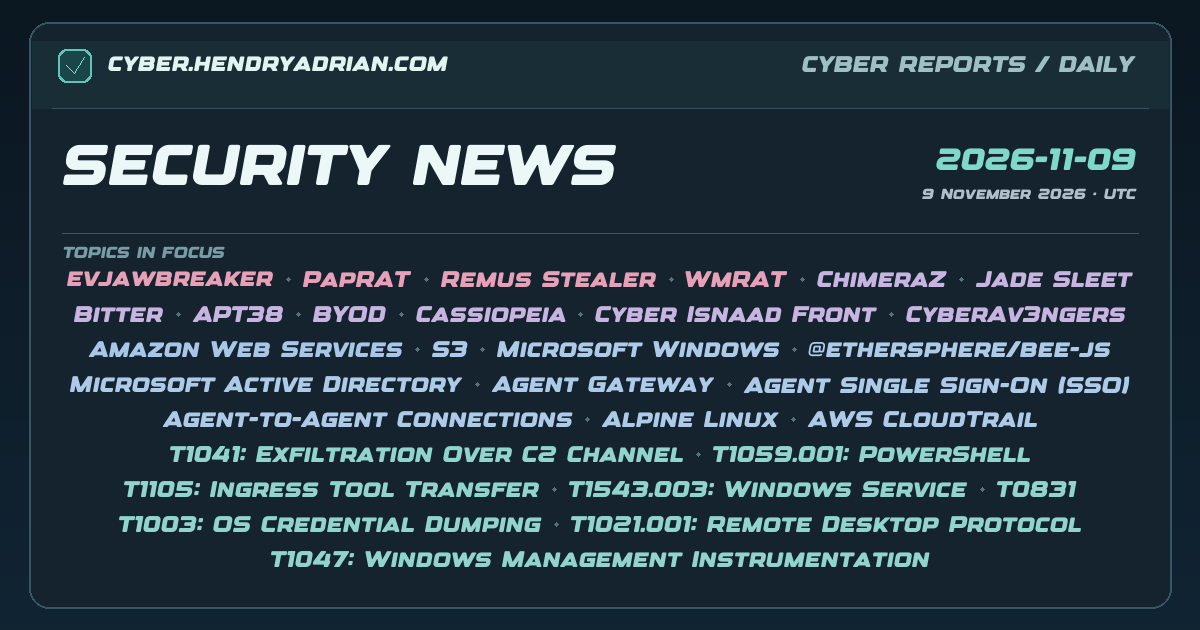
Daily Report (9 November 2026), Binance details developer-tool compromise behind wallet incident, France attributes refrigeration attacks to Iranian unit as U.S. agencies warn operators
Highlighted News
The day’s leading storiesBinance details developer-tool compromise behind wallet incident
Binance’s initial post-mortem describes a wallet incident affecting $6.34 billion in assets. A fake job assignment led an engineer to run a doctored pyenv copy; the attacker then used the engineer’s machine and an internal AI tool to access other engineers’ computers and find a deployment token.
Security Significance: The account illustrates how developer-tool tampering and social engineering can lead to access to sensitive infrastructure. Binance has not explained how the AI tool enabled access.
France attributes refrigeration attacks to Iranian unit as U.S. agencies warn operators
France attributed October attacks on about 700 retail sites to the IRGC-affiliated Shahid Kaveh unit, citing infrastructure and reconnaissance clues. Authorities said attackers changed refrigeration-controller settings, causing food losses and at least 15 fires. Separately, U.S. agencies warned of attacks on internet-accessible refrigeration and cold-chain systems.
Security Significance: The incidents demonstrate physical and financial consequences of compromised industrial controllers. The U.S. advisory also described a separate incident affecting three facilities at a French blood-storage provider without identifying the attackers.
Daily News Digest
Additional developmentsIncident Attackers abused Qubole’s AWS access to steal customer data and secrets
Wiz reported that attackers used credentials for a Qubole-operated AWS account to assume customer roles between October 14 and 26, search for secrets and copy accessible S3 data. How the credentials were obtained remains unknown.
Security Significance: The intrusion shows how trusted cloud access can expose customer credentials and data across a service-provider relationship.
Incident Beget rebuilds cloud infrastructure after data-wiping attack
Beget said an attacker accessed its infrastructure management layer on November 1 and ran data-zeroing scripts. Cloud data, including VPS, S3 and Kubernetes data, was lost; recovery remains ongoing.
Security Significance: The attack disrupted a hosting provider and destroyed customer cloud data, illustrating the impact of management-layer access.
Advisory LNbits urges operators to shut down servers amid reported exploits
LNbits asked all server operators to shut down while it prepared security fixes. One operator reported an exploit that allowed new accounts to withdraw 2,285,545 satoshis; no fixed version was available by 09:00 UTC.
Security Significance: The project’s shutdown instruction calls for immediate operator action while fixes are pending. The exploited extension was not identified.
Incident Malicious Ethersphere releases delivered wallet-stealing code and backdoors
Attackers used Ethersphere release workflows to publish malicious bee-js 13.3.0 and Swarm Desktop 0.56.2. The releases sought wallet configuration and encrypted key files and installed cross-platform backdoors; they were withdrawn, and no fund theft had been reported.
Security Significance: The malicious npm package ran its postinstall script automatically, even when a project did not import the library.
Vulnerability Exploitation attempts reported against OpenSSH SSHole flaw
A roundup reported 20 attempts from 13 IP addresses against CVE-2026-123158 as of November 9. The flaw can permit sign-ins to passwordless accounts on Linux systems using musl with PAM disabled, including Alpine Linux’s default OpenSSH server configuration.
Security Significance: The reported attempts make the affected configuration operationally relevant, although successful exploitation was not reported.
Incident Keplr reports private-key exposure in Web3Auth-backed wallets
Keplr said a Web3Auth infrastructure flaw exposed private keys for some wallets created using Google or Apple sign-in. Web3Auth moved funds from at-risk wallets to recovery wallets, and Keplr paused those sign-in options.
Security Significance: The companies have not explained the flaw or restoration timeline, and theft totals remain unclear. An empty balance may reflect a recovery transfer rather than theft.
Threat Research Bitter campaign deploys newly reported PapRAT backdoor
Fortinet reported that Bitter is targeting South Asian organizations with PapRAT through three infection chains, including scripts and MSI installers. The remote-access trojan has C++ and Rust implementations.
Security Significance: The Rust variant adds PowerShell execution and other commands, providing defenders with a newly reported tool associated with the campaign.
Incident Iris Plaza breach may have exposed data of 7.7 million people
Iris Ohyama said a breach discovered on October 28 may have exposed personal data belonging to 5.8 million current and former Iris Plaza members and 1.9 million non-member purchasers. The platform remains offline during investigation and remediation.
Security Significance: Potentially exposed member data includes contact details, birth dates and encrypted passwords; exposure has not been confirmed for every person counted.
Incident Frontline Education reports 3.08 million affected by breach
Frontline Education told Indiana officials that 3,085,266 people were affected. It said attackers exploited an unnamed third-party software vulnerability to access two products and steal personal information; the intrusion was contained the day after detection.
Security Significance: The revised affected-person count highlights the scale of the confirmed data theft and the role of a third-party software vulnerability.
Other Three arrested over alleged AI-assisted CEO impersonation fraud
Three men arrested in Spain and the U.K. face U.S. extradition over an alleged scheme using AI-generated CEO impersonations and phishing emails. Prosecutors allege the operation caused about $129 million in losses from 2024 to 2026.
Security Significance: The indictment describes alleged impersonation and phishing aimed at employees authorized to make large transfers.
Other Perry Johnson companies settle state investigation into healthcare breach
Four states reached a settlement requiring Perry Johnson companies to pay $300,000 and improve security after a 2023 breach involving data linked to more than 13.3 million people. Another $9.7 million is suspended; the companies neither admitted nor denied the states’ findings.
Security Significance: Investigators cited remote access without multifactor authentication and security software that recorded malicious activity without alerting staff.
Daily Threat Intelligence
Six Top 7 rankingsRanked by distinct supporting articles. Open Related Evidence for saved source contexts and CVE details.
Top 7 CVEs
- 1CVE-2026-123158 · OpenBSD OpenSSH
Top 7 MITRE ATT&CK Techniques
Top 7 Malware
Top 7 Threat Actors
- 5BYOD
Top 7 Mentioned Countries
- 6Iran
Top 7 Mentioned Industries
Other Articles (23)
-
ChimeraZ Claims Adems14 Data Leak Involving 36,628 People
darkwebinformer.com · Publisher date:
-
Actor Claims Colorbox Database Leak Involving 7.67 Million Rows
darkwebinformer.com · Publisher date:
-
Proton Removes Popular CEO Resignation Post Amid Secure-Coding Debate
privacyaffairs.com · Publisher date:
-
AWS Adds Cross-Partition Identity Federation to IAM
aws.amazon.com · Publisher date:
-
Guardsix Details Day-One SIEM Detection Pack With 63 Rules
guardsix.com · Publisher date:
-
Revolve Says 1.5 Million People Affected by Data Breach
securityweek.com · Publisher date:
-
Qualys Expands mROC Alliance With Mobile and OT Telemetry Integrations
blog.qualys.com · Publisher date:
-
Remus Stealer Claims Persistent Gmail Access, but Recovery Resistance Remains Unverified
infostealers.com · Publisher date:
-
Italy’s Meloni Blames Pro-Russian Hackers for Leak of Foreign Minister’s Data
securityweek.com · Publisher date:
-
Amplifon Americas Data Breach Affects 1.3 Million People
securityweek.com · Publisher date:
-
Corium Panel Packages ClickFix Malware Delivery and Campaign Management
infostealers.com · Publisher date:
-
York University Confirms Theft of Departmental Webform Data Dating to 2007
securityonline.info · Publisher date:
-
SOCRadar Tracks Five Unverified Dark-Web Access and Data Exposure Claims
socradar.io · Publisher date:
-
Former OpenAI Engineer Pleads Not Guilty to Allegedly Planting Covert Recorder
thehackernews.com · Publisher date:
-
Binance Denies Alleged 335 Million-User Data Breach Linked to ShinyHunters Handle
bleepingcomputer.com · Publisher date:
-
Former FBI Agent Pleads Guilty to Stealing Nearly $2.5 Million in Cryptocurrency
bleepingcomputer.com · Publisher date:
-
US Bans MEXC Crypto Exchange Over Sanctions Evasion and Cybercrime Links
bleepingcomputer.com · Publisher date:
-
Ukraine Arrests Four Suspects in €4.3 Million Crypto Investment Scam
bleepingcomputer.com · Publisher date:
-
Okta and Jamf Expand AI Agent Governance Across Identity and Devices
jamf.com · Publisher date:
-
Lawmakers Ask Nvidia CEO About Defenses Against Foreign Espionage
databreachtoday.com · Publisher date:
-
Vanderbilt Investigates Cyberattack After BYOD Claims Data Theft
bleepingcomputer.com · Publisher date:
-
SEGA Says Newsletter Breach Exposed 2.2 Million Email Addresses
bleepingcomputer.com · Publisher date:
-
York University Confirms Breach Exposing Personal Information Dating to 2007
bleepingcomputer.com · Publisher date:
METHODOLOGY AND LIMITATIONS
Reporting period and eligibility
Article selection uses the original publisher publication date within the saved reporting period. Articles without that date are excluded; discovery dates and Cyber publication dates do not substitute for it. Counts include articles meeting public eligibility rules after the saved Daily Report SCOPE exclusions were applied.
Daily scope includes only Security News and Cyber Attack & Data Breach. Each report covers one completed UTC calendar day, with an exclusive ending boundary. AI groups saved article evidence independently of PHP diagnostic event clusters.
Highlighted News and Daily News Digest selection
Daily editorial selection considers Security Impact & Scale, Urgency & Operational Relevance, Evidence Quality & Confidence, and Technical Novelty & Topic Diversity. Security impact and urgency receive the strongest consideration: actual incidents, breaches, disruption, active exploitation and immediate defensive needs. Confirmed impact is distinguished from potential impact; credible reporting and verified findings are distinguished from unverified claims.
Highlighted News aims to select two distinct, significant, well-supported developments when available. Different wording, publishers or PHP diagnostic clusters may describe the same underlying development and can be grouped together; shared entities alone do not establish SAME_EVENT. Separate incidents remain separate, and conflicting facts and uncertainty are retained.
Highlighted News contains up to two items. The Daily News Digest aims for twelve additional distinct, valuable developments, excluding developments already highlighted and duplicate coverage of the same event. These are upper bounds and editorial targets, never minimum counts: shorter or empty sections are valid when evidence is insufficient. No filler is added. Article frequency or the number of publishers alone does not establish security significance or independent verification.
Selection uses the supplied, budget-bounded saved article evidence. Unsupported claims, including unsupported severity assessments, predictions and quantitative facts, are omitted. These criteria describe the current editorial policy; historical reports retain their saved analysis.
Ranked lists and evidence
Ranked lists show up to seven saved, validated canonical entities per category, ordered by the number of distinct supporting articles. Each article counts once per entity. These are article references, not unique incident counts; multiple articles and publishers may cover the same event.
Related Evidence displays saved entity-specific contexts with publisher identity, publication dates and article links. Missing context is identified explicitly and does not mean a supporting article is missing: the article remains linked and counted. Article summaries are not substituted for unavailable entity context.
Entity mentions do not confirm attribution, infection, exploitation, attacker origin, victim location, targeting or industry compromise. Country and industry contexts retain the original research wording.
Saved CVE details
CVSS, severity, EPSS and CISA KEV details are available inside each CVE's Related Evidence, using saved snapshot enrichment only; unavailable values are Unknown. EPSS estimates exploitation probability, not vulnerability severity or confirmed exploitation. Absence from KEV does not establish absence of exploitation. CVE rankings depend on supporting articles, not scores or KEV status.
Historical and AI limitations
This report uses a saved historical evidence snapshot. Source edits, later enrichment and subsequent reporting do not automatically update it. AI analysis uses bounded editorial selections of summaries, key points and validated relationships; it cannot establish complete coverage of global threat activity. Historical completeness: Saved daily scope.
Ransomware operator claims and leak-site listings are unverified allegations, not confirmed attacks. Repetition by another publisher does not independently verify compromise, data theft or actor involvement.
Evidence panels provide ten articles per page, with every saved reference accessible. Without JavaScript, all references are displayed. Related entity metadata does not increase the supporting article count. Links use saved identities; their availability may change.
Supporting evidence
1 saved supporting article
- Binance Post-Mortem Traces $6.3B Wallet Heist to Fake Job Offerdecodedsecurity.com · Publisher date:
Supporting evidence
2 saved supporting articles
- France Blames Iran-Linked Unit for Supermarket Refrigeration Attacksbleepingcomputer.com · Publisher date:
- U.S. Agencies Warn of Attacks on Industrial Refrigeration Controllersthehackernews.com · Publisher date:
Supporting evidence
1 saved supporting article
Supporting evidence
1 saved supporting article
- Beget Rebuilding Cloud Infrastructure After Data-Wiping Attackbleepingcomputer.com · Publisher date:
Supporting evidence
1 saved supporting article
- LNbits Urges Operators to Shut Down Servers Amid Reported Exploitsthehackernews.com · Publisher date:
Supporting evidence
1 saved supporting article
- Malicious Ethersphere Releases Deliver Wallet-Stealing Malware and Backdoorsthehackernews.com · Publisher date:
Supporting evidence
1 saved supporting article
- Weekly Recap: OpenSSH SSHole Exploitation Attempts and Other Vulnerabilitiesthehackernews.com · Publisher date:
- CVE-2026-123158OpenBSD · OpenSSH
- OpenSSH
- Alpine Linux
Supporting evidence
1 saved supporting article
- Keplr Says Web3Auth Flaw Led to Private-Key Breach; Funds Moved to Recovery Walletsthehackernews.com · Publisher date:
Supporting evidence
1 saved supporting article
- Bitter Uses New PapRAT Backdoor in Campaign Targeting South Asiathehackernews.com · Publisher date:
Supporting evidence
1 saved supporting article
- Iris Plaza Breach May Have Exposed Data of 7.7 Million Peoplesecurityweek.com · Publisher date:
Supporting evidence
1 saved supporting article
- Frontline Education Says Data Breach Affected 3.08 Millionsecurityweek.com · Publisher date:
Supporting evidence
1 saved supporting article
- Three Arrested Over Alleged $129M AI Deepfake CEO Fraud Schemedatabreachtoday.com · Publisher date:
Supporting evidence
2 saved supporting articles
- States Reach Up to $10M Settlement Over Perry Johnson Healthcare Data Breachdatabreachtoday.com · Publisher date:
- Medical Data Breach Exposed 13.3 Million; Companies Agree to $300,000 Settlementmalwarebytes.com · Publisher date:
Related Evidence
1 saved supporting article
Entity: CVE-2026-123158
OpenBSD · OpenSSH
- CVSS
- 8.1 · HIGH
- EPSS
- 0.98%
- KEV
- Unknown
Supporting articles
that can enable sign-ins to accounts that have no password set. The vulnerability, tracked as CVE-2026-123158 (CVSS score: 8.1) and codenamed SSHole (or *sshole), impacts Linux systems that run OpenSSH on the
Publisher: thehackernews.com · Publisher date: VIEW ARTICLE
Related Evidence
2 saved supporting articles
The downloaded code was designed to send the Swarm key and password to the attackers' server.
Publisher: thehackernews.com · Publisher date: VIEW ARTICLEReconnaissance information is sent to the C2 server using curl.
Publisher: thehackernews.com · Publisher date: VIEW ARTICLE
Related Evidence
2 saved supporting articles
The retrieved script executes additional instructions as PowerShell commands.
Publisher: thehackernews.com · Publisher date: VIEW ARTICLEThe Corium advertisement claims support for in-memory PowerShell execution as a malware-delivery method.
Publisher: infostealers.com · Publisher date: VIEW ARTICLE
Related Evidence
2 saved supporting articles
The loader downloaded additional code from api.frameworkmetrics[.]xyz.
Publisher: thehackernews.com · Publisher date: VIEW ARTICLEThe scripts retrieve files from remote servers, including an MSI installer and talk.log.
Publisher: thehackernews.com · Publisher date: VIEW ARTICLE
Related Evidence
2 saved supporting articles
Windows Service is one of the behaviors mapped by the pack's detection coverage.
Publisher: guardsix.com · Publisher date: VIEW ARTICLEOn Windows, the remote-access client ran as a system service.
Publisher: thehackernews.com · Publisher date: VIEW ARTICLE
Related Evidence
1 saved supporting article
Attackers remotely changed refrigeration-controller defrost settings to high temperatures, consistent with manipulation of industrial control.
Publisher: bleepingcomputer.com · Publisher date: VIEW ARTICLE
Related Evidence
1 saved supporting article
OS Credential Dumping is one of the behaviors mapped by the pack's detection coverage.
Publisher: guardsix.com · Publisher date: VIEW ARTICLE
Related Evidence
1 saved supporting article
Remote Desktop Protocol is one of the behaviors mapped by the pack's detection coverage.
Publisher: guardsix.com · Publisher date: VIEW ARTICLE
Related Evidence
1 saved supporting article
The downloaded code also installs a backdoor. On Linux and macOS, it is a Go remote shell called evjawbreaker, saved in a hidden ~/.solidity folder. It runs in the background as a user service on Linux and as a
Publisher: thehackernews.com · Publisher date: VIEW ARTICLE
Related Evidence
1 saved supporting article
observed targeting South Asian organizations with a previously unreported remote access trojan called PapRAT.
Publisher: thehackernews.com · Publisher date: VIEW ARTICLE
Related Evidence
1 saved supporting article
Remus Stealer Markets Persistent Gmail Access: Hudson Rock Investigates
Publisher: infostealers.com · Publisher date: VIEW ARTICLE
Related Evidence
1 saved supporting article
via curl. Like before, the MSI installer serves as a conduit for PapRAT, which then proceeds to drop WmRAT, a malware previously identified as used by Bitter.
Publisher: thehackernews.com · Publisher date: VIEW ARTICLE
Related Evidence
2 saved supporting articles
The article reports that an actor using this handle claimed to have leaked a database associated with Adems14. The claim and the dataset have not been independently verified.
Publisher: darkwebinformer.com · Publisher date: VIEW ARTICLEThe handle is identified in the report as claiming to have leaked a database associated with Colorbox. The claim and the dataset's authenticity have not been independently verified.
Publisher: darkwebinformer.com · Publisher date: VIEW ARTICLE
Related Evidence
2 saved supporting articles
The FBI attributed the theft to TraderTraitor, described in the article as a North Korean hacking operation. North Korea denied the attribution.
Publisher: decodedsecurity.com · Publisher date: VIEW ARTICLEThe FBI attributed a previously reported Binance wallet-infrastructure compromise to the North Korean state-backed group TraderTraitor. The article says it is also tracked as Lazarus Group, Jade Sleet, and APT38.
Publisher: bleepingcomputer.com · Publisher date: VIEW ARTICLE
Related Evidence
1 saved supporting article
The article identifies Bitter as the group observed targeting South Asian organizations with PapRAT.
Publisher: thehackernews.com · Publisher date: VIEW ARTICLE
Related Evidence
1 saved supporting article
The article identifies APT38 as another tracking name for TraderTraitor, which the FBI attributed with the previously reported Binance wallet-infrastructure compromise.
Publisher: bleepingcomputer.com · Publisher date: VIEW ARTICLE
Related Evidence
1 saved supporting article
Claimed responsibility for the attack and alleged that it encrypted Vanderbilt's databases and stole university data. A ransom note and video also indicated BYOD involvement, but Vanderbilt had not officially confirmed the group's responsibility.
Publisher: bleepingcomputer.com · Publisher date: VIEW ARTICLE
Related Evidence
1 saved supporting article
The article identifies Cassiopeia as the username of the operator who advertised Corium, a panel designed to facilitate malware delivery. The advertisement does not establish that Corium was used in a confirmed infection campaign.
Publisher: infostealers.com · Publisher date: VIEW ARTICLE
Related Evidence
1 saved supporting article
CERT-FR says Shahid Kaveh operates through this online hacktivist identity.
Publisher: bleepingcomputer.com · Publisher date: VIEW ARTICLE
Related Evidence
7 saved supporting articles
"His wife and son, however, immediately left the United States without him," U.S. prosecutors said. "Rather than wait until the October 12 flight as booked, they initially planned to fly to Jeddah, Saudi Arabia, on
Publisher: thehackernews.com · Publisher date: VIEW ARTICLEAmplifon Hearing Health Care has disclosed a data breach impacting the information of more than 1.3 million individuals in the US.
Publisher: securityweek.com · Publisher date: VIEW ARTICLEThe US Department of the Treasury has cut off the MEXC Global crypto exchange from the US financial system over sanctions evasion and links with cybercrime gangs.
Publisher: bleepingcomputer.com · Publisher date: VIEW ARTICLEon China Chair John Moolenaar, R-Mich. They wrote that Congress must determine "the extent to which U.S. national security has been placed at risk," calling Chinese infiltration of advanced U.S. technology
Publisher: databreachtoday.com · Publisher date: VIEW ARTICLEAlleged US Bank Database Dump and Cloud Credentials Are Advertised
Publisher: socradar.io · Publisher date: VIEW ARTICLEThree men arrested in Europe face extradition to the United States for allegedly using artificial intelligence-generated deepfakes to defraud thousands of companies of more than $100 million.
Publisher: databreachtoday.com · Publisher date: VIEW ARTICLECERT-FR says Shahid Kaveh claimed responsibility for a large-scale sabotage campaign targeting Israeli and U.S.
Publisher: bleepingcomputer.com · Publisher date: VIEW ARTICLE
Related Evidence
3 saved supporting articles
Tags: Canada cybersecurity Data Breach York University
Publisher: securityonline.info · Publisher date: VIEW ARTICLEThe listing identified Canada as the target country and webmail as the access type but did not disclose the organization’s name, email domain, or supporting evidence.
Publisher: socradar.io · Publisher date: VIEW ARTICLEYork University is a major university based in Toronto, Canada, with more than 55,700 students across 200 undergraduate and graduate degree programs, and an administrative staff of 7,000.
Publisher: bleepingcomputer.com · Publisher date: VIEW ARTICLE
Related Evidence
3 saved supporting articles
have been recorded from 13 unique IP addresses from Denmark, Iran, Japan, the Netherlands, Norway, Singapore, Sweden, Switzerland, and the U.S.
Publisher: thehackernews.com · Publisher date: VIEW ARTICLEMegaspeed is a Nvidia customer and sells artificial intelligence computing services out of Singapore. Alice Huang is not related to the Nvidia CEO.
Publisher: databreachtoday.com · Publisher date: VIEW ARTICLEbank accounts all over the world, including in the U.S., Spain, Portugal, Greece, UAE, Singapore, Austria, Slovakia and China. The money was then converted into cryptocurrency to conceal the trail and
Publisher: databreachtoday.com · Publisher date: VIEW ARTICLE
Related Evidence
2 saved supporting articles
The Republican chairs of the House intelligence, foreign affairs and China committees sent a letter to Huang asking him to brief them in a closed-door session on Nov. 18. The lawmakers want to know how Nvidia protects
Publisher: databreachtoday.com · Publisher date: VIEW ARTICLEall over the world, including in the U.S., Spain, Portugal, Greece, UAE, Singapore, Austria, Slovakia and China. The money was then converted into cryptocurrency to conceal the trail and distribute among the
Publisher: databreachtoday.com · Publisher date: VIEW ARTICLE
Related Evidence
2 saved supporting articles
Targets of these attacks ranged from major supermarket chains to small grocers and butchers in Belgium, Estonia, Finland, France, Germany, Ireland, Italy, Luxembourg, the Netherlands, Portugal, Sweden, and the U.K.
Publisher: thehackernews.com · Publisher date: VIEW ARTICLEFrance blames Iranian hackers for supermarket attacks that sparked fires
Publisher: bleepingcomputer.com · Publisher date: VIEW ARTICLE
Related Evidence
2 saved supporting articles
9, 2026, a total of 20 exploitation attempts have been recorded from 13 unique IP addresses from Denmark, Iran, Japan, the Netherlands, Norway, Singapore, Sweden, Switzerland, and the U.S.
Publisher: thehackernews.com · Publisher date: VIEW ARTICLEthe attacks on Shahid Kaveh, a cyber-offensive unit affiliated with the electronic and cyber center of Iran's Islamic Revolutionary Guard Corps (IRGC).
Publisher: bleepingcomputer.com · Publisher date: VIEW ARTICLE
Related Evidence
2 saved supporting articles
Targets of these attacks ranged from major supermarket chains to small grocers and butchers in Belgium, Estonia, Finland, France, Germany, Ireland, Italy, Luxembourg, the Netherlands, Portugal, Sweden, and the U.K.
Publisher: thehackernews.com · Publisher date: VIEW ARTICLETajani, who is also a vice premier in Italy’s government, did not specify what kind of information had been shared, but suggested that the cyberthreat was ongoing.
Publisher: securityweek.com · Publisher date: VIEW ARTICLE
Related Evidence
4 saved supporting articles
The incident involves Amplifon Americas, the Minneapolis-based arm of the Italian hearing healthcare giant Amplifon, which claims to serve over 80 million members through a nationwide network of thousands of clinics.
Publisher: securityweek.com · Publisher date: VIEW ARTICLEIt now extends into mobile devices, medical technology, healthcare environments, manufacturing operations, operational technology, connected devices, and other cyber-physical systems.
Publisher: blog.qualys.com · Publisher date: VIEW ARTICLEClinical information from medical transcriptions, including test results, medications, treatment facilities, and healthcare providers.
Publisher: malwarebytes.com · Publisher date: VIEW ARTICLEA former healthcare IT services firm and several of its affiliated companies have agreed to pay up to $10 million and implement a long list of cybersecurity improvements to settle an investigation into a 2023 breach
Publisher: databreachtoday.com · Publisher date: VIEW ARTICLE
Related Evidence
2 saved supporting articles
"We are seeing these systems targeted across critical infrastructure sectors globally, putting inventory and equipment at risk."
Publisher: thehackernews.com · Publisher date: VIEW ARTICLEThey help deliver patient care, keep production lines running, support transportation networks, and operate critical infrastructure.
Publisher: blog.qualys.com · Publisher date: VIEW ARTICLE
Related Evidence
2 saved supporting articles
on the dark web of personal data.” She called attempts to sell confidential information about government officials “a matter of grave concern that must be addressed with the utmost determination.”
Publisher: securityweek.com · Publisher date: VIEW ARTICLEcompany, a claimed US banking database dump involving sensitive credentials, and an alleged Peruvian government registry leak affecting more than 20 million records.
Publisher: socradar.io · Publisher date: VIEW ARTICLE
Related Evidence
2 saved supporting articles
Other posts advertised an alleged Spencer’s retail database breach and millions of business contact records reportedly sourced from ZoomInfo.
Publisher: socradar.io · Publisher date: VIEW ARTICLElinked October cyberattacks that disrupted refrigeration systems at more than 700 supermarkets and other retail locations to Iranian state-backed hackers, saying the attacks caused food losses and sparked at least 15
Publisher: bleepingcomputer.com · Publisher date: VIEW ARTICLE
Related Evidence
1 saved supporting article
Artificial Intelligence & Machine Learning
Publisher: databreachtoday.com · Publisher date: VIEW ARTICLE
Related Evidence
1 saved supporting article
Bitquery, a blockchain data firm, counted at least $6.01 million moving from more than 44,000 wallets into the recovery wallets by late last week. The firm first reported the transfers as theft. It has since issued a
Publisher: thehackernews.com · Publisher date: VIEW ARTICLE
Related Evidence
1 saved supporting article
SOCRadar Dark Web Team detected an underground listing advertising approximately 30 million business leads allegedly associated with ZoomInfo, a business intelligence and contact data platform.
Publisher: socradar.io · Publisher date: VIEW ARTICLE