Residential Proxies Can Route AI Data Collection Through Home Internet Connections
Summary
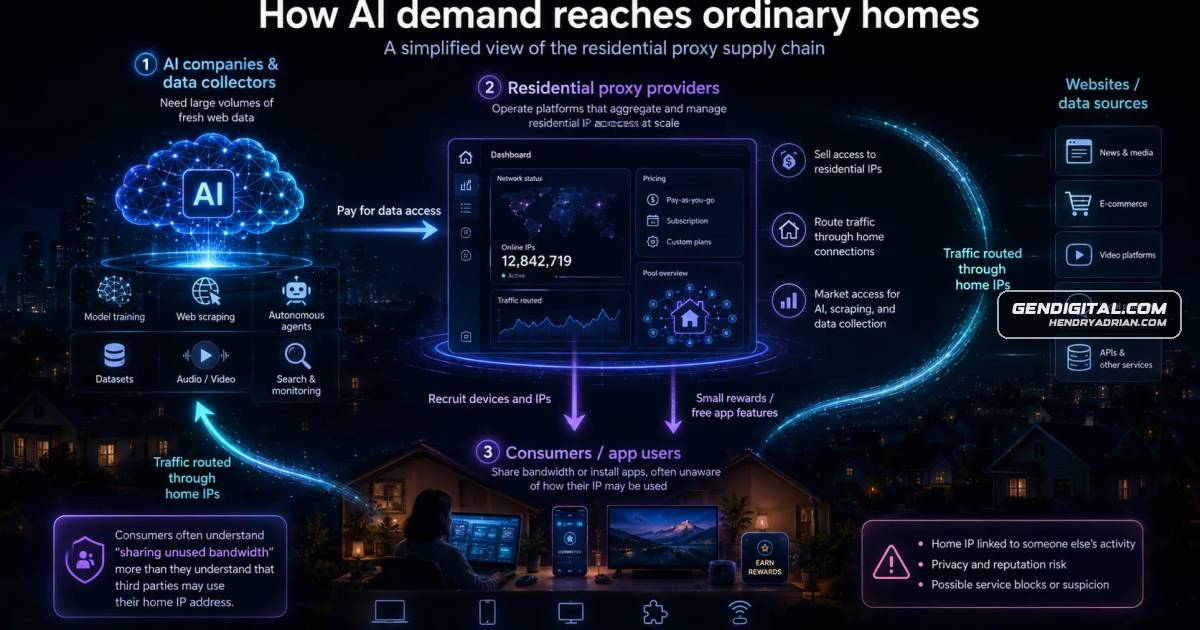
The article explains how residential proxy networks use household IP addresses for AI-related web collection, sometimes through apps with proxy components, and discusses consent, privacy risks, platform responses and malicious traffic linked to these networks.
Key points
- Residential proxies route automated web requests through household IP addresses, which can be harder for websites to distinguish from ordinary visitors.
- Some bandwidth-sharing tools and app SDKs turn household devices into proxy nodes; Spur Intelligence found proxy functionality in 2,058 of 6,038 scanned LG webOS and Samsung Tizen apps.
- Researchers found that a Bright Data SDK in some Samsung apps could keep a background service running after users left the app.
- LG said it would suspend webOS apps that did not remove proxy functionality. Samsung restricted new registrations containing proxy components and said it was removing existing apps with them.
- Gen Digital reported 7.4 million malicious incidents associated with residential proxy traffic since January 2026, affecting 572,000 users; phishing and malicious advertising were the largest categories.
- The article says consent should clearly explain that third parties may route traffic through a user's home IP address, describe uses, show when the proxy is active and disclose data-use limits.
Article Details
- Topic
- Residential proxy networks, their use in AI data collection, household-device consent, and associated malicious traffic
Vendors
Bright DataBright Data promotes infrastructure for model training, retrieval, multimodal datasets and web access for AI agents. It claims access to more than 400 million residential IP addresses and presents its services as a wayDecodorotating residential proxies for collecting product data, prices, listings and AI training sets. Decodo markets residential proxies and scraping tools for AI training and live agents. IPRoyal describesIPRoyalAI training sets. Decodo markets residential proxies and scraping tools for AI training and live agents. IPRoyal describes rotating residential proxies as infrastructure for large-scale AI data collection. LGSpur Intelligence scanned 6,038 applications across LG webOS and Samsung Tizen and reported residential proxy functionality in 2,058 of them. The list included games, screensavers and utilities, exactly the sort of appsOxylabsOxylabs sells proxy and scraping infrastructure for real-time AI search and agents, while SOAX recommends rotating residential proxies for collecting product data, prices, listings and AI training sets. Decodo marketsSamsungSpur Intelligence scanned 6,038 applications across LG webOS and Samsung Tizen and reported residential proxy functionality in 2,058 of them. The list included games, screensavers and utilities, exactly the sort of appsSOAXOxylabs sells proxy and scraping infrastructure for real-time AI search and agents, while SOAX recommends rotating residential proxies for collecting product data, prices, listings and AI training sets. Decodo markets
Products
Bright Data SDKwhile the proxy component remains active. Researchers at Mnemonic found that, once enabled, the Bright Data SDK in some Samsung apps activated a background service that continued running after the user navigatedLG webOSSpur Intelligence scanned 6,038 applications across LG webOS and Samsung Tizen and reported residential proxy functionality in 2,058 of them. The list included games, screensavers and utilities, exactly the sort of appsPetflix Roku appThe amount of traffic can also be difficult to judge from a consent screen. In the Petflix Roku app, the screen said Bright Data would "occasionally" use the device's free resources and IP address to download public webSamsung TizenSpur Intelligence scanned 6,038 applications across LG webOS and Samsung Tizen and reported residential proxy functionality in 2,058 of them. The list included games, screensavers and utilities, exactly the sort of apps