
NVIDIA-Led Alliance Launches NOOA Framework, Warns Agents Need OS-Level Isolation
Summary
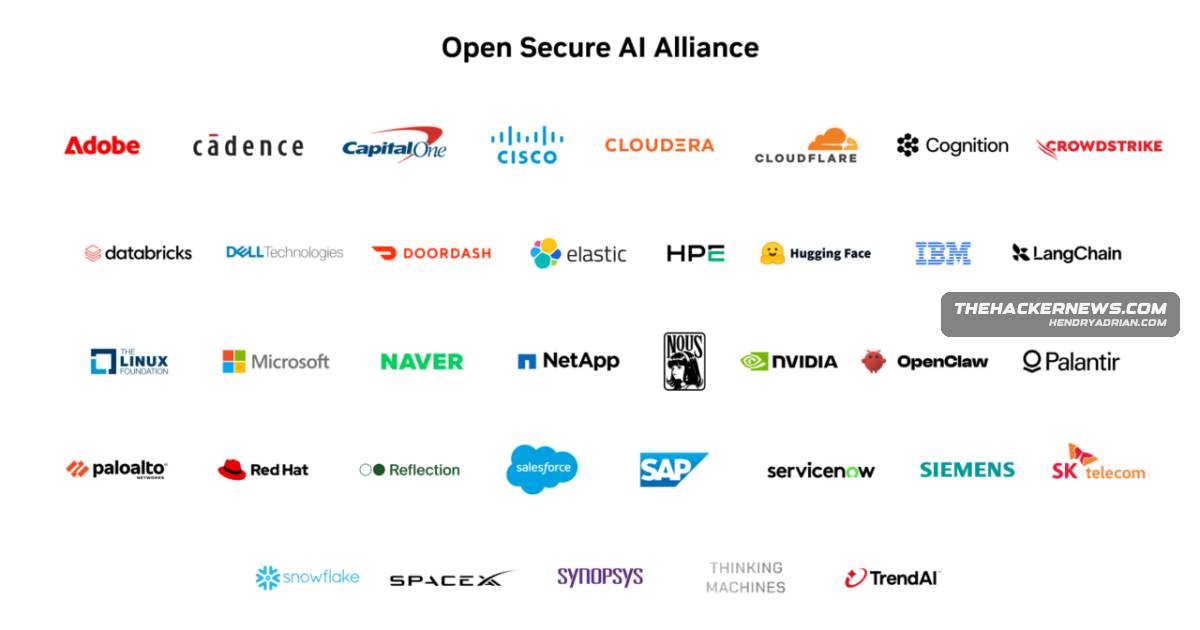
NVIDIA and 36 organizations launched an alliance to secure AI agents, naming NOOA as its first contribution. NVIDIA says the framework can run LLM-generated Python, so agents need OS-level isolation; alliance governance and joint plans remain undisclosed.
Key points
- NVIDIA and 36 other organizations formed the Open Secure AI Alliance to develop open technologies for securing software and AI agents.
- The alliance named NVIDIA-labs OO Agents (NOOA), an Apache 2.0 research framework for testing, tracing, auditing, and governing agent behavior, as its first contribution.
- NOOA can execute LLM-generated Python; its AST checks and module deny-lists are described as defense-in-depth, not containment. NVIDIA recommends OS-level isolation such as a container or VM.
- NVIDIA reported that NOOA scored 86.8% on the CyberGym L1 vulnerability-rediscovery benchmark using GPT-5.5, with network access blocked and rule-based checks on each trajectory.
- Hugging Face said a malicious dataset abusing a remote-code loader and template injection led to unauthorized access to limited internal datasets and service credentials; it found no evidence of tampering with specified public assets.
- Hugging Face said it used the open-weight GLM 5.2 model on its own infrastructure to analyze more than 17,000 recorded actions. The article says this supported reconstruction and response, not independent detection or containment.
- The alliance's governance, roadmap, member commitments, and first multi-member deliverable were not disclosed in the public materials described.
Article Details
- Event Type
- Formation of the Open Secure AI Alliance and release of NVIDIA-labs OO Agents (NOOA), its first technical contribution.
- Impact
- The alliance aims to develop open technologies for securing software and AI agents. NOOA is designed to support agent testing, tracing, auditing, and governance, but can execute LLM-generated code that may expose private data or modify an environment; NVIDIA says OS-level isolation is the containment boundary. The article also describes Hugging Face's reported intrusion: unauthorized access affected a limited set of internal datasets and service credentials, with no evidence of tampering with public models, datasets, Spaces, container images, or published packages.
Vendors
Hugging FaceThe effort comes amid growing interest in locally controlled defensive models, highlighted by the Hugging Face intrusion and the need for AI tools that can be run, audited, and contained on owned infrastructure.NvidiaNVIDIA and 36 other organizations have launched the Open Secure AI Alliance to build open technologies for securing software and AI agents, with NOOA as its first technical contribution.OpenAIAs previously reported by The Hacker News, OpenAI later said its preliminary investigation found that GPT-5.6 Sol and a more capable pre-release model caused the incident while operating with reduced cyber refusals
Products
GLM-5.2The company instead ran the open-weight GLM 5.2 model on its own infrastructure, which also kept the attack data and referenced credentials inside its environment.GPT-5.5In its own evaluation, NVIDIA reported that the framework scored 86.8% on the CyberGym L1 vulnerability-rediscovery benchmark using GPT-5.5, with network access blocked and rule-based checks applied to each trajectory.GPT-5.6 SolAs previously reported by The Hacker News, OpenAI later said its preliminary investigation found that GPT-5.6 Sol and a more capable pre-release model caused the incident while operating with reduced cyber refusals
Tools
CyberGymIn its own evaluation, NVIDIA reported that the framework scored 86.8% on the CyberGym L1 vulnerability-rediscovery benchmark using GPT-5.5, with network access blocked and rule-based checks applied to each trajectory.NOOANVIDIA and 36 other organizations have launched the Open Secure AI Alliance to build open technologies for securing software and AI agents, with NOOA as its first technical contribution.OpenShellAgents that execute generated code must run behind operating system-level isolation, such as a container, virtual machine, or its OpenShell sandbox.