
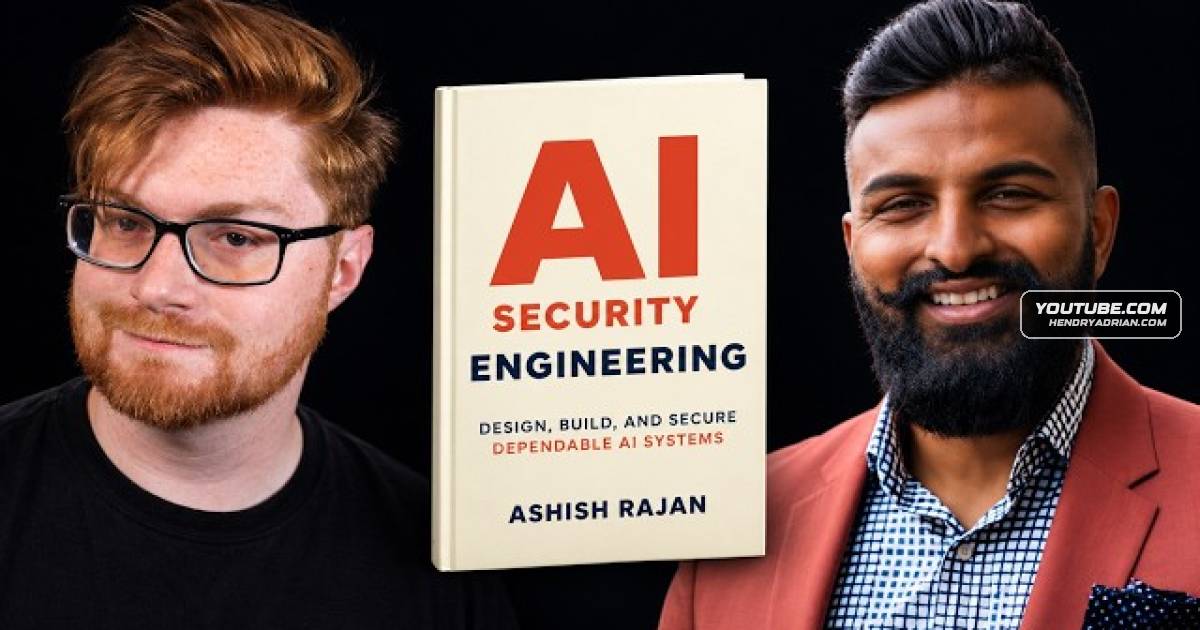
Ashish Rajan Discusses AI Agent Security, Configuration Controls and Incident Response
· 36:09 · Watch on YouTube ↗
Summary
Ashish Rajan discusses securing AI agents through network isolation, configuration enforcement and deterministic evaluations, and previews Charlie, an open-source tool intended to help practitioners assess coding-agent settings.
Key points
- Rajan's AI Security Engineering book focuses on securing AI systems rather than using AI for security, including building and scaling organizational security programs.
- He describes ongoing research into detecting rogue or compromised agents and understanding their blast radius across connected systems and databases.
- Rajan argues that sandboxing remains useful, but its effectiveness depends on network design and the external connections permitted to agents.
- Charlie, an open-source tool under development, is intended to help practitioners assess coding-agent settings and allowed MCP connections. Rajan says local administrator privileges can undermine configuration restrictions without endpoint enforcement.
- He recommends deterministic evaluations to validate agent actions, detect policy drift and provide evidence for audits rather than relying on an agent's own success claims.
- For AI incident response, Rajan emphasizes defining actionable incident boundaries, collecting telemetry and isolating affected systems through network controls. He also proposes honeytokens as tripwires for unexpected agent behavior.
Article Details
- Topics
- [02:03] AI Security Engineering and building organizational security programs for AI
- [04:21] Practitioner research on AI workflows and detecting compromised agents
- [08:53] Coding-agent attack surfaces and network sandboxing
- [15:13] Enterprise AI adoption and Charlie configuration assessment tooling
- [20:58] Deterministic evaluations, policy drift and audit evidence
- [24:29] Defining AI incidents, network containment and honeytoken detection
People
Ashish RajanInterview guest and author of AI Security Engineering who describes AI security research, the planned Charlie tool, configuration enforcement, evaluations and incident containment.John HammondInterview host who discusses coding-agent attack surfaces, malicious skills and MCP servers, and his assume-breach approach to dedicated hardware running AI agents.