
Malicious axios npm Releases Used a Hidden Dependency to Deploy Cross-Platform RATs
Summary
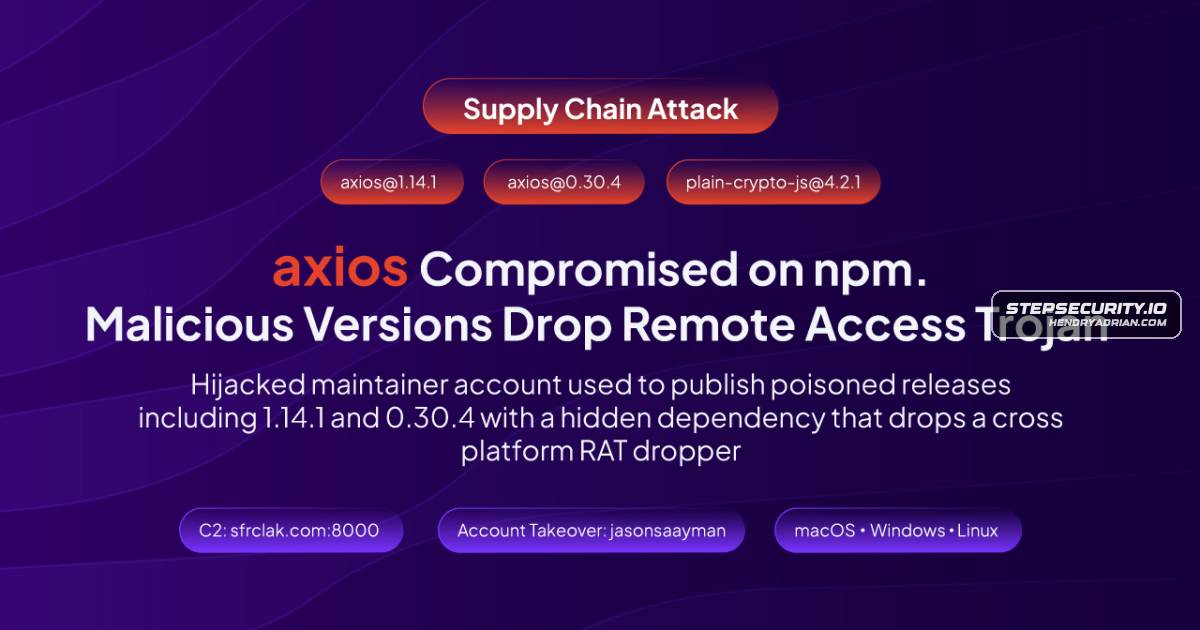
StepSecurity analyzed malicious axios versions 1.14.1 and 0.30.4, which added plain-crypto-js to launch a cross-platform RAT dropper. Runtime testing captured C2 contact and manifest replacement; npm removed the releases.
Key points
- [email protected] and [email protected] added [email protected] as a runtime dependency without importing it in axios source code; its postinstall hook executed setup.js.
- Registry metadata showed publishing under the compromised jasonsaayman account, without the Trusted Publisher binding used by legitimate releases. StepSecurity attributes this to stolen npm credentials.
- Static analysis decoded a dropper targeting macOS through AppleScript, Windows through VBScript and PowerShell, and Linux through Python, contacting hxxp://sfrclak[.]com:8000/6202033.
- The dropper deletes setup.js and replaces its manifest with a clean stub reporting version 4.2.0, potentially obscuring the installed malicious version during subsequent inspection.
- StepSecurity's instrumented Linux test captured outbound C2 connections, a detached background process and replacement of the package manifest, supporting the reconstructed execution chain.
- npm removed both malicious axios releases and replaced plain-crypto-js with a security-holder package. The Backstage team said the observed installation occurred in an intentionally sandboxed workflow and did not impact its project.
- The article recommends checking dependency records and endpoint artifacts, rotating exposed credentials, rebuilding affected persistent machines and using installation-script restrictions and release-age policies.
Article Details
- Attack Vectors
- A compromised axios maintainer account was used to manually publish [email protected] and [email protected] using stolen npm credentials, bypassing the project's normal GitHub Actions publishing workflow.
- Both poisoned releases added [email protected] as an unused runtime dependency. Its postinstall hook executed an obfuscated JavaScript dropper automatically during installation.
- The dropper selected operating-system-specific commands to download and execute second-stage payloads on macOS, Windows, and Linux.
- The malicious dependency cloned legitimate crypto-js source and metadata, while cleanup replaced its manifest with a clean stub reporting version 4.2.0.
- Defensive Notes
- Review dependency manifests, lockfiles, installation logs, and network telemetry for the compromised releases. Confirm search matches are actual dependency entries rather than documentation or comments.
- Do not rely solely on the installed plain-crypto-js version: the dropper replaces its manifest with one reporting 4.2.0. Investigate the package directory and platform-specific payload artifacts.
- The article recommends replacing compromised releases with [email protected] or [email protected], removing the malicious dependency, and using dependency overrides to prevent its reintroduction.
- Treat affected developer machines and persistent CI runners as compromised: isolate them, inventory credentials, rebuild from a known-good state, and rotate credentials from a clean machine.
- For affected ephemeral CI jobs, rotate all secrets available during execution even though the runner is subsequently destroyed.
- Disable installation scripts in automated builds where feasible, enforce network egress allowlists, and apply package release-age or cooldown policies.
- Use process, network, and file-integrity telemetry to detect callbacks, detached payload execution, and manifest replacement despite the dropper's self-deletion.
Indicators of compromise
| Type | Indicator | Context |
|---|---|---|
| DOMAIN | sfrclak[.]com | Attacker-controlled C2 domain contacted by the dropper and second-stage payload. |
ifstap@proton[.]me | Attacker-controlled email assigned to the compromised axios maintainer account. | |
nrwise@proton[.]me | Account email used to publish the staged plain-crypto-js dependency and its malicious 4.2.1 release. | |
| IPV4 | 142[.]11[.]206[.]73 | C2 IP identified by the article; affected systems should be checked for connections on port 8000. |
| SHA1 | 07d889e2dadce6f3910dcbc253317d28ca61c766 | Published package shasum for malicious [email protected]. |
| SHA1 | 2553649f2322049666871cea80a5d0d6adc700ca | Published package shasum for malicious [email protected]. |
| SHA1 | d6f3f62fd3b9f5432f5782b62d8cfd5247d5ee71 | Published package shasum for malicious [email protected]. |
| SHA256 | e10b1fa84f1d6481625f741b69892780140d4e0e7769e7491e5f4d894c2e0e09 | SHA-256 identified in the article for the malicious setup.js dropper. |
| URL | hxxp[:]//sfrclak[.]com:8000/6202033 | C2 endpoint used to retrieve platform-specific payloads and receive subsequent callbacks. |
MITRE ATT&CK
T1027 · Obfuscated Files or InformationSensitive strings were concealed using a reversed, Base64-encoded outer layer and an XOR-based inner layer.T1036 · MasqueradingThe malicious package cloned crypto-js metadata and source, and its replacement manifest concealed the installed malicious version.T1036.003 · Rename Legitimate UtilitiesThe Windows branch copied PowerShell to %PROGRAMDATA%\wt.exe to resemble Windows Terminal.T1059.001 · PowerShellThe Windows branch executed a downloaded PowerShell script with hidden-window and execution-policy-bypass arguments.T1059.002 · AppleScriptThe macOS branch wrote an AppleScript to /tmp/6202033 and executed it with osascript.T1059.003 · Windows Command ShellThe Windows VBScript invoked cmd.exe /c to download, execute, and delete the PowerShell payload.T1059.004 · Unix ShellThe dropper used Unix shell commands for curl downloads, chmod, background execution, and macOS payload launch through /bin/zsh.T1059.005 · Visual BasicThe Windows branch wrote a temporary VBScript and executed it through cscript to orchestrate payload retrieval and execution.T1059.006 · PythonThe Linux branch downloaded /tmp/ld.py and launched it with python3 through nohup.T1059.007 · JavaScriptThe dependency's postinstall hook ran node setup.js to execute the obfuscated JavaScript dropper.T1070.004 · File DeletionThe dropper deleted setup.js and the malicious package.json; platform commands also removed temporary scripts.T1071.001 · Web ProtocolsThe dropper used HTTP POST requests to port 8000 for platform-specific payload delivery, and runtime monitoring recorded a subsequent C2 callback.T1105 · Ingress Tool Transfercurl retrieved separate macOS, Windows, and Linux second-stage payloads from the same C2 endpoint.T1195.001 · Compromise Software Dependencies and Development ToolsPoisoned axios releases introduced [email protected], whose installation hook deployed the RAT dropper.T1564.003 · Hidden WindowWindows execution used a hidden VBScript-launched window and PowerShell's hidden-window option.
Threat Actors
Vendors
GitHubtier projects are public by design, allowing anyone to verify the detection: https://app.stepsecurity.io/github/backstage/backstage/actions/runs/23775668703?tab=network-eventsnpmRead the full behind-the-scenes story of how StepSecurity detected and helped remediate this attack: Behind the Scenes: How StepSecurity Detected and Helped Remediate the Largest npm Supply Chain AttackStepSecurityRead the full behind-the-scenes story of how StepSecurity detected and helped remediate this attack: Behind the Scenes: How StepSecurity Detected and Helped Remediate the Largest npm Supply Chain Attack
Products
Axiosaxios is the most popular JavaScript HTTP client library with over 100 million weekly downloads. On March 30, 2026, StepSecurity identified two malicious versions of the widely used axios HTTP client library publishedGitHub Actionsusing the compromised npm credentials of a lead axios maintainer, bypassing the project's normal GitHub Actions CI/CD pipeline.npmRead the full behind-the-scenes story of how StepSecurity detected and helped remediate this attack: Behind the Scenes: How StepSecurity Detected and Helped Remediate the Largest npm Supply Chain AttackStepSecurity AI Package AnalystThese compromises were detected by StepSecurity AI Package Analyst [1][2] and StepSecurity Harden-Runner. We have responsibly disclosed the issue to the project maintainers.StepSecurity Dev Machine Guardnpm list -g axios 2>/dev/null | grep -E "1\.14\.1|0\.30\.4"You can also use StepSecurity Dev Machine Guard (free for community users) to scan all installed npm packages on your machine and identify the compromisedStepSecurity Harden-RunnerThese compromises were detected by StepSecurity AI Package Analyst [1][2] and StepSecurity Harden-Runner. We have responsibly disclosed the issue to the project maintainers.